

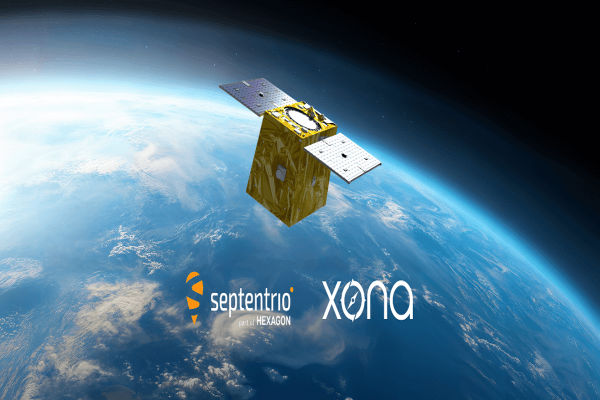
Septentrio, a Hexagon company known for its high-precision GNSS technology, has signed a Memorandum of Understanding (MOU) with Xona Space Systems, a pioneer in low-Earth orbit (LEO) satellite navigation. The agreement aims to strengthen their collaboration in developing next-generation positioning, navigation, and timing (PNT) solutions.
The partnership follows the recent successful launch of Xona’s Pulsar-0, its first production-grade LEO PNT satellite. Just days after the launch, Septentrio began tracking and analyzing Pulsar’s signals—an important early step in realizing the full capabilities of the service.
Together, the companies will continue joint testing and validation to prove Pulsar’s full capabilities, including:
- Native centimeter-level accuracy
- 100x stronger signal strength that reaches indoors and under dense foliage
- Robust protection against jamming and spoofing2
Through this partnership, Septentrio and Xona will advance receiver development, evaluate real-world performance, and explore commercial opportunities across diverse set of industrial and defense applications. Potential use cases span drones and autonomous vehicles, precision agriculture, construction and mining, robotics, timing and critical infrastructure.

This collaboration marks a significant step toward addressing the growing demand for robust, high-precision navigation in challenging environments. The MOU underscores a shared vision of both companies to advance satellite-based navigation technology and unlock the potential of hybrid GNSS-LEO solutions.
1. Global Navigation Satellite System including the American GPS, European Galileo, Russian GLONASS, Chinese BeiDou, Japan’s QZSS and India’s NavIC. These satellite constellations broadcast positioning information to receivers which use it to calculate their absolute position.
2. Jamming is a form of radio interference which occurs when GPS frequency is overpowered by other radio waves, resulting in accuracy degradation or event total loss of position. Spoofing is a malicious form of radio interference, where misleading signals are sent into the receiver, resulting in faulty coordinates, which lead the target away from its predefined track.












 with Xona Space Systems, a pioneer in low-Earth orbit (LEO) satellite navigation.)