
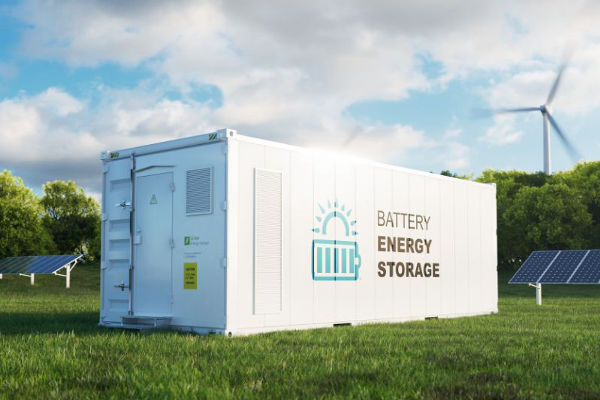
India’s renewable energy journey has reached a decisive inflection point. With solar and wind contributing in two digits of percentage of installed capacity, total renewable met >50% in Nov 2025. The challenge is no longer about generation, it is about reliability, dispatchability, power quality and grid stability. Battery Energy Storage Systems (BESS) have emerged as the linchpin technology to bridge this gap.
As we navigate through February 2026, the transition from “planning for a green grid” to “operating a storage-heavy grid” has officially begun. At Trontek Electronics, as a leading LFP manufacturer, we have watched this evolution from the cell level to the utility scale.
Recent tenders, policy frameworks, and market signals show that India is moving rapidly from pilot projects to utility-scale deployments. The government’s Viability Gap Funding (VGF) scheme, offering up to 40% capital expenditure support, has catalysed standalone BESS tenders.
In 2025, India witnessed a massive surge in Battery Energy Storage System (BESS) tender activity, with approx. 60 GWh of dedicated BESS tenders issued, a significant increase from 24 GWh in 2024.
The Macro-Landscape: Why BESS, Why Now?
India’s commitment to achieving 500 GW of non-fossil fuel capacity by 2030 is no longer a distant target; it is a daily operational reality. However, the inherent intermittency of solar and wind has created the infamous “Duck Curve,” where solar generation peaks at noon while demand peaks in the evening. BESS is the only solution to optimize it.
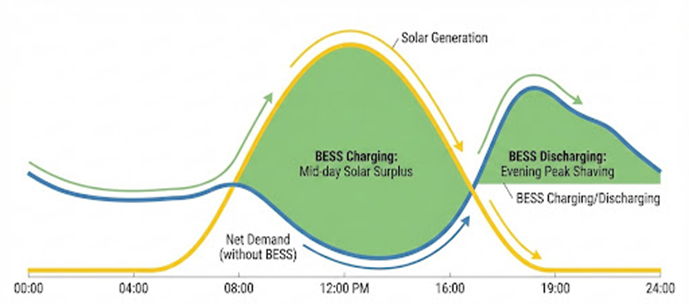
BESS as the solution to the “Duck Curve” phenomenon. Time-shifting of solar energy by BESS to flatten the duck curve and ensures grid stability.
The Price Discovery Trend India’s tendering activity reflects both ambition and learning curves:
We have witnessed a fascinating volatility in tender pricing over the last 18 months.
- Rajasthan (RVUNL): In late 2025, prices were discovered at approximately ₹1.77–1.78 Lakh per MW per month for standalone BESS.
- Gujarat : More recent auctions have crossed ₹2.1 lakh/MWh, reflecting rising demand and evolving risk premiums.
Why the increase?
The market is maturing. Costs are rising slightly due to supply chain pressures and higher financing costs. Developers are now accounting for higher compliance costs, the 20% Domestic Content Requirement (DCR) for VGF-funded projects, and the increased cost of advanced Grid-Forming (GFM) inverters which are becoming a standard requirement for grid stability. The long-term trajectory may remain downward as economies of scale and domestic manufacturing kick in.
There are two known terminologies for BESS types-FTM/BTM as per their applications.
FTM (Front Of The Meter) systems are capital-intensive but unlock grid-level value such as utility-owned projects (solar farms, storage) connecting directly to the grid.
BTM (Behind The Meter) systems are customer-centric, offering resilience and cost optimization such as systems (residential/commercial solar, batteries) installed on the customer side of the meter for on-site consumption.
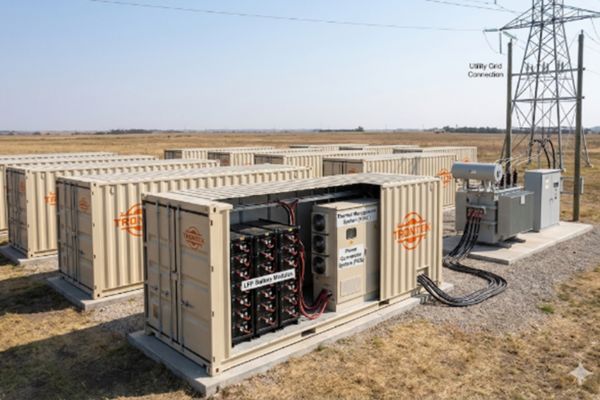
Key Components in BESS:
| Component | Description |
| Battery Racks (LFP) | Modular lithium iron phosphate cells arranged in racks |
| Battery Management System (BMS) | Controls cell balancing, safety, and diagnostics |
| Power Conversion System (PCS) | Converts DC from batteries to AC for grid export |
| Energy Management System (EMS) | Optimizes dispatch, monitors performance |
| Fire Suppression System | Includes smoke detection and extinguishing unit |
| HVAC Units | Maintains thermal stability of battery modules |
| Transformer | Steps up voltage for grid interconnection |
| Monitoring Panel | Displays system status, alarms, and controls |
Let’s know few of popular and common Terminologies in BESS
- SOC (State of Charge): Percentage of energy stored relative to capacity.
- SOH (State of Health): Indicator of battery degradation.
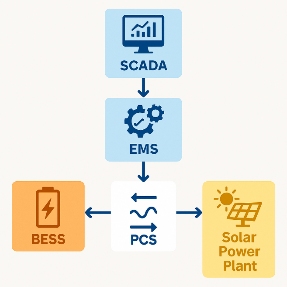
- EMS (Energy Management System): Software layer optimizing dispatch.
- PCS (Power Conversion System): Inverter/rectifier enabling AC/DC interface.
- SCADA (Supervisory Control and Data Acquisition): Real-time monitoring and control platform.
- DSM (Deviation Settlement Mechanism): Penalty regime for deviation from scheduled generation.
- VGF (Viability Gap Funding): Government support to bridge financial viability gaps.
Integration with Solar and SCADA
Solar-BESS hybrid plants are becoming mainstream. For example, 220 MW solar projects in Madhya Pradesh with integrated BESS are designed to deliver round-the-clock renewable power, leveraging SCADA for real-time visibility and dispatch.
SCADA ensures:
- Real-time monitoring of SOC, temperature, and grid parameters.
- Automated dispatch during peak demand.
- Predictive maintenance through analytics.
Technical Sizing of BESS
Sizing depends on:
- Peak demand requirement (MW).
- Duration of support (hours).
- Round-trip efficiency (~85–90%).
- Depth of discharge (DoD).
Penalty Risks: The DSM Factor
In India, the Deviation Settlement Mechanism (DSM) is the most significant risk factor for Front-of-the-Meter (FTM) systems. If a BESS is undersized or fails to respond to SLDC (State Load Dispatch Centre) commands, the penalties can erode profits in weeks.
- Accuracy Penalty: If actual injection deviates from the 15-minute schedule by more than a specific percentage (typically 10-15%), heavy DSM charges apply.
- Availability Penalty: Most modern tenders (like GUVNL) require 98% availability. Falling below this threshold often leads to liquidated damages equal to the capacity charge.
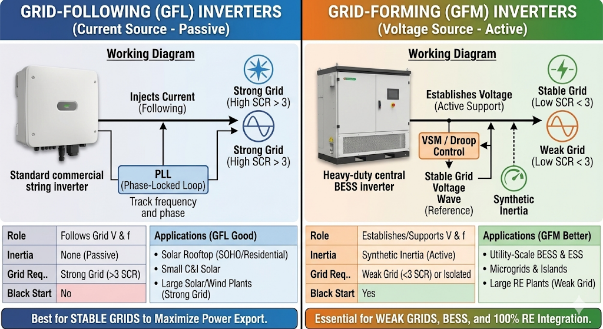
With PCS including Inverters, There are two types of Grid Tied Inverter popular. Let’s know about them.
Grid Following (GFL) vs Grid Forming (GFM) Inverters
- GFL inverters synchronize with an existing grid voltage and frequency, making them ideal for stable grid environments. They are simpler and cost-effective but rely on external grid signals and offer limited support during faults.
- GFM inverters, on the other hand, generate their own voltage and frequency references, enabling islanded operation and black-start capabilities. They enhance grid resilience and stability, especially in weak or microgrid setups, but require complex control algorithms and higher investment.
Selection Criteria:
- Use GFL for large interconnected grids. Example Solar rooftop.
- Use GFM for microgrids, black-start capability, or areas with poor grid reliability. Example. Solar power plants where Inverter capacity is very high vs Grid strength.
Let’s discuss about the role of PCS and EMS
- PCS: Converts DC battery output to AC grid-compatible power. Ensures compliance with grid codes.
- EMS: Optimizes dispatch, forecasts demand, and ensures DSM compliance.
- VGF Requirement: EMS sophistication is often mandated under VGF-supported tenders to ensure reliable operation.
Business Perspective
India’s BESS market is poised for exponential growth:
- Policy Push: National Energy Storage Mission and VGF schemes.
- Market Drivers: DSM penalties, renewable integration, peak demand management.
- Opportunity: Domestic LFP battery manufacturing (where Trontek is a leader) aligns perfectly with utility-scale BESS demand.
Trontek’s expertise in LFP chemistry, reliability engineering, and compliance positions it to deliver safe, long-life packs for both FTM and BTM applications. As India scales BESS, indigenous players will define cost competitiveness and reliability benchmarks.
Trontek’s LFP Advantage: Tailored for India’s conditions and regulations.
- Thermal Stability: LFP has a higher thermal runaway threshold compared to NMC.
- Cycle Life: Utility-scale BESS requires 6,000 to 10,000 cycles. LFP delivers this at a lower cost-per-cycle.
- Domestic Integration: As we move toward 20% local content compliance, Trontek is focusing on localizing the assembly of high-voltage battery racks, ensuring our partners meet VGF eligibility effortlessly.
Conclusion
India’s clean energy future hinges on how effectively we deploy BESS. With tenders scaling, costs stabilizing, and technology maturing, the next decade will define India’s leadership in energy storage. For companies like Trontek, locally manufacturing the LFP battery packs for ESS, BESS, this is not just a business opportunity—it is a responsibility to engineer reliable, ethical, and future-ready solutions that power India’s green transition.