
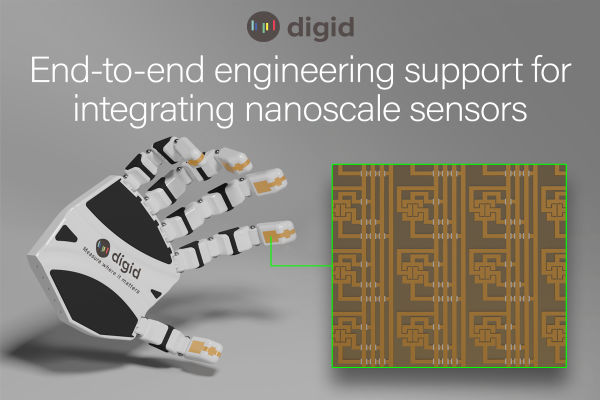
At Embedded World 2026, digid GmbH, a leader in nanoscale sensing technology, unveiled its full end-to-end engineering and integration support.
Known for creating some of the world’s tiniest printed force and temperature sensors—down to the nanometre scale—digid is now focusing on tackling one of the biggest challenges in adoption: seamless integration.
For hardware developers and engineers, connecting and reading signals from such tiny sensors can be extremely complex. digid overcomes this by offering tailored solutions and hands-on support, going beyond simply supplying components.
“When customers approach us, their concern is how to physically connect to the sensor,” said Dr. Konstantin Kloppstech, Chief Technology Officer at digid. “We take that burden off their hands. They provide CAD files and material parameters, and we handle the FEM simulations, sensor deposition, and signal routing. We manage the entire chain so our customers receive a fully plug-and-play solution.”
Digid can add their nanosensors directly on the customer part or provide a sub-assembly for seamless integration into production. The design process happens in close collaboration with the customer and is now further enhanced by digid’s collaboration with Ansys, leveraging industry-leading simulation tools to optimize sensor placement and performance before manufacturing begins.
To achieve this, digid wraps its sensors in mature, reliable connection methods. One example of this is depositing thin-film electrodes directly onto the customer’s mechanical part and wire-bonded to a flex PCB. The flexible circuit is then terminated with standard connectors, allowing designers to interface with the sensors conventionally.
Custom integration for real-world applications
digid’s customisable sensors are being used in applications where traditional sensors are too large or imprecise, and integration is too complex due to wiring and interfaces.
For instance, in precision handling, standard sensors are often too bulky for robotic hands. By depositing its force sensors directly onto a physical interface without altering its profile, digid enables precise force feedback in spaces where conventional sensors cannot fit – improving yield and production quality.
Similarly, in high-speed automated machinery, digid enables the retrofitting of sensing into existing production lines. Sensors integrated directly into machine mounts or funnels can be used to detect contact or blockages in real-time. This provides a simple detection method for contamination or safety issues, replacing indirect and often unreliable methods such as vibration monitoring.
The technology is equally transformative for thermal applications. Standard temperature probes often suffer from thermal lag or bulk. digid embeds sensors directly onto the surface of microchips, power components, and battery cells, enabling instantaneous, highly accurate temperature monitoring in environments where conventional thermocouples cannot fit.
Attendees at Embedded World 2026 in Nuremberg can find digid at Hall 3A, Booth 627 to find out more about their technology and see examples of integrated nanoscale sensors.