

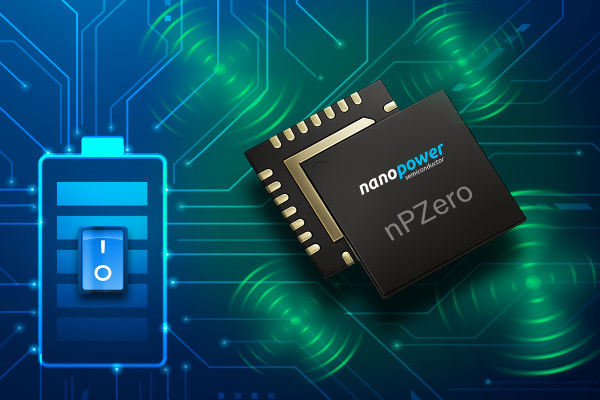
Nanopower Semiconductor, a European fabless semiconductor company, has announced that its award-winning nPZero power-saving integrated circuit (PSIC) is now in full-scale production. This milestone allows OEMs to transition from evaluation to high-volume deployment in energy-constrained IoT devices. The nPZero IC can cut energy consumption in battery-powered applications by up to 90%, with samples and development kits available immediately.
At Embedded World in Nuremberg, Nanopower will be at Hall 4 / Booth 4-460, demonstrating the nPZero in action. Visitors can explore design-in options, evaluation hardware, and live demos highlighting how the IC extends battery life and reduces maintenance in both battery-powered and energy-harvesting applications by keeping microcontrollers in deep sleep for longer periods.
Rewriting IoT power budgets: Meet nPZero
nPZero is a power-saving IC that enables always-on monitoring and control of sensors with the host microcontroller powered down. In operation, nPZero powers down the microcontroller, takes over the controller role, and autonomously handles power-up, configuration, and data reading from up to four sensors or other peripherals. The host is powered up, and control is returned when triggered by user-defined rules, allowing to remain off for long periods while the system continues to detect and respond to events.
nPZero is designed for battery-powered and energy-harvesting IoT devices where energy budgets limit sensing frequency, uptime, or maintenance intervals. Typical deployments include smart buildings, smart cities, and smart agriculture, as well as tracking, logging, and monitoring applications where devices must remain in the field for long periods and respond reliably to threshold events.
In a reference use case, nPZero has been empirically shown to significantly reduce current consumption for peripheral polling compared to a baseline system without nPZero. The measured system included a wireless microcontroller development kit plus a temperature sensor and a three-axis accelerometer.
Why energy efficiency is now a competitive advantage
Design teams building sensor-based IoT devices are under pressure to do more with less energy. In many systems, the microcontroller is woken frequently just to poll sensors, burning power even when nothing has changed. This creates a direct cost and operational burden as product fleets scale: shorter battery life, more maintenance visits, and tighter constraints on what can be measured, logged, or transmitted.
nPZero changes that system-level power profile by moving routine sensing and decision-making into an ultra-low-power companion IC, so products can remain responsive to real-world events without repeatedly waking the host processor.
To support fast evaluation and design-in, Nanopower provides access to the nPZero Configurator, which enables developers to adjust settings through a graphical user interface and automatically generate the necessary application programming interface (API) code, reducing manual bring-up effort.









 is now in full-scale production.)