
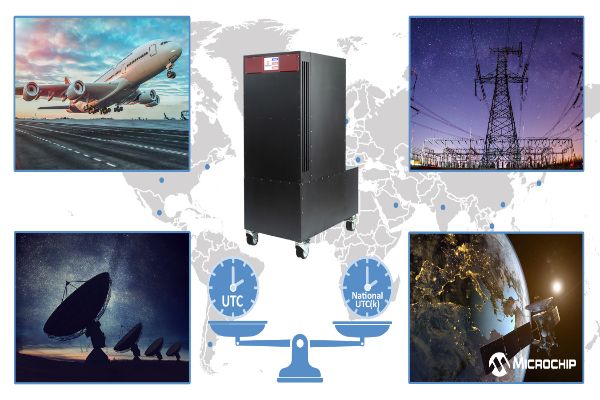
A hydrogen maser is an advanced atomic clock that uses hydrogen atoms to emit stable and precise microwave frequencies, providing highly accurate timekeeping. These devices play a crucial role in global time synchronization, contributing to Coordinated Universal Time (UTC), which governs systems like power grids, cell networks, and satellite communications. As countries increasingly depend on independent timekeeping systems to safeguard their infrastructure, the demand for hydrogen masers has surged. In response, Microchip Technology has opened a new manufacturing facility in Tuscaloosa, Alabama, dedicated to producing its MHM-2020 Active Hydrogen Maser, aiming to boost output and shorten lead times.
Microchip’s MHM-2020 Active Hydrogen Maser is designed for applications requiring extreme frequency stability and low phase noise. These applications include scientific research, national timekeeping services, radio astronomy, deep space tracking networks and GNSS/GPS ground stations. The MHM-2020 Active Hydrogen Maser is engineered to offer 1 picosecond synchronization for precise calibration to GNSS, with a demonstrated lifetime of greater than 20 years of continuous operation and minimal maintenance.
The new Tuscaloosa facility expands manufacturing of Microchip’s time and synchronization portfolio, including the MHM-2020 Active Hydrogen Maser, Auxiliary Output Generator (AOG-110) and ultra-high-performance 1000C-OCXO crystal oscillator. The AOG-110 provides supplementary functionality for stable frequency standards while the 1000C-OCXO provides exceptional phase noise for metrology and laboratory applications.
Microchip’s presence in Alabama comes from a series of acquisitions dating back to Frequency Time Systems in 1996. Since then, the company has operated a facility in Tuscaloosa County. The new facility is approximately 15,000 square feet with temperature stability testing areas and a state-of-the-art research and development laboratory. Within miles of the University of Alabama (UA) campus, the company formed a strategic collaboration with UA, which includes leveraging equipment, training and employing students, as well as advisory board participation.
“The Quantime Lab at the University of Alabama focuses on the investigation of basic quantum physics principles and developing timing, frequency and navigation tools. For the past three years, we have worked closely with Microchip on its hydrogen maser program,” said Dr. Thejesh Bandi, the principal investigator of the University of Alabama Quantime Laboratory and technical director of the ACCEPT program. “This expansion of their local manufacturing demonstrates our shared commitment to advancing timing and frequency solutions.”
“This facility in Tuscaloosa was a priority for Microchip, both to meet the growing customer demand for our hydrogen masers and to strengthen our collaboration with the University of Alabama’s Precision Navigation and Time Laboratory,” said Randy Brudzinski, corporate vice president of Microchip’s frequency and time systems business unit. “This investment increases our capacity to deliver the advanced timing technologies our customers rely on.”
Microchip offers an extensive portfolio of clock and timing systems, which ranges from miniature component oscillators, to small plug-in timing server cards, to multi-rack time scale systems. As a primary contributor to the world’s time, Microchip’s timing solutions are trusted, reliable and resilient. For more information, visit Microchip’s Clock and Timing Systems web page.
Pricing and Availability
The MHM-2020 Active Hydrogen Maser is now available for purchase. For additional information and to purchase contact a Microchip sales representative or authorized worldwide distributor.