
What is the Hydrogen Buses Market?
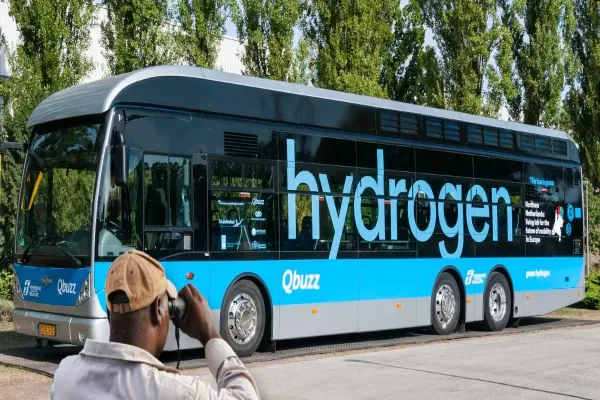
The Hydrogen Buses Market refers to the global industry focused on the development, manufacturing, and deployment of buses powered by hydrogen-based technologies, including fuel cell electric systems and hydrogen internal combustion engines (ICE). These buses are a critical part of the transition toward zero-emission public transportation.
Hydrogen buses use hydrogen as a fuel source to generate electricity or mechanical power, emitting only water vapor or significantly lower emissions compared to diesel-powered vehicles.
Hydrogen Buses Market Size & Forecast – Acumen Research And Consulting
- Hydrogen Buses Market Size (2025): USD 2,510 million
- Hydrogen Buses Market Forecast Value (2035): USD 67,427 million
- Hydrogen Buses Market CAGR (2026–2035): 39%
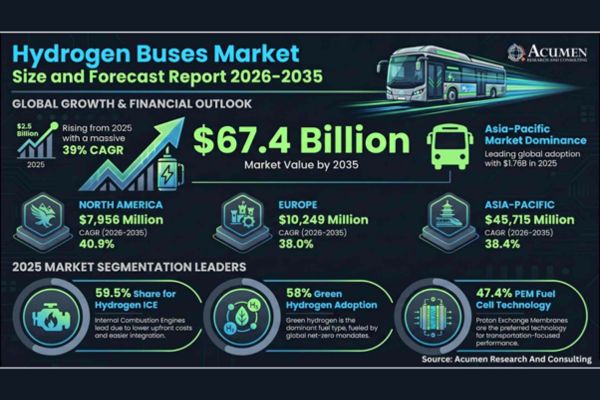
The Hydrogen Buses Market is projected to grow nearly 27x over the next decade, making it one of the fastest-growing segments in the clean mobility industry.
Why is the Hydrogen Buses Market Growing Rapidly?
The Hydrogen Buses Market growth is being fueled by a combination of environmental, technological, and economic factors.
1. Strong Government Policies
Countries worldwide are implementing strict emission regulations and net-zero targets. Hydrogen buses play a vital role in reducing urban carbon emissions.
2. Rising Demand for Clean Public Transport
Urbanization is increasing the need for sustainable mass transit solutions, pushing transit agencies toward hydrogen-powered fleets.
3. Infrastructure Development
Governments and private players are investing in hydrogen refueling stations, removing one of the biggest barriers to adoption.
4. Technological Advancements
Continuous improvements in fuel cell efficiency, hydrogen storage, and propulsion systems are making hydrogen buses more viable and cost-effective.
Which Region Dominates the Hydrogen Buses Market?
Asia-Pacific dominates the Hydrogen Buses Market due to strong government roadmaps, large public transport fleets, and rapid hydrogen infrastructure expansion. Europe is the second-largest market driven by strict emission regulations and funding programs.
Regional Breakdown
Asia-Pacific (Market Leader)
- Largest share in 2025
- Countries like China, Japan, and South Korea leading adoption
- Heavy investments in hydrogen ecosystems
Europe (Second Largest)
- Strong regulatory framework
- Government subsidies and funding initiatives
- Active deployment in Germany, UK, and France
North America (Emerging Market)
- Increasing investments in clean mobility
- Growing adoption in public transit systems
Hydrogen Buses Market Segmentation Analysis
By Bus Type
- Single-deck hydrogen buses dominated with 36.89% share in 2025
- Easier deployment
- Lower infrastructure costs
- Ideal for urban routes
- Fuel cell hybrid buses held 26.15% share
- Improved fuel efficiency
- Reduced hydrogen consumption
By Fuel Type
- Green hydrogen dominated with 57.96% share
- Produced using renewable energy
- Supported by global sustainability goals
- Grey hydrogen held 27.53% share
- Widely used in early adoption phases
By Propulsion Type
- Hydrogen ICE (Internal Combustion Engine)
- 59.50% market share
- Lower upfront cost
- Easier integration with existing systems
- Fuel Cell Electric
- 40.50% share
- Higher efficiency and longer range
By Manufacturing Type
- New hydrogen buses dominated with 71.20% share
- Retrofitted buses accounted for 28.80%
Retrofitting is gaining traction as a cost-effective way to transition from diesel fleets.
By Power Output
- 100–200 kW segment led with 44.20% share
- Above 200 kW segment held 32.50% share
By Technology
- Proton Exchange Membrane (PEM) Fuel Cells
- 47.40% share
- Fast startup and compact design
- Alkaline Fuel Cells
- 29.70% share
- Lower manufacturing costs
By Application
- Public transportation dominated with 42.70% share
- Tourism & airport transportation held 27.70% share
What are Hydrogen Buses and How Do They Work?
Hydrogen buses use hydrogen fuel cells or combustion engines to generate energy. In fuel cell buses, hydrogen reacts with oxygen to produce electricity, powering electric motors. The only emission is water vapor, making them environmentally friendly.
Key Advantages of Hydrogen Buses
- Zero or near-zero emissions
- Long driving range (300–500 km)
- Fast refueling time (5–10 minutes)
- Suitable for heavy-duty and long-distance routes
These advantages make hydrogen buses particularly suitable for large urban fleets and intercity transport systems.
Key Companies in the Hydrogen Buses Market
Major players shaping the Hydrogen Buses Market include:
- Toyota Motor Corporation
- Hyundai Motor Company
- Ballard Power Systems
- Plug Power Inc.
- Wrightbus
- Solaris Bus & Coach
Recent Developments
- Launch of next-generation hydrogen buses with improved efficiency
- Strategic partnerships for hydrogen supply chains
- Increased investment in green hydrogen production
- Expansion of hydrogen refueling networks globally
Emerging Trends in the Hydrogen Buses Market
1. Green Hydrogen Adoption
Green hydrogen is becoming the dominant fuel type due to global decarbonization goals.
2. Hybrid Hydrogen Systems
Fuel cell hybrid buses are gaining traction for enhanced efficiency and reduced fuel consumption.
3. Infrastructure Expansion
Rapid deployment of hydrogen refueling stations is accelerating market growth.
4. Digital Fleet Management
Integration of AI and IoT technologies is improving fleet efficiency and operational performance.
Challenges in the Hydrogen Buses Market
Despite strong growth potential, the market faces several challenges:
- High initial investment costs
- Limited hydrogen refueling infrastructure in developing regions
- Competition from battery-electric buses
- Hydrogen storage and transportation complexities
However, continuous innovation and economies of scale are expected to reduce these challenges over time.
Future Outlook of Hydrogen Buses Market
The Hydrogen Buses Market forecast indicates massive growth potential over the next decade. With a projected valuation exceeding USD 67 billion by 2035, hydrogen buses are expected to become a mainstream solution in public transportation.
Key future developments include:
- Expansion of hydrogen ecosystems
- Increased adoption in emerging economies
- Advancements in fuel cell technologies
- Stronger policy support worldwide
Hydrogen Buses Market FAQs
What is the CAGR of the Hydrogen Buses Market?
The Hydrogen Buses Market is expected to grow at a 39% CAGR from 2026 to 2035.
Which fuel type dominates the Hydrogen Buses Market?
Green hydrogen dominates the market with a 57.96% share, driven by renewable energy integration.
Which bus type leads the Hydrogen Buses Market?
Single-deck hydrogen buses lead the market with a 36.89% share, due to their suitability for urban transit.
Why are hydrogen buses important?
Hydrogen buses reduce carbon emissions, improve air quality, and support global sustainability goals.
Are hydrogen buses better than electric buses?
Hydrogen buses offer longer range and faster refueling, while battery-electric buses are more efficient for shorter distances. Both technologies complement each other in sustainable transportation systems.
The Hydrogen Buses Market is set for exponential growth, driven by environmental concerns, technological innovation, and strong government support. With a projected 39% CAGR and market size exceeding USD 67 billion by 2035 by Acumen Research Analysts, the industry presents immense opportunities for investors, manufacturers, and policymakers.
As the world transitions toward cleaner mobility, hydrogen buses will play a crucial role in shaping the future of public transportation.