
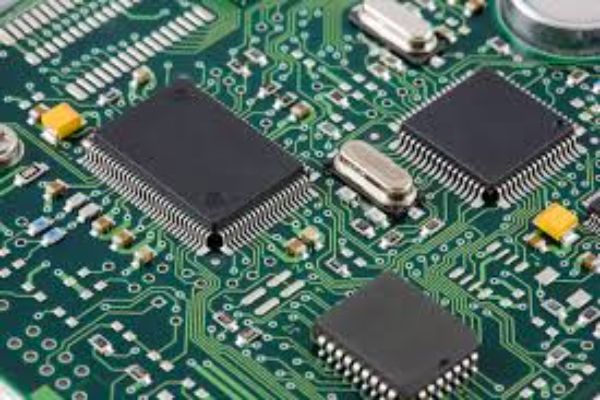
According to Cervicorn Consulting, the global Printed Circuit Board (PCB) Market is witnessing significant growth due to the rapid expansion of consumer electronics, electric vehicles (EVs), 5G infrastructure, industrial automation, and smart connected devices. Printed circuit boards form the backbone of modern electronic systems, enabling efficient electrical connectivity, compact device architecture, and enhanced performance across multiple industries
The increasing integration of advanced technologies such as Artificial Intelligence (AI), Internet of Things (IoT), cloud computing, robotics, and autonomous systems has accelerated the demand for high-performance PCB solutions including multilayer PCBs, flexible PCBs, rigid-flex PCBs, and High-Density Interconnect (HDI) boards.
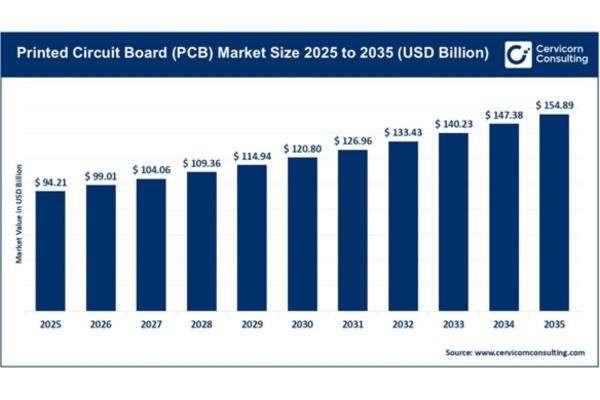
Global Printed Circuit Board (PCB) Market Size and Growth
The global PCB market was valued at approximately USD 94 billion in 2025 and is expected to surpass USD 150 billion by 2035, growing at a steady CAGR of around 5% during the forecast period. The market expansion is primarily driven by rising electronics production, increasing semiconductor demand, rapid digital transformation, and the growing penetration of smart devices worldwide.
Asia-Pacific continues to dominate the global PCB industry due to the strong presence of electronics manufacturing hubs in China, Taiwan, Japan, South Korea, and India. North America and Europe are also experiencing strong growth supported by automotive electronics, aerospace applications, advanced computing infrastructure, and government-led semiconductor initiatives.
Key Market Drivers
Rising Demand for Consumer Electronics: The increasing production of smartphones, laptops, tablets, wearable devices, gaming consoles, and smart home products is significantly driving PCB demand globally. Modern electronic devices require compact, lightweight, and high-speed circuit boards with advanced functionality.
Growth of Electric Vehicles (EVs): Electric vehicles utilize multiple PCB systems for battery management, infotainment, powertrain control, ADAS, and autonomous driving technologies. The rapid adoption of EVs worldwide is creating substantial demand for advanced multilayer and HDI PCBs.
Expansion of 5G Infrastructure: The deployment of 5G communication networks requires high-frequency and high-speed PCBs capable of supporting faster data transmission and low latency. Telecom infrastructure development continues to fuel market growth.
Increasing Adoption of AI and IoT: Artificial Intelligence, Industrial IoT, cloud computing, and smart manufacturing technologies require highly reliable and complex PCB architectures for data processing and connectivity applications.
Miniaturization of Electronic Devices: Manufacturers are increasingly focusing on compact and lightweight electronic products, boosting the adoption of flexible PCBs, rigid-flex boards, and HDI technologies.
Major Market Trends
- High-Density Interconnect (HDI) Technology: HDI PCBs are gaining popularity because they offer enhanced electrical performance, miniaturization capabilities, and improved reliability for advanced electronics.
- Flexible and Rigid-Flex PCBs: Flexible PCB solutions are increasingly used in smartphones, wearable electronics, medical devices, and automotive systems due to their lightweight structure and space-saving advantages.
- Sustainable PCB Manufacturing: Environmental regulations and sustainability goals are encouraging manufacturers to adopt eco-friendly materials, lead-free soldering processes, and energy-efficient production techniques.
- Supply Chain Localization: Countries worldwide are investing heavily in domestic electronics manufacturing and semiconductor ecosystems to reduce dependency on imports and improve supply chain resilience.
Market Segmentation
By PCB Type
- Single-sided PCB
- Double-sided PCB
- Multilayer PCB
- High-Density Interconnect (HDI) PCB
- Flexible PCB
- Rigid-Flex PCB
By Substrate Material
- FR-4
- Polyimide
- PTFE
- Metal Core
- High-Speed Materials
By End-Use Industry
- Consumer Electronics
- Automotive
- Telecommunications
- Healthcare
- Aerospace & Defense
- Industrial Electronics
- IT & Data Centers
Regional Analysis
- Asia-Pacific: Asia-Pacific holds the largest share of the PCB market due to strong electronics manufacturing capabilities, lower production costs, and government support for semiconductor and electronics industries. China, Taiwan, Japan, South Korea, and India are major contributors to regional growth.
- North America: North America is witnessing increasing demand for advanced PCB technologies in aerospace, defense, automotive electronics, AI infrastructure, and cloud computing applications.
- Europe: Europe’s market growth is supported by increasing electric vehicle production, industrial automation, renewable energy systems, and Industry 4.0 adoption.
- India: India is emerging as a promising PCB manufacturing destination due to initiatives such as “Make in India,” Production Linked Incentive (PLI) schemes, and growing domestic electronics manufacturing investments.
Competitive Landscape
The PCB market is highly competitive with manufacturers focusing on technology innovation, strategic partnerships, capacity expansion, and advanced material development.
Key companies operating in the market include:
- TTM Technologies
- Unimicron Technology Corporation
- Nippon Mektron Ltd.
- AT&S Austria Technologie & Systemtechnik AG
- Zhen Ding Technology Holding Limited
- Samsung Electro-Mechanics
- Ibiden Co., Ltd.
These companies are investing heavily in advanced PCB technologies such as IC substrates, HDI boards, flexible circuits, and high-frequency PCB solutions.
Challenges in the PCB Market
Despite strong growth prospects, the market faces several challenges:
- Fluctuating raw material prices
- High manufacturing and capital investment costs
- Supply chain disruptions
- Complex PCB design requirements
- Environmental compliance regulations
- Skilled labor shortages
Future Opportunities
The future of the PCB market looks highly promising due to:
- Increasing semiconductor manufacturing investments
- Rapid expansion of EV and autonomous vehicle technologies
- Growing AI and data center infrastructure
- Rising demand for wearable and smart medical devices
- Advancements in flexible and embedded PCB technologies
- Expansion of aerospace and defense electronics
The integration of next-generation technologies such as AI chips, advanced sensors, edge computing, and 6G communication systems is expected to create substantial opportunities for PCB manufacturers over the coming decade.
Conclusion
The global Printed Circuit Board (PCB) market is expected to experience sustained growth as electronic systems become increasingly advanced, connected, and compact. Strong demand from consumer electronics, electric vehicles, telecommunications, industrial automation, and AI-driven applications will continue to accelerate market expansion.
Manufacturers focusing on innovation, sustainability, advanced materials, and localized production capabilities are likely to gain a competitive advantage in the evolving global PCB industry.