

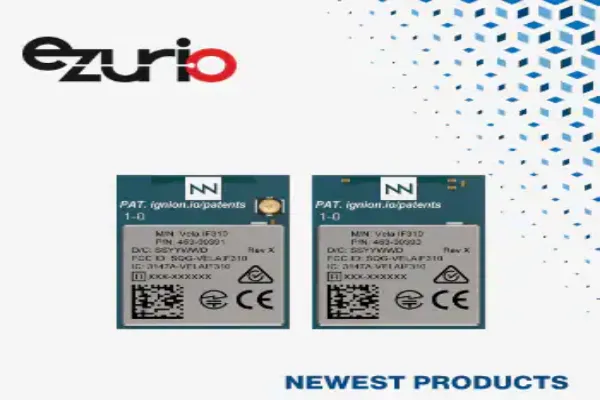
Mouser Electronics, the industry’s leading NPI distributor with the widest selection of semiconductors and electronic components, is now stocking the Vela IF310 multiprotocol modules from Ezurio. The Vela IF310 modules are based on the Infineon Technologies AIROC CYW55310 system on chip and combine Bluetooth Classic (BR/EDR) and the complete Bluetooth 6.0 Low Energy (LE) feature set. Engineered for high-reliability environments, the Vela IF310 modules deliver a low-risk, fast-to-market platform for applications including fitness equipment, automotive infotainment, POS and barcode scanners, and medical monitors.
The Ezurio Vela IF310 modules, now at Mouser, include LE audio with LC3, isochronous channels, Auracast, LE-coded, and two MPHY and advertising extensions, allowing legacy classic designs to be updated with a single module. The Vela IF310 modules feature a powerful MCU subsystem with a 192 MHz Arm Cortex-M33 processor, 2 MB ROM, and 768KB SRAM, with TrustZone and CryptoCell-312 security. The Vela IF310 series also offers a rich set of audio interfaces, including dual TDM/I2S plus PCM for HFP, A2DP, LE Audio, and multi-stream use cases. With flexible software hosting, the modules can be seamlessly integrated into automotive, retail, and medical applications. The Vela IF310 modules offer a single 12 × 16 mm2 footprint with multiple antenna variants, including integrated Ignion antenna, MHF4 connector, or RF trace pad, along with DVKs to make it easy to evaluate in real-world environments. The Vela IF310 modules minimize downtime in clinical settings and ensure interference-resistant audio in industrial spaces, with a rugged operating temperature range of -40°C to +85°C.
Ezurio Vela IF310 development kits provide a platform for rapid development and testing of the Vela IF310 modules. Two variations are available: part # 453-00390-K1 features an integrated chip antenna, and part # 453-00391-K1 includes an MHF4 connector for an external antenna. Featuring on-board headers and jumpers, the development kits provide a convenient way to isolate power and signal nets for debugging and power measurements.










