
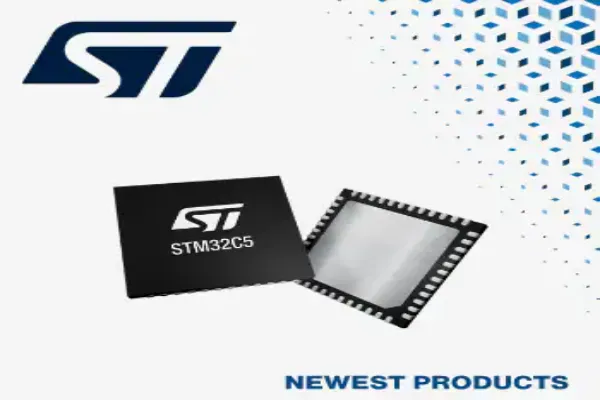
Mouser Electronics, a global authorized distributor of the latest electronic components and industrial automation solutions, is now offering STMicroelectronics’ new STM32C5 Arm Cortex-M33 mainstream microcontrollers. These MCUs are built for affordable, entry-level applications across smart homes, consumer electronics, industrial systems, robotics, wearable devices, and computer peripherals.
The STMicroelectronics STM32C5 series, available from Mouser, sets a new standard for entry-level MCU, thanks to an Arm Cortex-M33 core running at 144MHz with FPU (delivering 593 CoreMark) and standardized DSP instructions, and no external accelerators. The STM32C5 offers 3x the performance of a typical Cortex-M0+ product, with a higher RAM/Flash ratio (up to 1MB of Flash memory and 256KB of RAM), and a dedicated flash area for E2PROM software emulation. The STM32C5 also features an improved design based on ST’s proprietary 40nm manufacturing process, saving vital space to include modern features, such as improved sensing, smoother control, and enhanced user experiences, all while keeping dynamic power consumption low. The STM32C5 includes one Ethernet interface, octoSPI peripherals, and up to two FDCAN, along with hardware crypto for SAES, SPKA, and HUK features, and are available in several packages ranging from 20 to 144 pins.
Also available to order from Mouser are both the STMicroelectronics NUCLEO-C5A3ZG (for the STM32C55x/STM32C562 and STM32C59x/5A3) and NUCLEO-C542RE (for the STM32C53x/542) development boards. Featuring the STM32Cube software ecosystem, the NUCLEO-C5A3ZG board provides a flexible and affordable way to build prototypes and offers an easy means to expand the functionality of the Nucleo open development platform, with a wide choice of specialized shields through several expansion connectors. The NUCLEO-C5A3ZG board also integrates the ST-LINK debugger/programmer and does not require a separate probe. The STMicroelectronics NUCLEO-C562RE board is an STM32 Nucleo‑64 platform that offers compatibility with Arduino Uno V3 connectors and ST morpho headers, and enables straightforward expansion of the board’s functionality using a wide range of specialized expansion shields.