
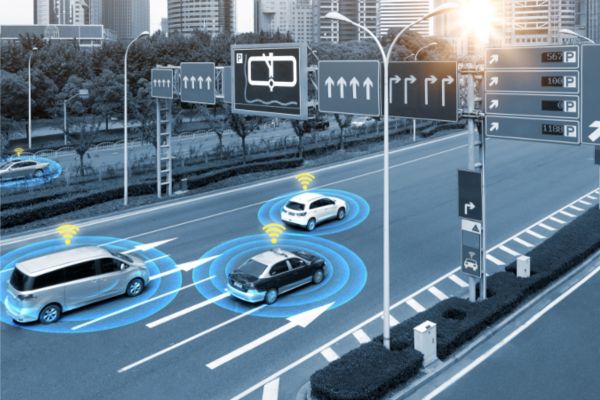
Automobiles are currently witnessing perhaps the greatest technological revolution of all time. The vehicles are not limited to just their mechanics anymore but have software controlling almost everything about them. Infotainment systems, digital instrument panels, Battery Management System (BMS), ADAS and autonomous driving functions among others are becoming the backbone of modern transportation. This has led to the idea of software-defined vehicles whereby different improvements like features, performance and even cybersecurity measures are made available through a lifetime of the vehicle.
The main technology that is making such innovations possible is that of Over-the-Air (OTA) updates. With OTA updates, manufacturers can easily install software or firmware updates through wireless networks without having their customers to take the cars to the service centres each time an update needs to be made. It is similar to operating system updates on smartphones and tablets and makes the vehicles continuously evolving. However, OTA updates bring in a whole range of opportunities but also pose certain cybersecurity risks which must be addressed. Since software controls many safety-critical vehicle functions, protecting the OTA update process has become essential. A secure OTA ecosystem ensures that vehicles remain reliable, resilient against cyber threats, and compliant with emerging automotive cybersecurity regulations.
Understanding Over-the-Air Updates
Over-The-Air Updates (OTA) are updates for software and firmware that are transmitted wirelessly from the manufacturer to the connected vehicle via cellular and/or Wi-Fi communications. There is no need to replace the hardware components, and manual updates of ECUs in order to make an update are not required, as it can be done remotely by the manufacturer.
OTA update technology provides updates for various systems of a connected car including the infotainment system, digital instrument cluster, navigation data base, BMS, powertrain controller, telematics unit, charging algorithm, body control module, and ADAS software. It is quite common for modern electric vehicles to perform OTA updates to increase the efficiency of batteries, improve charging performance, add new driving modes, etc.
OTA updates allow maintaining the technological up-to-date of vehicles during the whole operation period. Bugs can be fixed right away, any vulnerabilities can be patched instantly, and new features can be added.
OTA Update Architecture
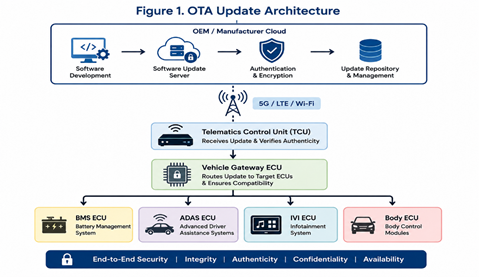
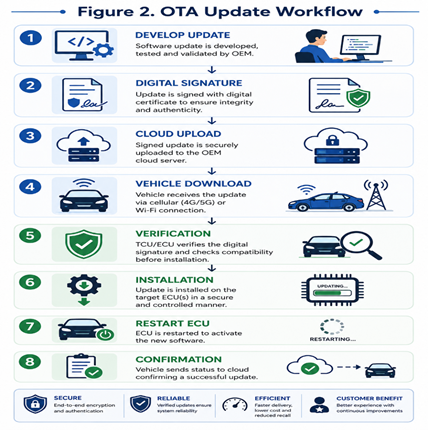
OTA security ecosystem comprises several components which are interlinked in order to achieve secure software distribution. The process starts from the development and validation of the new firmware in the Original Equipment Manufacturer. Upon successful testing of the new software package, it is cryptographically signed and stored in secure cloud servers.
When an eligible vehicle comes into consideration, the OTA manager sends the software package through cellular or Wi-Fi networks. It is received by the Telematics Control Unit in the car and further forwarded through the car gateway to the destination ECU. Prior to the actual installation of the software, its integrity is confirmed to make sure that the software was not tampered with during the transmission process. The update is verified in terms of compatibility and, if successful, installed and tested by the ECU.
Benefits of OTA Technology
OTA updates offer numerous advantages not only for manufacturers and service providers but for car owners as well. The introduction of OTA allows manufacturers to decrease costs related to recall campaigns significantly. Many problems caused by the software defects that emerge during the use of vehicles can be fixed remotely without any additional expenditures. OTA allows car owners to enjoy upgrades in software continuously without affecting their normal schedule. Maps can be kept updated, additional functions will be added to infotainment systems, battery life can be extended and new digital solutions will emerge throughout the period of owning a car. OTA allows manufacturers to present customers innovative services even after cars have been delivered to them. The use of predictive maintenance applications will allow to solve problems that may emerge prior to breakdowns.
Real-World Applications of OTA Updates
In today’s world, the use of OTA technology is prevalent throughout the automobile industry. The manufacturers of electric vehicles update their vehicles to increase charging efficiency, increase the driving range of the vehicles, and optimize the thermal management capabilities. The ADAS solutions also receive improvements to the lane keeping algorithms, improvements to the adaptive cruise control, better object detection, and sensor calibration.
Fleet managers also use OTA technology to keep many connected vehicles updated at the same time without having any disruptions to maintenance schedules. With the growth in the connected car industry, OTA technology will be used for autonomous driving software, digital cockpit software applications, cybersecurity, and vehicle diagnostics.
Cybersecurity Challenges in OTA Systems
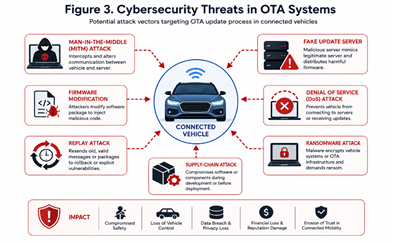
Despite all the benefits that OTA technology provides, it increases the attack surface of the vehicle at the same time. Since software updates will be transmitted via public communication networks, then attackers can try to intercept, modify, or substitute the software packages. The Man-in-the-Middle (MITM) attack is one of the main problems that can be faced when updating the software of connected cars. Without proper encryption, malicious actors can change the software while it is being delivered.
Firmware modification is one of the major issues in this area. In case the software package is modified by attackers, it might compromise the safety of vehicles or even install malicious firmware. A replay attack includes the situation when old software packages are transmitted to vehicles and can re-introduce the vulnerabilities that have been already fixed. Similarly, a fake server that distributes malicious firmware can pretend to be the legitimate manufacturer. There are also DoS attacks preventing vehicles from receiving updates, ransomware attacking connected car infrastructure, supply-chain attacks affecting the development of software, and attempts to gain access to ECUs without proper authorization.
Security Mechanisms for Secure OTA Deployment
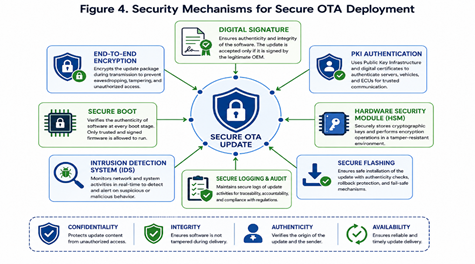
There are various ways used by automotive manufacturers to ensure protection in the OTA ecosystem. End-to-end encryption is used for the safe delivery of packages ensuring that the software cannot be tampered with.
Digital signatures can verify software before being installed ensuring that any update made to the vehicle comes from the manufacturer. Secure Boot is used to make sure that the vehicle uses authenticated software during the ECU boot process. The system will not allow for any unauthorized firmware to run and will stop the initialization of the system. The Public Key Infrastructure enables for trusted communications using digital certificates and cryptography to allow communication among cloud servers, telematics devices, and the vehicle controllers. Hardware Security Modules are common features in many automotive systems. They provide secure storage of cryptographic keys as well as increase encryption speed.
Industry Standards Driving Secure OTA
International standards now mandate the inclusion of cybersecurity in the vehicle development process.The ISO/SAE 21434 standard addresses engineering processes in cybersecurity for the entire lifecycle of the vehicle, from threat analysis to vulnerability management and incident response. UNECE Regulation R155 mandates the need for Cybersecurity Management System (CSMS) to detect and mitigate cyber threats during the lifecycle of the vehicle. UNECE Regulation R156 is applicable specifically to Software Update Management Systems (SUMS), which ensures that the OTA updates are developed and deployed with security and traceability. This gives a comprehensive approach for developing secure connected vehicles.
Artificial Intelligence Strengthening OTA Security
AI is becoming an increasingly important part of automotive cybersecurity. AI-based intrusion detection systems constantly monitor all network activities and detect any irregularities which might point out to possible cyberattacks. Machine learning algorithms can spot any anomalies in communication between ECUs, any modifications in firmware of the car’s software, installation of suspicious software, and any other anomalies in the network. Predictive analytics also helps car manufacturers to detect future vulnerabilities and suggests necessary updates on time. As the number of data generated by software-defined cars keeps growing, AI will play an important part in developing cybersecurity of the future.
Future Outlook
The development of Over-the-Air (OTA) technology does not stop at software updates and maintenance. The introduction of technologies such as delta updates, edge computing, blockchain validation, Zero Trust Architecture, and 5G/6G connections will result in software updates becoming faster, more efficient, and safer. Artificial Intelligence will add additional value to OTA technology by offering prediction of updates, advanced threat detection, and performance improvements. With the increasing adoption of Software-Defined Vehicles in the automotive industry, OTA updates will become an essential element for introducing innovations, enhancing vehicle performance, and cybersecurity of the car all throughout its life cycle. At the same time, successful operation of OTA technology requires a high level of security provided by such tools as encryption, digital signatures, secure boot, and compliance with international cybersecurity standards.