
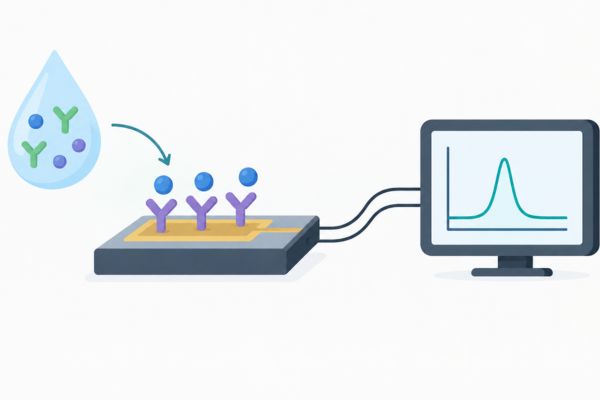
Electrochemical biosensors are turning biological and chemical changes into electrical signals that electronics can measure, process and communicate. This technology is becoming increasingly important in medical diagnostics, wearable devices, continuous monitoring and point-of-care testing.
At the heart of these systems are electrodes, integrated circuits (ICs) and signal-processing electronics. Together, they create the link between a biological sample and a digital health reading.
How Electrochemical Biosensors Work
An electrochemical biosensor detects a target substance, such as glucose, lactate, electrolytes or specific biomarkers, through an interaction at the sensor surface.
When this interaction changes an electrical property such as current, voltage or impedance, the electronics measure that change and convert it into usable data.
A simplified signal path looks like:
Biomarker → Bioreceptor → Electrode → Analog Front End → ADC → Microcontroller → Digital Output
This combination allows chemical information to move from the biological environment into an electronic system.
Why Electrodes is Important
Electrodes form the critical interface between the biological sample and the electronic circuit. A typical electrochemical sensor can use a working electrode, reference electrode and counter electrode, depending on its measurement method.
The working electrode is where the main electrochemical reaction occurs. The reference electrode provides a stable reference potential, while the counter electrode completes the electrical circuit.
Materials such as gold, platinum, carbon and conductive polymers can be used depending on the application. Electrode design directly affects sensitivity, selectivity, stability and the quality of the resulting signal.
The Role of Integrated Circuits
The electrical signal generated at an electrode can be extremely small, making direct measurement difficult. This is where specialized ICs become important.
An analog front end (AFE) can provide signal conditioning, amplification, filtering and current or voltage measurement before the signal reaches a digital processor.
Potentiostats are another important electronic building block. They control the potential between electrodes and measure the resulting current, allowing the system to perform techniques such as amperometry, voltammetry and potentiometry.
Signal Processing Turns Signals Into Information
The raw electrical output from an electrochemical reaction is not automatically a useful health reading. Electronic circuits first need to remove unwanted noise and condition the signal.
An analog-to-digital converter (ADC) then converts the conditioned analog signal into digital data. A microcontroller or processor can analyze this information and apply calibration algorithms to estimate the concentration of the target biomarker.
Modern systems can also use digital filtering and machine-learning algorithms to identify patterns and improve interpretation.
Where Are These Biosensors Used?
One of the best-known applications is glucose monitoring, where electrochemical sensing is used to measure glucose concentration.
The same underlying technology is being explored for lactate, electrolytes, metabolites, hormones and other biomarkers. Wearable systems can analyze sweat or other biological fluids, while portable devices can support rapid testing closer to the patient.
This makes electrochemical biosensors useful for both laboratory systems and increasingly compact point-of-care electronics.
According to Towards Healthcare Research and Consulting, the global biosensors market size is calculated at USD 32.64 billion in 2025, grew to USD 35.46 billion in 2026, and is projected to reach around USD 74.76 billion by 2035. The market is expanding at a CAGR of 8.64% between 2026 and 2035.

Advantages and Limitations
Advantages
- High sensitivity: Can detect relatively small changes in target substances.
- Compact design: Sensors and electronics can be integrated into small medical devices.
- Low power consumption: Suitable for portable and wearable applications.
- Rapid measurements: Can provide results quickly for many applications.
- Easy electronics integration: Can connect with microcontrollers, smartphones and healthcare platforms.
- Real-time monitoring: Supports continuous measurement in suitable applications.
- Multiple sensing options: Can be designed to detect glucose, lactate, electrolytes and other biomarkers.
Limitations
- Electrode fouling: Materials can degrade or accumulate unwanted substances during operation.
- Signal interference: Other chemicals can affect measurement accuracy.
- Temperature and pH effects: Environmental and biological conditions can influence sensor performance.
- Sensor drift: Performance can change over time, requiring calibration.
- Biological variability: Differences between individuals and samples can affect readings.
- Noise in small signals: Very low electrical signals require careful circuit and signal-processing design.
- Long-term stability: Maintaining accuracy during extended use remains challenging.
What Comes Next?
The next generation of electrochemical biosensors is moving toward flexible electrodes, printed electronics, miniaturized ICs, wireless connectivity and edge processing.
Researchers are also exploring multi-analyte systems that can measure several biomarkers using a single compact platform. Combining better electrode materials with low-noise electronics and intelligent signal processing could make these sensors more practical for continuous and personalized monitoring.