
Overview
A 5G-enabled medical device can contain advanced sensors, precise signal-processing circuits and a high-speed cellular modem. However, these components cannot deliver reliable remote monitoring if the wireless signal weakens when the device is worn on the body, placed near other electronics or operated in a different environment.
This is why radio frequency (RF) testing is a critical part of medical electronics development. It helps engineers measure antenna performance, evaluate cellular transmission and reception, identify interference risks and verify how consistently a device communicates under different conditions.
For wearable patient monitors, portable diagnostic equipment and connected medical sensors, RF testing must go beyond checking whether the device connects to a 5G network. Engineers need to understand how the complete electronic system performs in real-world use.
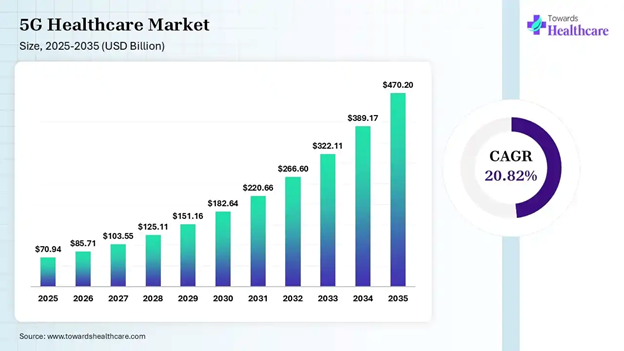
According to Towards Healthcare Research and Consulting, the global 5G healthcare market size was valued at US$ 70.94 billion in 2025 and is projected to grow to 85.71 billion in 2026. Forecasts suggest it will reach approximately US$ 470.20 billion by 2035, registering a CAGR of 20.82%.
Why 5G RF Testing Matters in Medical Electronics
5G can support faster data transfer, lower network latency in suitable conditions and greater connectivity for connected devices. These capabilities can benefit medical applications that transmit diagnostic images, physiological measurements or other patient data.
However, actual performance depends on network coverage, device design, signal conditions and the type of 5G service being used. A 5G connection alone does not guarantee uninterrupted communication or clinically reliable data delivery.
Consider a wearable ECG monitor that sends cardiac readings to a remote monitoring platform. Its antenna may perform well during laboratory testing but become less efficient when the patient wears the device beneath clothing. The body can absorb RF energy, while the enclosure, battery and nearby electronic components can alter antenna behaviour.
If the connection becomes unstable, the device may experience packet loss, delayed uploads or repeated reconnections. For medical electronics, engineers must determine whether these events affect the intended function and whether the device handles communication failures safely.
The U.S. Food and Drug Administration (FDA) identifies wireless coexistence, quality of service, cybersecurity and electromagnetic compatibility as important considerations when developing wireless medical devices. These factors make RF testing part of both hardware validation and medical-device risk management.
How RF Testing Evaluates a 5G Medical Device
RF testing measures how a device transmits, receives and handles radio signals. Testing generally combines component-level measurements, cellular conformance checks and over-the-air evaluation of the finished product.
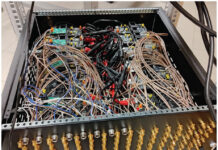
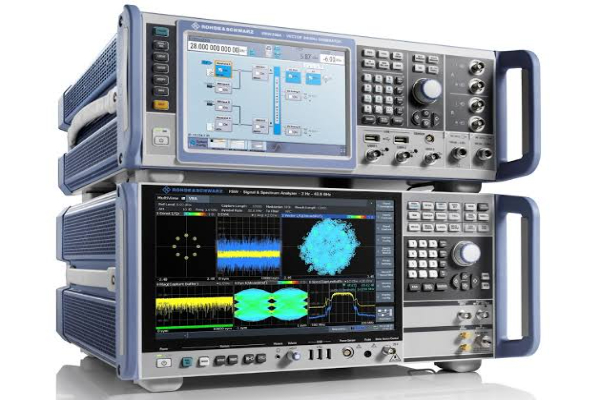
A typical 5G RF test setup includes:
- Device under test (DUT): The medical device or its cellular electronics being evaluated.
- 5G base-station simulator: Emulates a cellular network and establishes controlled test connections.
- RF signal analyser: Measures transmission characteristics, unwanted emissions and signal quality.
- Vector network analyser (VNA): Measures antenna impedance and matching characteristics.
- OTA test chamber: Creates a controlled environment for measuring radiated performance without a direct RF cable connection.
- Control and logging software: Records measurements, test conditions, network events and device performance.
The exact equipment depends on the device, supported frequency bands, antenna architecture and intended use. Engineers may begin with a cellular modem or antenna prototype before testing the final assembled medical product.
Key Measurements Used in 5G RF Testing
1. Antenna Impedance and S11
An antenna must be appropriately matched to the RF transmission line and radio circuitry. Poor impedance matching can cause some of the transmitter’s power to reflect towards the source rather than being delivered to the antenna.
The reflection coefficient, commonly measured as S11, indicates how much of the incident signal is reflected at the antenna port. Engineers often review return loss and voltage standing wave ratio (VSWR) alongside S11.
A commonly used design target is S11 below −10 dB across the intended operating band, although the required value depends on the design and performance objectives. This is a useful engineering guideline, not a universal medical-device acceptance criterion.
Testing should cover the relevant 5G bands and account for the final enclosure, battery, printed circuit board (PCB), cables and nearby components. A matching network that performs well on a bare PCB may behave differently after assembly.
2. Total Radiated Power
Total Radiated Power (TRP) measures the power radiated by a device across different directions. Unlike a conducted power measurement taken at an RF port, TRP helps show how much power the complete device actually radiates through its antenna system.
TRP is influenced by transmitter output, antenna efficiency, impedance matching and losses in the device structure. A low TRP result may indicate that the antenna or its integration is reducing effective transmission performance.
For a portable medical monitor, engineers can use TRP measurements to compare antenna layouts, enclosure materials and device configurations. The results help identify designs that transmit more consistently under controlled conditions.
3. Total Isotropic Sensitivity
Total Isotropic Sensitivity (TIS) evaluates a device’s overall ability to receive weak signals from different directions. It combines receiver sensitivity with the effects of antenna performance and the finished device’s RF environment.
Poor TIS can make a medical device more vulnerable to weak coverage, especially indoors or in locations where cellular signals are obstructed.
Noise generated by digital processors, switching power supplies and display circuits can also affect receiver performance. This makes PCB layout, grounding, shielding and power-management design important parts of RF optimisation.
TRP and TIS are commonly measured through over-the-air (OTA) testing. Neither measurement alone proves that a device will maintain a reliable connection in every real-world environment.
4. Receiver Sensitivity, Throughput and Latency
Conducted RF tests can assess receiver sensitivity, transmitter characteristics and performance against applicable cellular requirements. Network-based testing adds another layer by examining how the device behaves during an active connection.
Engineers may measure:
- Downlink and uplink throughput.
- Packet error rate and data retransmissions.
- Connection establishment and recovery.
- Latency under defined network conditions.
- Performance as signal strength decreases.
- Handover behaviour between supported cells or network configurations.
These measurements matter because a medical device may need to transmit small but time-sensitive data packets rather than simply achieve a high peak data rate. A device should be assessed against its intended clinical and technical requirements, not only its maximum throughput.
Technologies Used in 5G RF Testing
- 5G New Radio (NR): Defines the cellular radio interface and the relevant operating bands and transmission modes.
- RF transceivers and power amplifiers: Transmit and receive radio signals; testing evaluates output, linearity, sensitivity and unwanted emissions.
- Filters and duplexers: Help control frequency selection and isolation between RF paths.
- Antenna matching networks: Adjust impedance to improve energy transfer between the radio circuitry and antenna.
- MIMO antenna systems: Use multiple antennas and radio paths where supported by the device to improve link performance or data capacity.
- OTA chambers: Measure the integrated device’s radiated behaviour under controlled conditions.
- 5G RedCap: Reduced Capability 5G, introduced in 3GPP Release 17, targets certain IoT devices with less demanding performance and complexity requirements than full-featured 5G equipment.
Not every medical device requires MIMO or RedCap. The appropriate architecture depends on power consumption, data volume, physical size, network availability and cost.
How Over-the-Air Testing Measures Antenna Performance
OTA testing is particularly important when antenna performance cannot be fully understood from measurements at a single connector. It evaluates the assembled device as a radiating system.
The device is placed inside a suitable chamber, where measurement equipment captures its performance from multiple directions. The test system can then calculate parameters such as TRP and TIS.
A typical process includes:
- Configure the device: Select the supported 5G band, channel, transmission mode and required operating conditions.
- Establish a controlled link: Use a base-station simulator or appropriate test equipment to control the cellular connection.
- Measure radiated performance: Record transmitter and receiver behaviour across the required angular positions.
- Repeat across relevant conditions: Test selected bands, channels, antenna states and device configurations.
- Compare the results: Evaluate the measurements against engineering requirements and applicable certification or network-approval criteria.
For 5G devices using millimetre-wave (mmWave) frequencies, OTA testing becomes especially important because antenna arrays and beamforming systems can make performance highly dependent on direction. Body placement, device orientation and the user’s surroundings can also affect the effective link.
Testing Wireless Reliability Around the Human Body
Medical electronics face physical conditions that conventional RF development boards do not fully represent. The human body contains water-rich tissue that can absorb RF energy and influence antenna tuning. Clothing, straps, enclosures and the position of a wearable device can further change its performance.
Engineers should therefore test the device in configurations that represent its intended use. Depending on the product, this may include body-worn positions, different orientations, representative accessories and suitable body-equivalent test fixtures.
Testing should also examine how the device responds when signal quality deteriorates. For example, a remote monitor may need to store readings locally during a temporary network outage, display a connection warning or retry transmission without losing essential data.
The purpose is not to guarantee a permanent cellular connection. It is to establish measurable performance limits and verify that the device responds appropriately when wireless communication is interrupted.
RF Interference and Electromagnetic Compatibility
A medical device may operate close to smartphones, Wi-Fi access points, Bluetooth accessories, other cellular equipment and electronic instruments. Signals from these sources can interfere with wireless communication or affect susceptible circuits within the medical device.
Two related but different questions need to be tested:
- Wireless coexistence: Can the device maintain its intended wireless function when other radio systems operate nearby?
- Electromagnetic compatibility (EMC): Can the medical device continue operating safely and as intended when exposed to electromagnetic disturbances?
RF coexistence testing can examine packet delivery, connection stability and functional wireless performance in the presence of controlled interference. EMC immunity testing assesses whether external RF energy disrupts the device’s electronic or medical functions.
The FDA has also published a regulatory science method using representative 5G FR1 emissions to assess medical-device immunity to nearby 5G transmitters. This highlights the importance of considering not only a device’s own cellular performance but also how it responds to external RF energy.
Relevant standards and test plans depend on the device category and intended market. Examples include applicable 3GPP user-equipment specifications, cellular certification requirements, IEC 60601-1-2 for relevant medical electrical equipment, and wireless coexistence guidance such as ANSI C63.27. Manufacturers should determine applicability with their test laboratory and regulatory team rather than assume one standard covers every requirement.
Challenges in 5G RF Testing for Medical Electronics
- Compact antenna design: Medical devices have limited PCB area, and batteries, displays and metal enclosures can affect antenna efficiency.
- Body-related signal loss: Human tissue and changing device positions can alter antenna matching and radiation patterns.
- Multiple frequency bands: A device supporting several 5G bands requires careful optimisation and verification across its intended configurations.
- mmWave beam sensitivity: Directional antenna arrays require appropriate OTA methods to assess beam coverage and performance.
- Electronic noise: Switching regulators, processors and high-speed digital interfaces may degrade receiver sensitivity.
- Battery limitations: Repeated transmission, weak-signal operation and reconnection attempts can increase energy consumption.
- Network variability: Real-world coverage, congestion and handovers cannot be represented by a single laboratory result.
- Medical risk management: Engineers must determine whether a wireless failure could affect diagnosis, monitoring, alarms or another intended medical function.
Opportunities for Better RF Design and Validation
RF testing provides useful feedback well before final product approval. Engineers can compare antenna locations, modify matching components, improve PCB isolation and identify sources of unwanted noise while changes are still practical.
Simulation can help predict antenna behaviour and identify problem areas, while physical measurements validate the model. Combining conducted testing, OTA measurements, coexistence testing and end-to-end data checks provides a more complete picture than relying on one RF metric.
A structured test plan can also reduce late-stage redesign. If engineers evaluate the final enclosure, realistic device positions and weak-signal behaviour early, they are more likely to identify connectivity issues before production tooling and regulatory submissions are finalised.
The Future of RF Testing in Medical Electronics
As connected medical devices adopt 5G NR, RedCap and more compact antenna designs, RF testing will increasingly need to evaluate the complete device under realistic conditions. Automated OTA systems, repeatable test fixtures and more detailed logging can help engineering teams compare design versions and investigate failures.
Future test strategies are also likely to place greater emphasis on power consumption during weak coverage, network recovery, device coexistence and performance across different deployment environments. These measurements are particularly important for devices that must operate for long periods without frequent charging or user intervention.
No single test can prove universal wireless reliability. The strongest validation combines controlled RF measurements with functional testing and a clear understanding of the device’s medical purpose.
Conclusion
5G RF testing is more than a check of cellular signal strength. It measures how antenna design, RF circuitry, receiver performance, enclosure materials and nearby electronics work together in the finished medical device.
Parameters such as S11, TRP, TIS, throughput and latency help engineers identify weaknesses and compare design alternatives. OTA, coexistence and EMC testing then extend the evaluation to radiated performance and interference conditions relevant to the intended use.
For medical electronics manufacturers, the goal is not simply to achieve a successful 5G connection. It is to develop a device whose wireless performance is measurable, repeatable and appropriate for its medical function, including when connectivity becomes weak or temporarily unavailable.
Source: https://www.towardshealthcare.com/insights/5g-healthcare-market-size
About Author
Payal Rabde is a Healthcare Market Research Analyst at Towards Healthcare Research & Consulting with over 4+ years of experience in pharmaceutical, biotechnology, medical device, and healthcare market research. She holds an MBA in Pharmaceutical-Biotechnology Management and a B.Pharm, specializing in market analysis, forecasting, competitive intelligence, and strategic healthcare insights.
About Towards Healthcare Research and Consulting
Towards Healthcare Research & Consulting is a global strategy consulting firm with a presence in both Canada and India. We provide innovative solutions customized to the healthcare sector, helping business leaders overcome challenges and accelerate growth. We specialize in delivering advanced technological solutions, clinical research services, and powerful data analytics. Our focus is on building meaningful partnerships that foster innovation and deliver actionable insights to drive success in healthcare.