
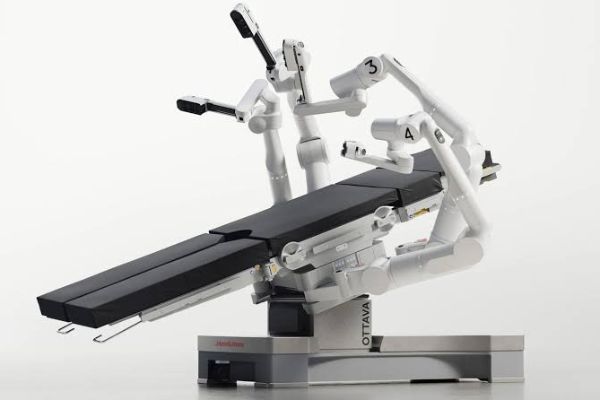
Surgical robotics is becoming an increasingly sophisticated combination of mechanical engineering, electronics, embedded software and digital technology. Johnson & Johnson MedTech’s OTTAVA Robotic Surgical System takes this integration further by incorporating four robotic arms directly into the operating table.
In October 2026, J&J published additional details about the engineering teams behind OTTAVA, including mechanical and electrical hardware engineers, robotics-control software engineers, systems-integration engineers and cloud-data engineers. The system received U.S. FDA De Novo authorization in July 2026 for 10 upper-abdominal general surgery procedures.
According to Towards Healthcare Research and Consulting, the global robotic surgery market size is calculated at USD 13.79 billion in 2025, grew to USD 16.07 billion in 2026, and is projected to reach around USD 63.73 billion by 2035. The market is expanding at a CAGR of 16.54% between 2026 and 2035.

OTTAVA Surgical Robotics: Key Technical Facts
| Technical parameter | Verified information |
| Manufacturer | Johnson & Johnson MedTech |
| Robotic arms | Four, integrated into the operating table |
| Arm architecture | Nine joints per arm, according to J&J’s system documentation |
| Motion technology | Software-controlled arm movement and synchronized table-arm motion |
| Automation | Predefined arm positions for setup and procedural positioning |
| Digital platform | Polyphonic digital ecosystem |
| FDA authorization | July 21, 2026 |
| Initial clinical study | 30 patients across six U.S. hospitals |
| Operating room sizes in the study | Approximately 243–694 sq. ft. |
1. Four Robotic Arms Integrated Into One Surgical Table
The most distinctive feature of OTTAVA is its physical architecture. Four robotic arms are integrated into a standard-size surgical table rather than being arranged around the patient using separate external support structures.
This design requires coordination between mechanical hardware, electrical systems, control software and the table itself. Each arm must reach the intended surgical area while maintaining suitable positioning relative to the patient, instruments and other arms.
J&J describes nine joints per arm, providing multiple points of articulation to support access to different anatomical locations. The manufacturer has not publicly disclosed every motor specification, joint torque rating or detailed control parameter, so these should not be assumed.
The arms can also be moved into predefined positions to support setup and breakdown. This automation is intended to reduce the amount of manual repositioning required from operating room staff.
2. Motion Control: How Robotic Arms Follow Surgical Commands
Motion control is central to any robotic-assisted surgical system. The hardware must convert surgeon inputs into controlled instrument movement while accounting for the position of the robotic arms and the geometry of the surgical setup.
OTTAVA uses software-controlled robotic movement. J&J identifies robotics-control and software engineers as part of the development teams responsible for its automation algorithms.
At a general engineering level, a robotic motion-control system needs to coordinate several functions:
- Command interpretation: Converting control inputs into requested instrument or arm movements.
- Joint coordination: Managing multiple articulated joints so the arm can reach the required position.
- Position control: Coordinating movement to reach intended configurations.
- System monitoring: Checking operating conditions and responding to faults or conditions that require intervention.
- Workflow automation: Moving arms into predefined setup or procedural positions.
These are standard engineering functions for robotic systems, not a claim that J&J has disclosed the exact internal algorithms or sensor-fusion architecture used by OTTAVA.
In surgical applications, movement control must be evaluated alongside instrument accuracy, system reliability, human factors and the ability of trained clinicians to respond to unexpected situations.
3. Twin Motion: Coordinating the Table and Robotic Arms
A key OTTAVA feature is twin motion, which synchronizes movement of the operating table and robotic arms.
In a conventional robotic setup, changing the patient’s position can require additional steps if the robotic arms and table cannot move together. Depending on the system and procedure, the team may need to reposition equipment or disengage and reconnect parts of the setup.
OTTAVA is designed to coordinate the table and arms so that patient repositioning and access to multiple abdominal areas can occur with limited intraoperative adjustments. This can help preserve procedural continuity and reduce some of the manual work involved in repositioning.
From an engineering perspective, synchronized movement requires the system to coordinate the table’s position with the configuration of the robotic arms. The motion must account for the relationship between the patient, the table and the surgical instruments.
The potential operational benefit is easier repositioning and improved access to the surgical field. Whether this consistently reduces procedure time or improves outcomes requires supporting clinical and workflow data.
4. Motors, Sensors and Embedded Control Electronics
The mechanical structure provides the movement, but electronic and software systems make that movement controllable.
J&J’s engineering overview confirms that its teams developed the robotic-arm hardware and integrated motors and sensors into the arms. Systems-integration engineers worked to ensure these components operated correctly within the complete platform.
Motors provide mechanical movement, while sensors can supply information about system conditions. Embedded control electronics and software are commonly used in robotic platforms to manage movement, monitor operating states and coordinate connected subsystems.
The exact motor types, sensor models, processor specifications and communication buses used in OTTAVA have not been fully disclosed in the cited public material.
This distinction matters because it is easy to confuse the general electronics architecture of a surgical robot with verified details about a particular product. Accurate technical reporting should identify the known components without inventing circuit designs or performance specifications.
5. Polyphonic: Connecting Surgical Robotics With Digital Data
OTTAVA also connects to J&J’s Polyphonic digital ecosystem, which brings together surgical data, media, learning resources and data-driven insights.
This introduces a second engineering layer beyond the physical robot. Digital systems can help organize information generated during surgical workflows and make selected insights available for education and continuous improvement.
J&J describes cloud and data engineering teams as part of the platform’s development. Its public materials also discuss future possibilities involving simulation and digital twins. These are areas of development and potential application; they should not be interpreted as proof that every digital-twin or AI capability is already available in the authorized system.
For hospitals, digital integration raises practical questions about data security, system interoperability, user access, information governance and how insights will be incorporated into clinical workflows.
6. Clinical Evidence: What Has Been Demonstrated?
OTTAVA’s engineering must be assessed alongside evidence from actual surgical use.
In May 2026, J&J reported results from a prospective, multicenter study involving 30 patients undergoing Roux-en-Y gastric bypass procedures across six U.S. hospitals. The company reported that the study met its primary safety and performance endpoints through 30 days, and all procedures were completed robotically without conversion to a non-robotic approach.
The study also included operating rooms ranging from approximately 243 to 694 square feet. Five of the six participating sites used rooms that had not previously been used for robotic surgery.
These results support the feasibility of using OTTAVA in the studied procedure and demonstrate its use in a range of operating room environments. However, a 30-patient study does not establish that the system is superior to other surgical robots, nor does it prove that its design reduces complications or operating costs across all procedures.
7. Engineering Challenges and Future Opportunities
Integrating a surgical table with multiple robotic arms introduces complex design and validation requirements.
- Mechanical coordination: Arm movement and table positioning must remain coordinated throughout the procedure.
- System reliability: Motors, sensors, electronics and software must operate together consistently.
- Operating room integration: The system must fit into clinical workflows and accommodate the needs of surgeons and bedside staff.
- Automation validation: Predefined arm positions must be evaluated for their intended use and operating conditions.
- Digital security: Connected data systems require appropriate safeguards for sensitive surgical information.
- Training and usability: Clinical teams need to understand system operation, setup and relevant safety procedures.
Future opportunities include more advanced simulation, improved workflow analytics and additional digital tools that support surgical education. Any new capabilities must undergo appropriate validation and regulatory review where required.
Conclusion
OTTAVA demonstrates how surgical robotics is evolving beyond standalone robotic arms toward integrated platforms combining mechanical systems, motors, sensors, software-controlled motion and digital infrastructure.
Its four table-integrated arms and twin-motion architecture are designed to simplify patient repositioning and improve access within the operating room. J&J’s published engineering information confirms that mechanical, electrical, controls, systems-integration and cloud-data engineering all contribute to the platform.
The next measure of success will be whether these design choices deliver reliable performance and meaningful workflow benefits in routine clinical practice. For electronics engineers and medical device developers, OTTAVA offers a useful example of the challenges involved in integrating complex electromechanical systems into safety-critical healthcare technology.