

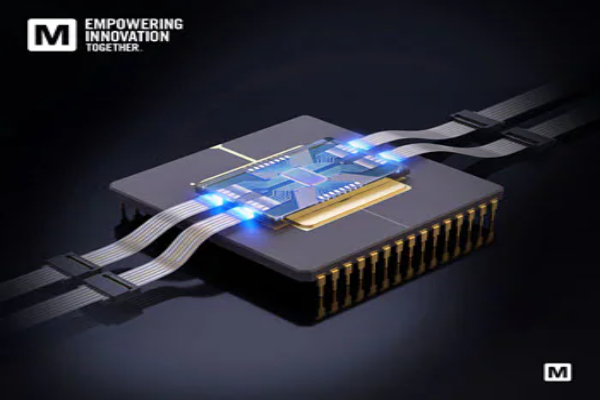
Mouser Electronics, the authorized global distributor with the newest electronic components and industrial automation products, announced the latest installment of its Empowering Innovation Together (EIT) technology series, Moving Beyond Moore’s Law. The series explores how engineers are advancing computing performance as traditional semiconductor scaling approaches its physical limits, from chiplets and advanced packaging to silicon photonics and emerging transistor technologies.
As a key driver of semiconductor advancement, Moore’s Law has served as a roadmap for the industry, describing the trend of transistor counts on integrated circuits doubling approximately every two years. With conventional silicon transistors becoming increasingly difficult to shrink, continued progress can no longer depend on transistor density alone. Engineers are combining gate-all-around (GAA) transistors, chiplet architectures, advanced packaging, and system-level design to improve performance and efficiency while investigating longer-term possibilities, such as single-molecule transistors and optical computing.
“For decades, Moore’s Law helped define the pace and direction of computing innovation, but the industry is now entering a more complex stage of development,” said Jeff Newell, President of Mouser Electronics. “Advances across materials, architectures, packaging, and photonics will shape the next generation of computing. Through Empowering Innovation Together, Mouser is helping engineers understand how these technologies can work together to continue moving computing forward.”
In The Tech Between Us podcast, Raymond Yin, Director of Technical Content at Mouser Electronics, is joined by Maurice Steinman, Senior Vice President and General Manager at Lightelligence. Their discussion examines the current state of semiconductor manufacturing, the potential of silicon photonics to enhance computing performance, and the technical challenges in scaling optical computing to the level of today’s silicon-based systems and beyond.
“Moving beyond Moore’s Law is not about finding a single replacement for conventional silicon scaling,” said Yin. “It requires engineers to rethink how computing systems are designed, integrated, and manufactured. This installment explores the range of technologies that could help overcome current limitations and shape the next phase of computing.”
In addition to the podcast, the EIT series includes an in-depth video, technical articles, a topic-related infographic, and subscriber-exclusive resources examining the future of computing beyond Moore’s Law. The featured article, Rethinking Moore’s Law in Modern Semiconductor Design, explores how chiplets, advanced packaging, GAA transistors, and system-level design are enabling continued improvements in semiconductor performance. Together, these resources give engineers insights into both the near-term approaches extending silicon technology and the emerging innovations that could redefine computing architectures. Established in 2015, Mouser’s Empowering Innovation Together program is one of the electronic component industry’s most recognized educational programs.