
Testblox AB, a new test & measurement company that focuses on reducing the size, complexity, and cost of functional test, announced a collaboration with UK-based test system integrator Peak Production Equipment. Peak is adopting Testblox as its standard instrumentation platform for a new generation of automated, fixture-based production test systems, and two of the company’s lead customers have already taken advantage of the new approach.
The collaboration combines Peak’s more than 40 years of experience designing and manufacturing automated test equipment with Testblox’s compact, commercial-off-the-shelf (COTS) instrumentation. Together, the companies are demonstrating how Testblox’s standardised, credit-card-sized modular hardware and Peak’s application-specific interface boards can dramatically simplify the design, manufacture and maintenance of production test systems.
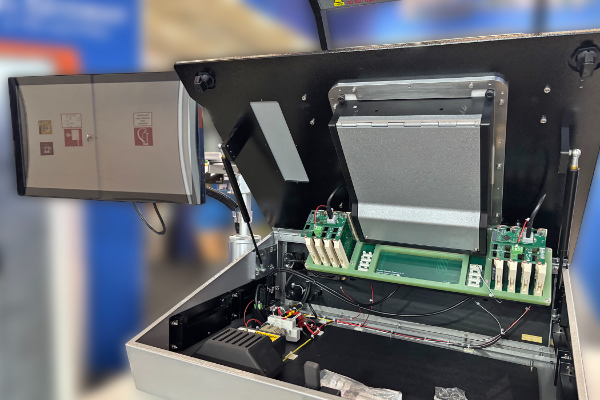
At the centre of the collaboration is a new test architecture developed by Peak that incorporates eight Testblox instrumentation modules mounted on two backplanes. Rather than connecting the instruments to the device under test (DUT) through conventional cable assemblies, Peak’s custom interface board connects directly to the Testblox modules’ edge connectors. This direct, pin-to-pin approach eliminates much of the individual instrument-to-fixture wiring traditionally required in functional test systems. It also shortens signal paths, reduces the number of interconnections and creates a compact, repeatable design that can be readily adapted to other test applications.
“One of the biggest challenges in building fixture-based production test systems is fitting all the equipment inside the fixture,” said Karl Miles, Sales & Marketing Director at Peak Group. “With Testblox, we’re starting with a standardised ultra compact set of instruments and building the application-specific connections around them. Our custom interface board eliminates a significant amount of wiring, saving design and assembly time. Equally important, this approach makes the finished system much easier to support and quicker to replicate. Testblox’s small size means we don’t have instruments sat on the bench next to the fixture taking up valuable space, with awkward external cables that can be damaged or unplugged.”
Peak expects the architecture to deliver significant improvements over conventional test systems, including:
- An estimated 50% reduction in total hardware and integration costs.
- Accelerating delivery of new test systems
- Reduced design effort through standardized COTS hardware
- Quicker build time due to reduced wiring
- Simplified debug and commissioning with vastly reduced wiring and increased signal quality
- Easy reuse of unified software
- Maintenance complexity is reduced with simplified wiring, easy fault isolation and quick module replacement
“Peak is exactly the kind of company we had in mind when we developed Testblox,” said Kyle Voosen, Product Manager at Pickering Interfaces, a founding partner of Testblox. “They know how to build great test systems, but they’ve historically had to spend a lot of time and money connecting all the pieces together. By standardising the instrumentation and letting Peak focus its engineering expertise on the fixture and the customer application, we can take real cost and complexity out of the system. The eight-module design is a great example of what we mean when we say: ‘The Fixture is the ATE.'”
The collaboration will be highlighted at electronica 2026 in Munich, Germany, from 10–13 November, where visitors to booth A4 242 can learn more about the Testblox platform and Peak’s approach to integrated functional test.