

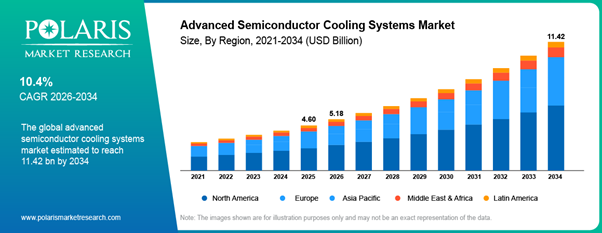
For two decades, the semiconductor story has been about transistors: smaller, faster, denser. Today the binding constraint is more physical and far less glamorous. It is heat. As AI accelerators push past 1,000 watts per chip, thermal management has moved from a procurement line item to a boardroom-level strategic decision. The advanced semiconductor cooling systems market was valued at USD 4.60 billion in 2025 and is forecast to reach USD 11.42 billion by 2034, a 10.4% CAGR, according to Polaris Market Research. Yet the headline understates the shift. The more important question for executives is not how large this market becomes, but who controls the thermal layer that every future compute dollar depends on.
Heat Is Now the Bottleneck of AI Infrastructure
Accelerator racks draw so much power that fans and heat sinks can no longer carry the heat away. Liquid loops and immersion tanks are taking share as a result, and chips above 1,000 watts form the fastest-growing power class, expanding at 21.8% a year. Cooling is therefore designed into rack architecture from day one rather than bolted on later.
The economics reinforce the engineering. NVIDIA said in June 2026 that its Rubin servers run fanless on coolant entering at 45°C, and estimated that a 50-megawatt hyperscale site could save over USD 4 million annually in cooling-related energy and water costs. With the International Energy Agency projecting data center electricity demand near 945 terawatt hours by 2030, every point of cooling efficiency becomes a competitive advantage wherever power is scarce.
Where Value Is Concentrating in the Cooling Stack
Not all thermal revenue is equal. Coolant distribution units and heat exchangers generated USD 1,386 million in 2026, the largest component pool, because every liquid loop needs one. These units are specified early, replaced rarely, and are scaling from rack-level boxes to megawatt-class hall infrastructure. Whoever wins that specification wins the customer relationship.
Air Is Not Dead, but Its Share Is Shrinking
Air still holds 36.9% of technology revenue, thanks to consumer devices and servers below 500 watts. Immersion (18.0% CAGR) and two-phase cooling (17.2%) are growing fastest. The practical lesson: hybrid designs, liquid on the accelerators and air on memory, storage and networking, will dominate for years, so smart suppliers and buyers plan for both.
Regional Insights: Three Distinct Growth Stories
North America (35.5% of 2026 revenue) remains the largest market because hyperscalers and chip designers concentrate AI budgets there. It is also the slowest-growing region, at 8.8% annually, simply because its base is already large.
Asia Pacific (33.5%) is the growth engine, expanding at 12.4% a year. Taiwan, South Korea and China host most chip packaging and server assembly, while India, growing at 18.0%, is building semiconductor capacity that will generate its own process-cooling demand.
Europe (21.8%) grows at 9.2%, shaped less by volume than by regulation. A draft EU rating scheme for data centres and tight grids in hubs like Frankfurt and Amsterdam reward efficient designs and heat reuse, which warm liquid loops make practical.
The Gulf and Latin America are greenfield opportunities. Middle East & Africa is projected to grow 12.1% annually and Latin America 10.7%. ODATA committed USD 630 million to liquid cooling at its Brazil and Mexico campuses, and Submer set up a Saudi subsidiary to serve regional capacity expected to grow from 1 GW to 3.3 GW. When halls are new, cooling is designed in, not retrofitted.
Competitive Landscape: Thermal Is Being Absorbed Into the Power Stack
The sharpest strategic signal is consolidation. Eaton closed its USD 9.5 billion acquisition of Boyd Thermal in March 2026. Trane Technologies agreed to buy immersion specialist LiquidStack, and Schneider Electric, owner of Motivair, is launching new coolant distribution units. Vertiv reported a USD 15 billion backlog, up 109%, in early 2026. Power and HVAC giants clearly want to sell one integrated system from chip to chiller.
Independent specialists are not standing still. ZutaCore raised USD 100 million for waterless two-phase systems, and Asetek booked its largest rack-level order to date. But buyers hold real power. Hyperscalers split orders across suppliers, qualification is slow, and rivalry is intense. Scale, chip-maker approvals and service reach increasingly matter as much as product design. Emerging standards work between the Open Compute Project and ASHRAE should lower qualification costs and give smaller players a path into large accounts.
Future Outlook: From Option to Default
Liquid cooling is set to become the default for accelerator racks within the forecast period. The next frontier is the chip itself. Microsoft reported lab tests of microfluidic channels etched into silicon that cut peak temperature by up to 65%. Manufacturing cost and leak risk still need to fall, so adoption will likely start with premium accelerator programs. Retrofit costs and leak anxiety also remain the main brakes on older facilities, which is why new builds will lead.
Conclusion: Treat Thermal as Strategy, Not Plumbing
The organizations that thrive will be those that stop treating cooling as infrastructure overhead. Data center operators should specify liquid architectures at the design stage and favor vendors with proven service networks. Suppliers should chase early specification in coolant distribution and secure chip-maker qualifications. Investors should watch consolidation, since proven thermal capability is now commanding premium valuations. In the AI era, compute is only as powerful as the heat it can shed, and that makes cooling one of the most consequential markets in electronics.