
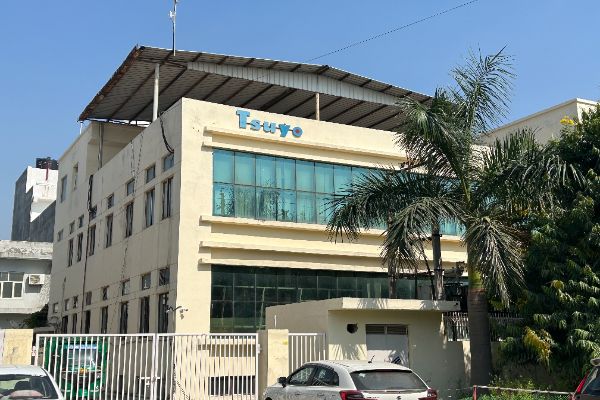
TSUYO Manufacturing, a leading Indian electric mobility technology company specializing in advanced e-mobility components and integrated hardware-software solutions, has received Single Window Clearance from the Government of Karnataka. This approval allows the company to set up a 20-acre EV Powertrain Manufacturing and Validation Facility in the Hubli-Dharwad region, marking a major step in strengthening India’s domestic electric mobility ecosystem.
The State-Level Single Window Clearance Committee granted the clearance, enabling TSUYO to move forward with its integrated manufacturing and testing campus. Earlier, in November 2025, the company had signed a Letter of Intent (LOI) with the Karnataka government at the Bengaluru Tech Summit 2025.
The proposed facility involves an investment of ₹250 crore and will focus on developing, manufacturing, and validating advanced EV powertrain technologies. The facility will comprise integrated facilities for electric traction motors, motor controllers, power electronics, and drivetrain systems, designed to support multiple EV mobility segments.
Commenting on the clearance and plans, Vijay Kumar, Founder & CEO, said, “The Hubli–Dharwad facility will be a significant breakthrough in Tsuyo’s mission to build a globally competitive EV powertrain ecosystem from India. With advanced manufacturing, integrated validation infrastructure, and system-level engineering capabilities, this investment will enable us to deliver high-power, high-voltage electric powertrain solutions for both domestic and international markets. Our focus is to develop and manufacture complete electric powertrain systems with world-class engineering and validation capabilities. The new facility will allow Tsuyo to accelerate innovation in motors, power electronics, and integrated drivetrain solutions while meeting the reliability and performance standards required by Indian as well as global OEMs.”
Lalit Baid, Founder & Chief Operating Officer, shared further details, stating,“The facility will be developed in two phases to progressively scale our integrated EV powertrain technology capabilities. Phase 1 will support powertrain platforms of up to 250 kW with voltage architectures up to 650V, while Phase 2 will expand our capabilities to develop powertrains of up to 1100 kW with high-voltage architectures reaching 850V DC. Importantly, the project will also create over 500 jobs, reinforcing our pledge to building advanced EV technologies and strengthening India’s domestic electric mobility ecosystem.”
The phased approach will enable Tsuyo to support a wide spectrum of electric mobility applications, from light mobility platforms to high-performance commercial vehicle powertrains.
Commenting on the development, Vikas Verma, Partner Avaana Capital said, “From the outset, what stood out to us about Tsuyo was the team’s rare combination of deep engineering capability, product innovation, disciplined execution, and focus on localized manufacturing to build globally competitive EV powertrain technologies from India. The approval of this facility is a testament to Tsuyo’s rapid progress and its strong trajectory in scaling both manufacturing and technological capabilities. Their continued progress in building advanced EV powertrain solutions in India is closely aligned with our conviction in the long-term potential of the country’s electric mobility ecosystem.”
The upcoming facility is designed as a fully integrated powertrain development ecosystem, combining manufacturing infrastructure with advanced testing and validation capabilities. Key features of the facility will include integrated EV powertrain assembly lines, advanced power electronics and drivetrain testing laboratories, and a dedicated open test track for commercial-vehicle powertrain validation.
The facility will serve multiple EV segments, including 3-wheelers, Passenger vehicles, Commercial vehicles and Industrial mobility applications.
This project is expected to generate over 500 engineering and technical jobs over the next three years while building specialised expertise in electric motor design, power electronics engineering, and drivetrain systems development. The initiative is also expected to contribute to the growth of a localised EV component supply chain, supporting India’s broader manufacturing and electrification goals.
The project has received support and facilitation from key state ecosystem partners, including Invest Karnataka, Karnataka Udyog Mitra, Karnataka Digital Economy Mission, and Karnataka Industrial Areas Development Board. The initiative fits with broader policy efforts to strengthen India’s EV manufacturing ecosystem and accelerate domestic innovation in electric mobility technologies.