

6G Market Overview
The global 6G market is entering a transformative phase as governments, telecom operators, technology companies, and research institutions accelerate investments in next-generation wireless communication. While commercial deployment is still in its early stages, 6G is expected to redefine digital connectivity by enabling ultra-high data speeds, near-zero latency, AI-native networking, immersive digital experiences, and intelligent automation across industries.
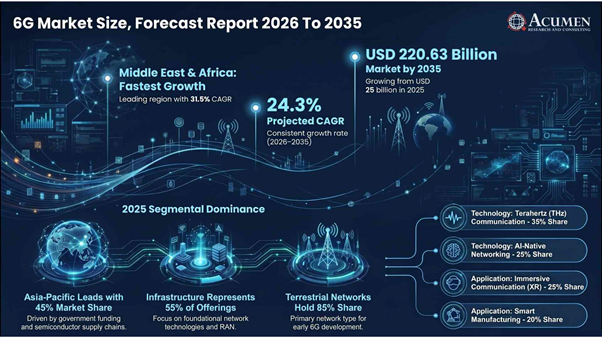
According to Acumen Research and Consulting, the Global 6G Market size was valued at USD 25 billion in 2025 and is projected to reach USD 220.63 billion by 2035, expanding at a CAGR of 24.3% from 2026 to 2035.
The rapid expansion of artificial intelligence, edge computing, satellite communications, digital twins, Industry 4.0, and smart city initiatives is expected to create substantial opportunities for market participants over the next decade.
Key Takeaways
- Global 6G market size reached USD 25 billion in 2025.
- Market is projected to reach USD 220.63 billion by 2035.
- Expected CAGR of 24.3% during 2026–2035.
- Asia-Pacific accounted for 45% of the global market in 2025.
- Middle East & Africa is expected to register the fastest CAGR of 31.5%.
- Infrastructure dominated the offering segment with 55% market share.
- Connectivity services are forecast to grow at a 34.2% CAGR.
- Terrestrial networks held 85% market share in 2025.
- Terahertz (THz) communication represented 35% of the communication technology market.
- Telecom operators accounted for 60% of total end-user demand.
What is Driving the Growth of the 6G Market?
The evolution from 5G toward sixth-generation wireless communication is being fueled by growing demand for intelligent, autonomous, and ultra-reliable connectivity.
Unlike previous generations of wireless technology, 6G is expected to integrate artificial intelligence directly into network architecture while supporting applications requiring massive bandwidth, microsecond-level latency, and highly reliable communications.
Key growth drivers include:
- Rising investments in AI-powered communication networks
- Expansion of Industry 4.0 and industrial automation
- Increasing adoption of immersive technologies such as XR and holography
- Growth in smart city infrastructure
- Demand for autonomous transportation systems
- Advancements in terahertz communication
- Integration of satellite and terrestrial communication networks
- Government-led 6G research initiatives
These factors are collectively accelerating research, infrastructure development, and ecosystem collaboration across the telecommunications industry.
Global 6G Market Trends
AI-Native Networking Becomes a Core Technology
Artificial intelligence is expected to become an integral component of future communication networks.
AI-native networking enables:
- Autonomous network optimization
- Predictive maintenance
- Intelligent traffic management
- Dynamic spectrum allocation
- Automated resource orchestration
These capabilities improve operational efficiency while supporting highly complex wireless environments.
Terahertz Communication Gains Momentum
Terahertz communication is emerging as one of the most promising technologies for future wireless systems.
The segment accounted for 35% of the global market in 2025, reflecting significant investments in high-frequency communication technologies capable of delivering unprecedented data transmission speeds.
Researchers continue to advance THz technologies to support future applications including:
- Holographic communication
- Digital twins
- Autonomous mobility
- Smart factories
- Extended Reality (XR)
Integration of Satellite and Hybrid Networks
The future 6G ecosystem is expected to extend beyond traditional terrestrial infrastructure.
Hybrid communication networks that integrate terrestrial systems with satellite and aerial platforms are gaining momentum to ensure seamless connectivity across urban, rural, maritime, and remote environments.
The hybrid network segment accounted for 10% market share in 2025.
6G Market Segmentation Analysis
By Offering
The market is segmented into:
- Infrastructure
- Connectivity Services
Infrastructure dominated the global market with a 55% share in 2025.
This leadership reflects extensive investments in:
- Radio Access Networks (RAN)
- Core networks
- Edge computing infrastructure
- AI-enabled network architecture
Meanwhile, Connectivity Services are projected to witness the fastest growth, registering a 34.2% CAGR through 2035.
The commercialization of 6G is expected to unlock new revenue opportunities from enterprise connectivity, private wireless networks, cloud-native communication services, and intelligent digital applications.
By Network Type
Based on network type, the market includes:
- Terrestrial Networks
- Hybrid Networks
- Non-Terrestrial Networks
Terrestrial networks remained the dominant segment with an 85% market share in 2025.
Their established infrastructure provides the foundation for future 6G deployment while supporting gradual upgrades from existing 5G ecosystems.
Hybrid networks ranked second with 10% market share, driven by increasing demand for uninterrupted connectivity integrating terrestrial infrastructure with satellite communications.
By Communication Technology
Communication technology segmentation includes:
- Terahertz Communication
- AI-Native Networking
- Massive MIMO Evolution
- Intelligent Reflecting Surfaces
- Quantum Communication Technologies
Terahertz communication led the market with 35% share.
AI-native networking followed closely with 25% market share, highlighting growing industry emphasis on intelligent network automation and self-optimizing wireless infrastructure.
By Application
Major applications include:
- Immersive Communication (XR & Holography)
- Smart Manufacturing
- Smart Healthcare
- Autonomous Mobility
- Smart Cities
- Digital Twins
Immersive communication accounted for 25% of the market in 2025.
Growing adoption of augmented reality, virtual reality, mixed reality, holographic conferencing, and immersive collaboration platforms is expected to accelerate demand throughout the forecast period.
Smart manufacturing represented 20% market share, supported by Industry 4.0 initiatives, connected factories, robotics, predictive maintenance, and industrial automation.
By End User
Major end users include:
- Telecom Operators
- Enterprises
- Government Organizations
- Defense
- Healthcare Providers
Telecom operators dominated with 60% market share.
Their leadership reflects continued investments in:
- Spectrum research
- Infrastructure modernization
- Network testing
- Commercial deployment planning
Enterprises represented 20% market share, driven by increasing demand for secure, ultra-low latency communication supporting manufacturing, logistics, healthcare, energy, and enterprise digital transformation.
6G Market Regional Analysis
Asia-Pacific Leads the Global 6G Market
Asia-Pacific accounted for the largest market share of 45% in 2025.
The region benefits from:
- Strong semiconductor manufacturing capabilities
- Presence of major telecom equipment providers
- Government-backed 6G initiatives
- Rapid digital transformation
- High investments in research and development
Countries across the region continue collaborating with academia and private organizations to strengthen technological leadership in next-generation wireless communications.
Middle East & Africa Emerges as the Fastest-Growing Region
The Middle East & Africa is expected to register the highest CAGR of 31.5% during the forecast period.
Growth is supported by:
- Smart city development
- AI investments
- National digital transformation programs
- Expansion of digital infrastructure
- Growing adoption of advanced communication technologies
Increasing investments in intelligent transportation, energy infrastructure, and public digital services are expected to accelerate future market growth.
Competitive Landscape
The global 6G market is characterized by continuous innovation, strategic collaborations, and increasing investments in next-generation communication technologies.
Market participants are focusing on:
- AI-enabled wireless networks
- Terahertz spectrum research
- Satellite communication integration
- Edge computing
- Advanced semiconductor development
- Open RAN technologies
- Network virtualization
- Cloud-native architectures
Partnerships between telecom operators, equipment manufacturers, technology companies, research organizations, and governments continue to shape the future commercial ecosystem.
6G Market Future Outlook
The future of the 6G market extends beyond faster wireless communication.
It represents the foundation for a fully intelligent digital society where AI, cloud computing, edge computing, digital twins, robotics, autonomous systems, and immersive technologies operate seamlessly through highly reliable wireless infrastructure.
As commercialization progresses over the coming decade, organizations investing early in infrastructure, AI-native networking, and advanced communication technologies are expected to gain significant competitive advantages.
As Acumen Research And Consulting Analysts projected the market to reach USD 220.63 billion by 2035, the next decade is expected to witness substantial technological innovation and ecosystem development across industries worldwide.
Frequently Asked Questions (FAQs)
What is the current size of the global 6G market?
The global 6G market was valued at USD 25 billion in 2025.
What is the projected value of the 6G market by 2035?
The market is forecast to reach USD 220.63 billion by 2035.
What is the expected CAGR of the 6G market?
The market is expected to grow at a 24.3% CAGR during 2026–2035.
Which region dominates the global 6G market?
Asia-Pacific held the largest market share at 45% in 2025.
Which region is expected to grow the fastest?
The Middle East & Africa is anticipated to register the highest CAGR of 31.5% over the forecast period.
Which offering segment leads the market?
Infrastructure accounted for 55% of the global market in 2025.
Which communication technology dominates the market?
Terahertz (THz) communication held the largest share at 35%.
Who are the major end users of 6G technology?
Telecom operators represent the leading end-user segment, accounting for 60% of the global market in 2025.