

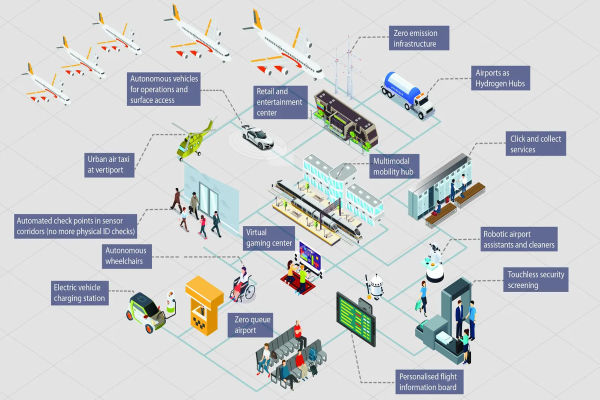
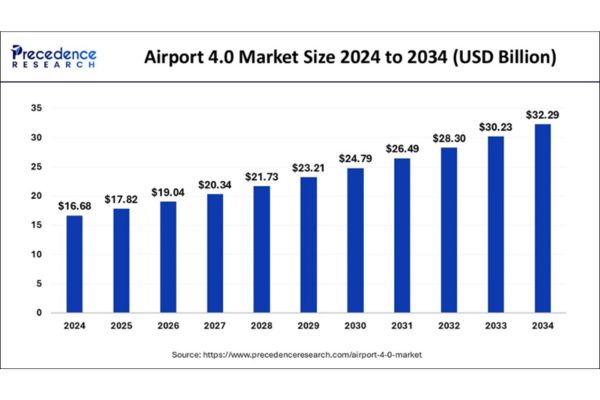
The global Airport 4.0 market is entering a transformative era, expanding from an estimated USD 16.68 billion in 2024 to a projected USD 32.29 billion by 2034, reflecting a robust compound annual growth rate (CAGR) of 6.83% over the 2025–2034 forecast period. Accelerated by advances in AI, IoT, and big data analytics, the Airport 4.0 revolution is reshaping airports into intelligent, passenger-centric hubs, where frictionless travel, heightened safety, and operational efficiency are emerging as the dominant growth drivers.
Airport 4.0 Market Quick Insights
- 2024 Market Size: USD 16.68 Billion
- Forecast (2034): USD 32.29 Billion
- CAGR (2025–2034): 6.83%
- Leading Region (2024): North America (45% market share)
- Fastest-Growing Region: Europe
- Notable Region: Asia Pacific holds a sizeable share
- Dominant Segment (by end market): Upgrade & Services
- High-Growth Segment: Implementation
- Top Application (2024): Airside operations
- Rapid Growth Application: Passenger Screening
- Largest Airport Size Segment: Large Airports
- Dominant Operation Type (2023): Non-Aeronautical
Why Ask: What’s Driving This Surge in Airport 4.0?
- AI-Powered Passenger Flow & Screening: Intelligence-driven automation ensures security, minimizes wait times, and improves throughput.
- IoT-Connected Infrastructure: Sensors monitor real-time conditions, from baggage handling to energy usage, enabling proactive responsiveness.
- Big Data Insights: Analytics platforms forecast maintenance needs, optimize staffing, and personalize travel experiences.
- Operational Efficiency & Safety: Integration across systems enhances resource utilization, cost-efficiency, and passenger trust.
- Sustainability & Non-Aeronautical Innovation: Smart systems support green operations while diversifying revenue through retail, concessions, and services—all vital for airport profitability.
What’s Powering Airport 4.0? Exploring Opportunities & Emerging Trends
Will Smart Solutions, AI, and Eco-Innovation Shape the Future of Aviation?
The airport 4.0 transformation is driven by a convergence of advanced technologies. Airports are evolving into data-rich ecosystems where IoT sensors, AI-powered predictive analytics, and biometric authentication converge to optimize every touchpoint. Major hubs in the US and Europe are pioneering these efforts, deploying real-time monitoring, automated check-ins, and facial recognition to streamline flows and boost passenger safety.
Opportunity Highlights:
- Sustainability: Growing emphasis on renewable energy, smart building management, and eco-friendly materials.
- Passenger Experience: Biometric journeys, personalized updates, and virtual reality lounges redefine service standards.
- Predictive Maintenance: AI-enabled systems continuously monitor facility health, reducing downtime and cost.
Europe’s airports are rapidly embracing these advances, with Germany, the UK, and Scandinavian nations integrating green solutions. Asia-Pacific, especially China and Singapore, showcase cutting-edge digitalization projects, while India and Japan invest heavily in automation and sustainability.
Thought Leadership: Expert Perspective
“The airport 4.0 revolution is not simply about technological upgrades—it’s about fundamentally reimagining how airports serve, secure, and inspire travelers. With real-time analytics, passenger-centric services, and eco-innovation, the sector is shaping a resilient, intelligent backbone for future aviation,” said Dr. Lena Chopra, Principal Consultant at Precedence Research. “In the coming decade, those who leverage smart solutions for both operational excellence and sustainability will set the benchmark for global airport competitiveness.”
Airport 4.0 Market Scope
| Report Coverage | Details |
| Market Size in 2025 | USD 17.82 Billion |
| Market Size by 2034 | USD 32.29 Billion |
| Market Growth Rate from 2025 to 2034 | CAGR of 6.83% |
| Largest Market | North America |
| Base Year | 2024 |
| Forecast Period | 2025 to 2034 |
| Segments Covered | By End Market, By Application, By Size, and By Operation |
| Regions Covered | North America, Europe, Asia-Pacific, Latin America, and Middle East & Africa |
Airport 4.0 Market Segmentation
- By End Market: Implementation involves installing new airport 4.0 technologies like IoT infrastructure and biometric systems, driving initial digital transformation. Upgrade & Services focuses on updating existing platforms and providing ongoing support to maintain operational efficiency.
- By Application: Airside leverages smart scheduling for smoother operations, Airtraffic Maintenance uses automation for better safety, Aircraft Maintenance applies IoT for quicker diagnostics, Passenger Screening benefits from AI and biometrics, while “Others” covers digital baggage and customer services.
- By Size: Large airports lead adoption due to greater resources and complex needs. Medium airports adopt scalable upgrades to boost performance, and small airports focus on basic digital tools for improved efficiency.
- By Operation: Aeronautical operations, including flight handling and security, get enhanced safety and efficiency from digital upgrades. Non-aeronautical areas like retail and parking use technology to increase revenue and passenger engagement.
U.S. Airport 4.0 Market Growth 2025 to 2034
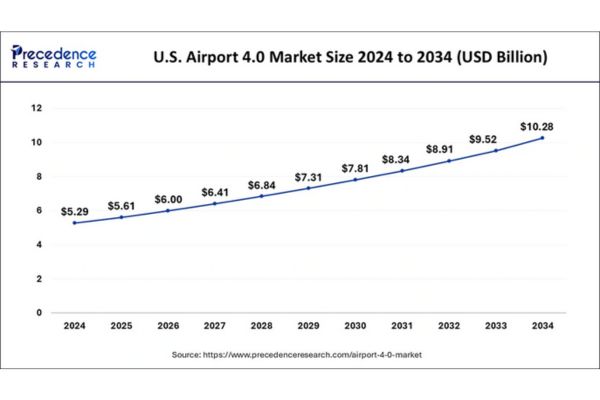
The U.S. airport 4.0 market size was USD 5.29 billion in 2024 and is predicted to be worth around USD 10.28 billion by 2034, rising at a CAGR of 6.87% from 2025 to 2034.
Regional Insights
North America: Leading With Innovation
North America, commanding 45% of the global market, is home to the most technologically advanced airports. The US tops the chart, driven by massive investments in IoT, AI, and biometrics. Canadian airports, notably Toronto Pearson, are deploying sustainability projects and smart passenger services, securing the region’s leadership.
United States
- Major Investment: O’Hare International Airport (Chicago)
- Broke ground on the $1.3 billion Concourse D, a satellite terminal connected to Terminal 1 as part of the broader O’Hare 21 modernization plan, with completion aimed by 2028 and the initiative extending through 2034. Funded primarily by United and American Airlines, this expansion aligns with demand surges, O’Hare welcomed a record 8 million passengers in June 2025.
- Sustainability Innovation: Denver International Airport (DEN)
- Exploring the use of Small Modular Reactors (SMRs) to power the airport, a first in the U.S. with a feasibility study (~$1.25 million) examining the economic, regulatory, and environmental viability, aiming to support its projected 120 million annual passengers by 2045.
Europe: Rapid Growth Fueled by Sustainability
Europe is the world’s fastest-growing market, propelled by eco-friendly initiatives and heavy investment in modernization. Leading airports in Germany and the UK implement AI, big data analytics, and predictive maintenance to improve efficiency and passenger satisfaction, while Southern and Eastern Europe increase digitalization to address rising air traffic.
United Kingdom
- Heathrow Modernization
- Heathrow Airport raised its modernization budget to £2.3 billion, targeting improvements in baggage systems, passenger experience, and sustainability via projects like the Independent Journeys Project and Active Travel initiatives, marking the largest private-sector investment in UK transport infrastructure.
- London Gatwick Expansion Proposal
- Plans to bring its Northern Runway into full-time use, potentially enabling up to 60,000 additional flights and drawing an additional 1.6 million international tourists annually by 2038. The proposal anticipates a £275 million annual boost to the regional economy, though a final decision is due in October 2025.
- East Midlands Freight Hub Growth
- East Midlands Airport saw nearly 20% growth in freight volume recently, surpassing Heathrow, with new cargo carriers and expanded trade routes to China, boosted by the adjacent freeport and logistics park developments
Asia-Pacific: The Next Frontier in Smart Airports
Asia-Pacific’s dense population and aviation boom make it a hotbed for airport 4.0 expansion. China’s mammoth hubs and Singapore’s award-winning Changi Airport exemplify the leap toward smart, seamless travel using automation and biometrics. India and Japan invest in tech upgrades to accommodate vast passenger volumes and promote greener travel practices.
China
- Dalian’s Artificial Island Airport
- A monumental £4 billion project is underway to build the world’s largest artificial island airport near Dalian, set to handle 80 million passengers and one million tonnes of cargo yearly by around 2035. It’s part of an expansive plan involving 22 new airports to boost China’s aviation infrastructure.
Airport 4.0 Market Key Players
- Cisco system
- Honeywell International, Inc.
- IBM Corp
- Raytheon Technologies
- Siemens AG
- SITA
- Smart airport system SAS
- Thales
- T-system international
- Huawei Technologies Co, Ltd.