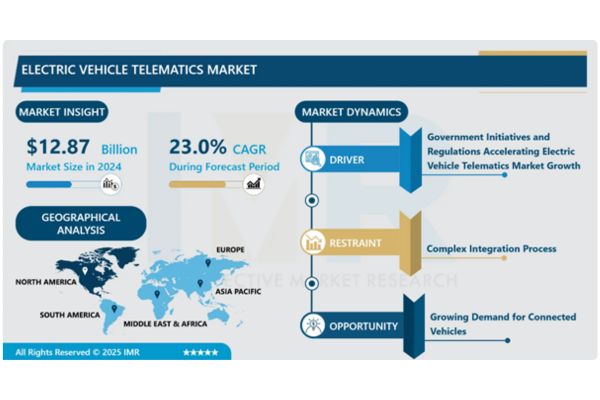
The global Electric Vehicle (EV) Telematics Market is poised for exponential growth, projected to expand from USD 12.87 billion in 2024 to USD 67.42 billion by 2032, registering a robust CAGR of 23.0% during the forecast period. According to Introspective Market Research (IMR), this growth is driven by the rapid adoption of electric vehicles, increasing demand for connected car solutions, and the growing importance of real-time data analytics in vehicle performance and fleet management.
Electric vehicle telematics systems integrating GPS, onboard diagnostics, connectivity modules, and cloud-based analytics are transforming how vehicles are monitored, managed, and optimized. These systems enable real-time insights into battery health, driving behavior, navigation, and predictive maintenance, making them essential for modern EV ecosystems.
Quick Insights
- Market Size (2024): USD 12.87 Billion
- Forecast Size (2032): USD 67.42 Billion
- CAGR (2025–2032): 23.0%
- Leading Segment: Embedded Telematics Systems
- Fastest-Growing Segment: Fleet & Diagnostics Applications
- Leading Region: Asia-Pacific
- Key Players: Bosch, Continental AG, Verizon Connect, Trimble Inc., Geotab, AT&T
- Core Driver: Rising adoption of connected and electric vehicles
- Key Opportunity: Integration with AI, cloud, and predictive analytics
- Primary Challenge: Data security and system integration complexity
Revenue Breakdown & Market Segmentation
| Segment Category | Key Insights |
| Base Year | 2024 – USD 12.87 Billion |
| Forecast Year | 2032 – USD 67.42 Billion |
| CAGR | 23.0% |
| By Type | Embedded, Retrofitted |
| By Vehicle Type | Two-Wheelers, Passenger Vehicles, Commercial Vehicles |
| By Application | Safety & Security, Navigation, Diagnostics, Infotainment, Others |
| By Region | North America, Europe, Asia-Pacific, MEA, South America |
The embedded telematics segment dominates the market, as OEMs increasingly integrate connectivity solutions directly into EV platforms for enhanced functionality and user experience.
What’s Driving Growth? What Trends Are Reshaping the Market?
Why is the EV telematics market becoming a core pillar of connected mobility?
- Rapid EV adoption: Growing global EV sales are directly increasing demand for telematics systems.
- Connected vehicle ecosystem: Integration of IoT, cloud computing, and 5G is enabling real-time vehicle communication.
- Fleet management demand: Logistics and ride-sharing companies rely on telematics for route optimization and performance tracking.
- Battery monitoring & optimization: Advanced telematics systems provide insights into battery health, charging patterns, and energy efficiency.
- Predictive maintenance: AI-driven analytics enable early fault detection and reduce downtime.
Regional & Segment Analysis
- Asia-Pacific leads the market, driven by strong EV adoption in China, Japan, and South Korea, along with government-backed digital mobility initiatives.
- North America is witnessing rapid growth due to increasing demand for connected vehicles and fleet telematics solutions.
- Europe is driven by stringent emission regulations and advancements in smart mobility infrastructure.
Segment Insights:
- Passenger vehicles dominate due to high EV adoption rates.
- Commercial vehicles are the fastest-growing segment, fueled by fleet digitization.
- Diagnostics and navigation applications are gaining traction due to their role in enhancing efficiency and safety.
Latest Industry Developments
- Bosch and Continental AG are developing AI-enabled telematics platforms for predictive maintenance and real-time analytics.
- Geotab and Verizon Connect are expanding fleet telematics solutions tailored for EVs, focusing on battery optimization and route efficiency.
- Trimble Inc. is integrating telematics with advanced logistics and fleet management platforms.
- Increasing adoption of 5G-enabled telematics systems is enabling faster data transmission and enhanced vehicle connectivity.
Challenges & Cost Pressures
- Data privacy & cybersecurity risks: Increased connectivity exposes vehicles to potential cyber threats.
- High integration costs: Advanced telematics systems require significant investment in hardware and software.
- Standardization issues: Lack of uniform communication protocols across regions and manufacturers.
- Complex system architecture: Integration with multiple vehicle systems increases design complexity.
Case Study: EV Fleet Optimization Through Telematics
A global logistics company implemented EV telematics solutions across its fleet, enabling real-time monitoring of vehicle performance, battery usage, and route efficiency. The result was a 15–20% improvement in operational efficiency and reduced downtime, demonstrating the critical role of telematics in fleet electrification strategies.