


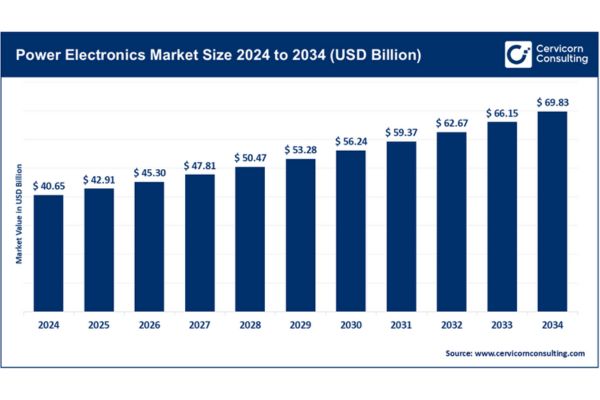
The global power electronics market was valued at USD 40.65 billion in 2024 and is projected to reach USD 69.83 billion by 2034, growing at a CAGR of 5.56% from 2025 to 2034. Market expansion is being fueled by several interconnected factors. A key driver is the rapid adoption of electric and hybrid vehicles, which require advanced power modules, inverters, and converters to maximize energy efficiency. Additionally, the rise of renewable energy sources—particularly solar and wind—demands sophisticated power conversion and control systems to ensure smooth grid integration and boost energy storage adoption. At the same time, global commitments to decarbonization and clean energy transition, along with corporate initiatives to improve energy efficiency, are accelerating the adoption of power electronics technologies.
Power Electronics Market Report Highlights
- By Region: Asia-Pacific holds the largest share at 40.8% in 2024 and is expected to grow at a 7–9% CAGR, driven by strong electronics manufacturing, rising EV demand in China, and supportive renewable energy policies.
- By Device: Power modules are expected to see the fastest growth, at 8–9% CAGR, supported by applications in EVs, smart manufacturing, and grid-connected renewables.
- By Materials: Wide-bandgap semiconductors (silicon carbide and gallium nitride) are expanding at a 15–18% CAGR, replacing traditional silicon due to higher efficiency and better thermal performance.
- By Applications: The automotive sector, particularly electric and hybrid vehicles, leads the market with a 12–14% CAGR, fueled by electrification targets and innovations in battery technology.
- By End-User: Consumer electronics continues to dominate in volume, while renewables and critical industries are growing rapidly at a 10–12% CAGR, supported by the deployment of smart grids and advanced energy storage solutions.
Power Electronics Market Segmental Analysis
Device Type Analysis
- Power ICs: Power integrated circuits are gaining traction as compact electronics and hyperscale data centers prioritize efficient power conversion. Growth in cloud computing and the IoT ecosystem is fueling demand, with the segment projected to grow at a 6–7% CAGR.
- Power Modules: This is the fastest-growing segment, expected to register an 8–9% CAGR through 2030. Adoption is being driven by EVs, renewable energy systems, and industrial automation. Notably, Tesla has integrated silicon carbide (SiC) modules into certain vehicle inverters, boosting driving range and system efficiency.
- Power Discrete Devices: Comprising diodes, transistors, and thyristors, this category remains vital for consumer and low-power applications. Their affordability and ease of integration into smartphones, laptops, and home appliances support steady growth of 5–6% CAGR.
Material Analysis
- Silicon-based Devices: Dominating with 87.20% revenue share in 2024, silicon remains the material of choice for consumer electronics, industrial, and mid-power applications. While it has performance limits in high-voltage and high-frequency domains, its mature supply chain and low cost ensure continued leadership, holding over 70% market share.
- Silicon Carbide (SiC): SiC devices are on the steepest growth trajectory, projected to expand at 15–18% CAGR (2025–2034). Their superior efficiency, thermal conductivity, and >1,200V handling make them ideal for EVs, renewable inverters, and heavy-duty industrial modules.
- Gallium Nitride (GaN): GaN is expected to grow at a 12–14% CAGR over the next decade. It excels in high-frequency, compact applications such as 5G base stations, data centers, and fast chargers. GaN enables 40% size reduction in portable charging devices, with major brands like Apple, Samsung, and Xiaomi integrating it into consumer products. Key players including Navitas and GaN Systems are advancing its adoption in high-performance markets.
Application Analysis
- Automotive: The fastest-growing application, expected at 12–14% CAGR (2025–2034). EVs and hybrids rely heavily on power modules, inverters, and battery management systems. Companies like Tesla and BYD leverage SiC MOSFETs in inverters, achieving 10–15% range improvements.
- Consumer Electronics: Currently the largest segment by volume, driven by demand for smartphones, laptops, and smart appliances. Adoption of GaN-based ICs and chargers enhances energy efficiency, extending battery life and enabling ultra-fast charging.
- Industrial: Growth of 7–8% CAGR is expected, fueled by automation, robotics, and advanced motor drives. Strong adoption is seen in Germany, Japan, and China, where mature manufacturing ecosystems support smart factory initiatives.
- Renewable Energy: Projected to grow at 10–12% CAGR, led by solar and wind power. Advanced inverters, especially SiC-based models, now achieve >98% efficiency, lowering the cost of utility-scale renewable deployment. Global solar capacity surpassing 1,200 GW further underpins demand.
- Aerospace & Defense: Though smaller in scale, this segment emphasizes rugged, mission-critical power devices for avionics, satellites, and defense systems.
- ICT & Data Centers: Rapid growth due to cloud expansion and 5G rollout. With data centers consuming ~3% of global electricity, operators like Google and Amazon are investing in GaN-based power architectures for higher density and improved sustainability.
Power Electronics Market Regional Analysis
Asia-Pacific: Market Leader
The Asia-Pacific power electronics market was valued at USD 16.59 billion in 2024 and is projected to reach USD 28.49 billion by 2034. The region leads the market due to its large-scale electronics manufacturing ecosystem, strong industrial base, and rapid adoption of clean energy and EVs. Japan and South Korea play a pivotal role, with companies such as Mitsubishi Electric, Toshiba, and Samsung investing heavily in SiC and GaN technologies. Meanwhile, India is emerging as a fast-growth hub, expected to grow at 8–10% annually through 2030, supported by its 500 GW renewable energy target and robust EV policies. Overall, scale advantages, cost efficiencies, and strong policy support cement Asia-Pacific’s dominance.
North America: Strong Expansion
The North America market stood at USD 11.87 billion in 2024 and is forecast to surpass USD 20.39 billion by 2034. Growth is fueled by EV infrastructure investments, renewable energy integration, and aerospace electrification. Canada’s goal of achieving 90% clean electricity by 2030 is pushing demand for advanced grid converters and storage systems. The U.S. federal target of 500,000 fast-charging stations by 2030 is expected to drive a 10–12% annual increase in power electronics for charging networks. Key players like Tesla, Wolfspeed, and ON Semiconductor are accelerating regional innovation, with Tesla deploying SiC inverters and Wolfspeed scaling domestic SiC wafer production.
Europe: Third-Largest Market
The Europe power electronics market was valued at USD 9.11 billion in 2024 and is projected to grow to USD 15.64 billion by 2034. The region’s growth is anchored in strict EU emission rules, renewable energy regulations, and EV adoption. Germany, the UK, and France dominate, with automakers such as Volkswagen, BMW, and Renault integrating SiC and GaN components into EV platforms. Europe also benefits from its advanced renewable sector—countries like Denmark and Spain already generate 40%+ of electricity from wind and solar. The EU’s 2050 climate-neutrality target is expected to channel significant investment into intelligent power management, storage systems, and grid-integration solutions.
LAMEA: Emerging Opportunities
The Latin America, Middle East, and Africa (LAMEA) market was valued at USD 3.09 billion in 2024 and is anticipated to reach USD 5.31 billion by 2034. Growth is supported by renewable and electrification initiatives such as Brazil’s wind and hydropower programs, Mexico’s expanding solar projects, and large-scale energy strategies across the Middle East and Africa. Notable examples include Saudi Arabia’s Vision 2030, the UAE’s 2050 clean energy plan, and South Africa’s REIPPPP. With wind and solar parks expanding rapidly and EV adoption slowly rising, the region is expected to grow at a 7–9% CAGR over the next decade, offering opportunities for companies that can provide specialized, efficient power electronics solutions.