

The global analog semiconductor market is set for remarkable growth, reaching $180.24 billion by 2034, driven by a steady CAGR of 5.94% and powered by Asia Pacific’s manufacturing dominance, digital transformation, and next-gen applications in AI, automotive, and IoT. North America’s R&D momentum and Europe’s green energy push are transforming market trends in 2025 and beyond.
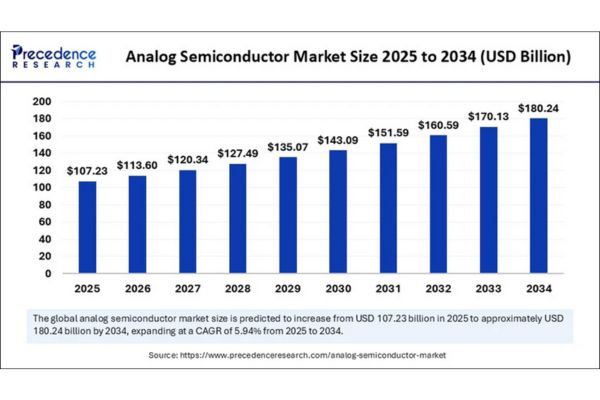
The analog semiconductor market, sized at $107.23 billion in 2025, is accelerating, fueled by surging demand for power-efficient devices, 5G deployment, edge computing, and the increasing integration of artificial intelligence.
Key drivers include IoT proliferation, automotive electrification, and healthcare innovation, reflecting a market that is not just expanding, but transforming how industries connect the physical and digital worlds.
Analog Semiconductor Market Key Insights
- The analog semiconductor market is projected to grow at a 5.94% CAGR from 2025 to 2034, reaching $180.24 billion.
- Asia Pacific led with 45% market share in 2024 and remains dominant through rapid IoT adoption.
- North America is forecast to grow fastest, powered by R&D strength and leading semiconductor firms.
- The top players driving innovation: Texas Instruments, Analog Devices, Infineon Technologies, NXP Semiconductors, STMicroelectronics.
- Power Management ICs led the product segments with a 35% share in 2024.
- Automotive was the largest application segment at 32% market share.
- OEMs accounted for 50% share, highlighting integration in end-product manufacturing.
Market Scope
| Report Coverage | Details |
| Market Size by 2034 | USD 180.24 Billion |
| Market Size in 2025 | USD 107.23 Billion |
| Market Size in 2024 | USD 101.22 Billion |
| Market Growth Rate from 2025 to 2034 | CAGR of 5.94% |
| Dominating Region | Asia Pacific |
What Role Is AI Playing in Analog Semiconductor Markets?
Artificial intelligence is dramatically reshaping the demand landscape for analog semiconductors. As AI and ML applications proliferate from image recognition to autonomous systems the need for chips that bridge the physical and digital worlds intensifies. Analog semiconductors enable real-time sensing, signal amplification, and power management in devices powering predictive analytics, smart vehicles, and intelligent healthcare solutions, making them the backbone of next-gen “smart” systems.
In new verticals automotive, healthcare, industrial automation AI-driven edge devices require analog chips for interfacing with real-world environments. The market’s appetite for more precise, efficient, and responsive analog components grows as AI expands into everyday devices, ensuring the analog sector remains a critical partner for digital innovation.
What Are the Key Growth Factors Fueled by Market Shifts?
Rising demand for power-efficient consumer devices and interconnected electronics.
Proliferation of IoT devices and edge computing, driving the need for advanced analog components.
Accelerating shift towards electric and connected automotive systems.
Rollout of 5G networks, increasing requirements for high-speed, reliable analog signal processing.
The focus on renewable energy generation and storage, positioning analog products at the center of the next wave of green technology.
What Opportunities and Trends Are Emerging for Investors?
How is electrification shaping new opportunities?
Global trends toward electrification especially in automotive and renewable energy are catalyzing demand for analog ICs in battery management and smart grid integration. Governments and industries alike are prioritizing green energy, presenting lucrative growth for power management ICs and voltage regulators.
What does the rise of IoT mean for analog chips?
Billions of connected devices from smart homes to industrial automation require analog semiconductors for energy efficiency, real-time sensing, and reliable signal conversion. Market opportunities abound for innovative chipmakers who can deliver highly integrated, low-power solutions at scale.
Regional Analysis: From Asia’s Factory Floors to North America’s Labs
Asia Pacific: Dominates with the largest market share, led by China’s manufacturing prowess, thriving innovation ecosystems, and robust consumer base. Key drivers: smartphone sales, 5G networks, wearable tech, and government support for semiconductor supply chains.
North America: Sees fastest growth, propelled by advanced R&D, substantial investment in domestic manufacturing, and leadership in automotive and telecom sectors. Leading companies fuel the region’s momentum.
Europe: Growth is tied to trends in renewable energy and automotive electrification. Germany’s leading role reflects strong industrial automation and robotics, as well as a favorable regulatory environment supporting sustainability and advanced technologies.
Segmentation Analysis
Product Type
Power Management ICs: Power Management ICs accounted for 35% of the market share in 2024, leading due to their vital role in stabilizing and distributing electrical power within electronic systems, especially in energy-efficient electronics, automotive EVs, and industrial automation. They manage electricity for devices requiring long battery life and robust power control, including smartphones, wearables, and medical devices.
Data Converters: Data converters facilitate communication between analog and digital systems. Their demand is driven by applications in 5G, medical imaging, automotive radar, and industrial automation, where precise, high-frequency, and low-power data conversion is needed for enhanced performance, particularly in AI and IoT devices.
CMOS ICs: MOSFET & CMOS ICs led the technology segment with 40% market share in 2024. CMOS analog ICs are valued for scalability, low power consumption, and integration with digital circuits, supporting signal conditioning, amplification, and processing in devices such as IoT modules and base stations.
GaN & SiC-based ICs: These ICs are seeing rapid growth, owing to their efficiency at higher voltages and temperatures. They are critical in power electronics for electric vehicles, renewable energy systems, and charging infrastructure, where their high-speed switching and low energy loss are decisive advantages.
Application
Automotive: The automotive sector dominated with a 32% share in 2024. Applications include EV battery management, ADAS, infotainment, and lighting systems. The push for electrification and advanced connectivity is making analog ICs essential to automotive innovation and safety.
Consumer Electronics: Growth here is driven by demand for efficient power management, audio processing, and sensor integration in smartphones, wearables, and smart home devices. Analog ICs ensure high performance, battery optimization, and enhanced audio quality, responding to the demand for longer battery life and richer user experiences.
Technology
MOSFET & CMOS: CMOS technology dominates for its compatibility with digital systems and low energy requirements, supporting miniaturized, multifunctional devices and efficient signal processing across sectors.
GaN/SiC-based Solutions: Gallium Nitride (GaN) and Silicon Carbide (SiC) technologies offer superior speed, durability, and power efficiency, making them critical in next-gen automotive, renewable energy, and industrial solutions.
End User
OEMs (Original Equipment Manufacturers): OEMs held a 50% market share in 2024. They integrate analog chips into finished products such as consumer electronics, cars, and medical devices, relying on analog ICs for reliability, safety, and advanced user experiences.
System Integrators: System integrators are increasingly important for assembling complex electronics in sectors like industrial automation, telecom, and smart infrastructure. They use analog chips for seamless system operation, predictive maintenance, and power optimization.
Analog Semiconductor Market Companies
- Texas Instruments
- Analog Devices
- Maxim Integrated
- Infineon Technologies
- NXP Semiconductors
- ON Semiconductor
- STMicroelectronics
- Renesas Electronics
- Microchip Technology
- Skyworks Solutions
- Broadcom
- Qualcomm
- Toshiba Electronics
- ROHM Semiconductor
- Sony Semiconductor
- Fujitsu Semiconductor
- Diodes Incorporated
- Cree (Wolfspeed)
- Semtech
- Vishay Intertechnology
What Challenges and Cost Pressures Shadow the Market?
A major inhibitor is the mounting complexity of system integration. As analog ICs become smaller and multifunctional, the design and quality control challenges intensify raising production costs and making reliability assurance a bottleneck.
The skills and resources needed for advanced simulation and testing are at a premium, sometimes slowing market scaling.
Case Study: GLOVA – Variation-Aware Analog Circuit Design Using Reinforcement Learning
What Was the Challenge?
Analog and mixed-signal circuits are at the heart of modern electronics—power regulators, data converters, RF front-ends, and sensors all depend on them. Unlike digital circuits, however, analog performance is highly sensitive to variations in manufacturing processes, supply voltages, and temperature (commonly called PVT variations).
- Designers typically have to run massive numbers of simulations to test different operating conditions.
- This process is slow, costly, and can still miss corner cases where performance degrades.
- The industry needed a smarter, faster way to design analog circuits that remain robust under real-world variations.
The GLOVA Approach
Researchers introduced GLOVA (Global Variation-Aware framework), a reinforcement learning (RL) based solution for analog circuit design.
Here’s how it works:
- Risk-Sensitive RL:
- Unlike traditional RL that just optimizes for average performance, GLOVA incorporates risk sensitivity.
- This means it doesn’t just chase “good” designs — it actively avoids designs that might fail under variation conditions.
- Ensemble-Based Critic:
- Reinforcement learning often suffers from noisy evaluations.
- By using an ensemble of critics (evaluation models), GLOVA stabilizes learning and makes more reliable design choices.
- Efficient Verification:
- Verification is the bottleneck in analog design.
- GLOVA uses smarter sampling methods so it doesn’t need to brute-force every possible variation scenario.
Together, these innovations cut down the time and compute resources needed to design robust analog circuits.
The Results
The results were impressive:
- ~80× improvement in sample efficiency
→ GLOVA learned good design strategies much faster than prior methods. - ~76× reduction in design cycle time
→ What once took weeks of simulations could now be achieved in hours or days. - Robust performance across PVT variations
→ Circuits designed with GLOVA maintained reliability under real-world conditions.
This makes it far more practical for commercial analog/mixed-signal IC design.
Why This Matters
- For Designers: Analog design is notoriously slow compared to digital. A tool like GLOVA can accelerate product development cycles significantly.
- For Manufacturers: By improving yield (fewer chips fail due to variation), companies save cost and reduce waste.
- For Industry: As devices pack more sensors, converters, and mixed-signal interfaces (think IoT, 5G, automotive electronics), the demand for robust analog design automation is exploding.
- For Innovation: Complex analog architectures that were previously “too risky” may now become feasible with this AI-driven approach.