
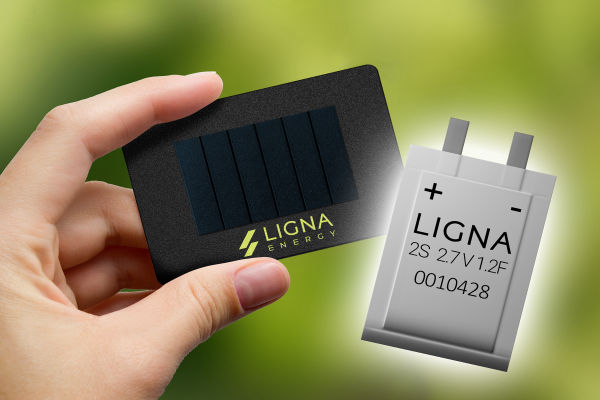
Ligna Energy, a leading developer of ultra-thin supercapacitors for wireless devices, will be participating in Embedded World 2026 in Nuremberg, Germany. The company will present energy solutions that enable engineers to create smaller, longer-lasting, and more sustainable connected devices, including indoor sensors that operate without primary batteries and sleek, space-saving designs.
Attendees can visit Ligna Energy at Hall 2, Booth 2-230, where the company and its ecosystem partners will explore complete IoT system solutions, covering sensing, wireless connectivity, power management, and energy harvesting.
Highlights will include applications ranging from smart cards to smart buildings, with a focus on scalable design, discreet sensors, battery-free indoor sensing, and sustainable technologies.
Ligna’s work with ultra-thin energy storage has sharpened a question: why can’t building sensors adopt the same design discipline as smart cards? Electronics are pushed to be thinner, more power-efficient and more cost-optimised than many traditional housings require. Ligna believes those constraints are increasingly relevant for smart buildings, where customers want sensors that are easier to place, less visually intrusive, and cost-efficient to deploy at high density.
“Battery replacement is one of the ‘taxes’ – it adds service visits, waste and cost” said John Söderström, Marketing Director at Ligna Energy. “At Embedded World, we’re showing practical building blocks that help teams move from promising prototypes to deployments that scale.”
Ligna Energy presents Gwen, a battery-free indoor climate sensor reference design. It is a product created to explore how smart card style design can be applied to indoor IoT sensors prioritizing thinness, power efficiency, material reduction and scalability.
Gwen harvests energy from ambient energy, stores it in Ligna Energy’s S-Power 2S supercapacitor, and measures temperature and humidity, transmitting data using Bluetooth Low Energy (BLE). The design removes the need for batteries, enabling maintenance-free operation and opening new possibilities for placement in modern buildings.
At the show, Ligna will share learnings from its demonstrator work, exploring how ultra-thin energy storage and minimal materials can support new form factors for indoor sensing and asset-tracking applications. The goal is not to present a “one-size-fits-all sensor,” but to provide a foundation that OEM and solution providers can adapt to their own industrial designs.
Ligna also highlights indoor sensing concepts aimed at long-term operation. As part of the ecosystem, Ligna points to indoor sensor approaches intended to reduce maintenance effort and avoid battery waste.
“Battery-free can be a better product experience,” Söderström added. “When you remove routine battery swaps, you unlock simpler operations and new possibilities for where sensors can live – including thin or discreet placements where bulky enclosures are a non-starter. This also simplifies end-of-life handling, by reducing the need to remove, sort, or treat batteries separately when devices are retired.”
Ligna Energy’s sustainability positioning is grounded in published lifecycle assessment and product transparency work. Ligna released Environmental Product Declaration (EPD) and Life Cycle Assessment (LCA) data for its S-Power supercapacitors, reporting a cradle-to-gate carbon footprint of 12g CO₂e per unit, alongside a third-party verified EPD to support standardised impact reporting for OEMs.