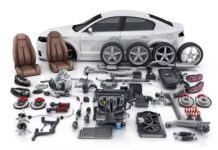

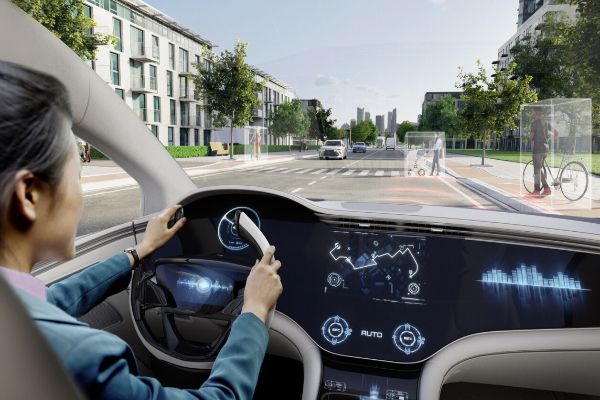
The modern vehicles are no longer defined by its engine system alone. Today, intelligence is shaping the future of mobility. From vehicles that can sense their surroundings to those that can assist, warn, and even act in critical situations, the transformation is being driven by Automotive System-on-Chips (SoCs) and embedded platforms.
Hidden beneath attractive dashboards and other interfaces, these technologies form the digital brain of the vehicle. They enable everything from safety systems like in ADAS and connectivity to infotainment, battery management in case of Electric vehicles EV’s , and autonomous decision-making. As the automotive world showing a shift toward electrification and automation, embedded computing is quietly becoming the most critical component on the road.
From Machines to Software-Defined Mobility
For decades and also now we see vehicles are relied on mechanical systems supported by basic electronics. Each function like engine control, braking, infotainment is as a whole handled by a separate Electronic Control Unit (ECU). While this distributed architecture worked well for simpler systems, it has become increasingly difficult in handling the requirements of modern vehicles.
Today, the automotive industry is shifting towards software-defined vehicles (SDVs), where functionality is driven by software rather than fixed hardware. Features can now be updated or upgraded or added even after the vehicle leaves the factory for example : Over-The-Air (OTA) updates. This transformation requires powerful and flexible computing platforms capable of managing multiple functions simultaneously.
Automotive SoCs are central to this shift. By integrating CPUs, GPUs, AI accelerators, memory interfaces, sensors, camera and communication modules into a single chip, SoCs enable high-performance computing within a compact and energy-efficient footprint. Instead of dozens of independent ECUs doing individual tasks, a few centralized processors can now control entire vehicle domains. In essence, vehicles are no longer just engineered they are programmed.
What Makes Automotive SoCs Unique?
Automotive SoCs are fundamentally different from chips used in consumer electronics like we see in the computer’s, laptop’s etc. While smartphones prioritize speed and user experience, automotive systems must balance performance with safety, reliability, and longevity. These chips operate in harsh environments characterized by extreme temperatures like wind-snow, vibrations, and electromagnetic interference. More importantly, they are responsible for safety-critical functions where failure is not an option like a driverless car has more responsibility.
Key characteristics of automotive SoCs include:
Automotive SoCs integrate heterogeneous computing (CPUs, GPUs, DSPs, and AI accelerators) with real-time processing to ensure deterministic performance for safety-critical functions. They are designed with built-in functional safety, energy efficiency for EVs and other vehicles, and long lifecycle support to meet demanding automotive requirements. Unlike consumer devices, where performance upgrades are frequent and need to buy a new one, automotive SoCs must remain reliable and supported throughout the vehicle’s lifespan.
Embedded Platforms: The Intelligence Layer
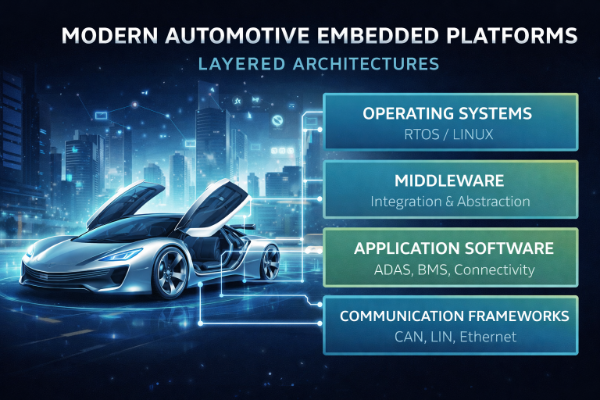
While SoCs provide the hardware foundation, embedded platforms bring intelligence to use. These platforms consist of operating systems, middleware, and application layers that enable seamless interaction between hardware and software. Modern automotive embedded platforms use a layered architecture with RTOS/Linux operating systems, middleware for integration, application software (ADAS, BMS, connectivity), and communication protocols like CAN, LIN, and Ethernet. Standardized frameworks like AUTOSAR (Classic and Adaptive) have become essential for enabling scalability, interoperability, and efficient development across multiple suppliers. These platforms ensure that complex vehicle functions can be developed, integrated, and updated efficiently a key requirement in the era of software-defined mobility.
AI at the Edge: A Game Changer
One of the most transformative developments in automotive SoCs is the integration of artificial intelligence (AI) for every aspect in the software.
Now vehicles are expected to interpret their surroundings like recognizing pedestrians, detecting obstacles, reading traffic signs, and monitoring driver behaviour to avoid accidents and safety of the pedestrians. These capabilities rely on machine learning models that require significant computational power.
To address this, automotive SoCs now include dedicated AI accelerators capable of processing neural networks in real time. This enables edge computing and fast computing, where data is processed within the vehicle itself rather than being sent to the cloud and then processed to provide results.
Edge computing enables faster decisions (low latency), reliable operation without network dependency, and enhanced data privacy by processing data within the vehicle.
These capabilities are particularly critical for Advanced Driver Assistance Systems (ADAS) and future autonomous driving technologies, where milliseconds can make a difference between safety and risk.
Challenges Beneath the Surface
Despite their advantages, automotive SoCs and embedded platforms introduce significant engineering challenges.
System complexity is one of the biggest concerns. As multiple functions and multiple systems are consolidated into centralized systems, ensuring proper isolation and resource management becomes critical. Safety-critical and non-critical functions must coexist without interference.
Thermal management is another challenge. These high-performance chips generate heat, which must be effectively dissipated within the confined environment of a vehicle.
Cybersecurity is increasingly important as vehicles become connected and software-driven. A vulnerability in the system can compromise not just data, but also safety. A hacker can enter into the system and can have control over the system. Hence it requires a strong focus on secure design, communication, and updates.
The Shift Toward Centralized and Zonal Architectures
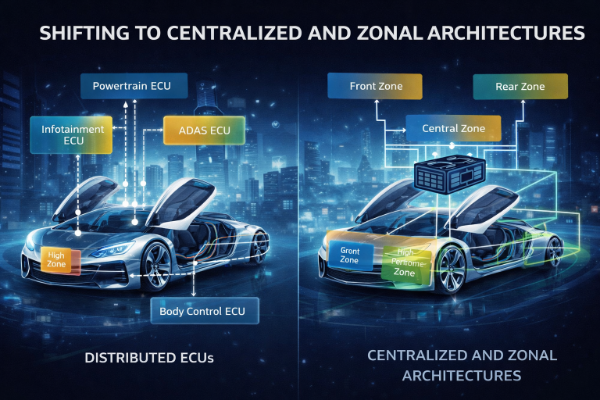
The automotive industry is moving away from distributed ECUs toward centralized and zonal architectures.
In a zonal architecture, the vehicle is divided into physical zones, each managed by local controllers, while centralized high-performance computing units handle processing. This approach reduces wiring complexity, improves scalability, and enhances system efficiency.
Such architectures also enable over-the-air (OTA) updates, allowing manufacturers to improve functionality, fix issues, and introduce new features throughout the vehicle’s lifecycle.
At the core of these architectures are powerful SoCs capable of handling diverse workloads while maintaining real-time performance and safety compliance.
Conclusion
Automotive SoCs and embedded platforms are redefining what it means to drive. They are enabling vehicles to perceive, decide, and respond transforming them into intelligent systems capable of enhancing safety, efficiency, and user experience. While these technologies may remain invisible to most drivers, their impact are visible. They are not just supporting components; they are the foundation of modern mobility.
In the years ahead, the true performance of a vehicle will not be measured solely by speed or power, but by its ability to process information, make decisions, and adapt to an ever-changing environment with the use of AI.
Because in the future of mobility, intelligence will be the ultimate driving force.