
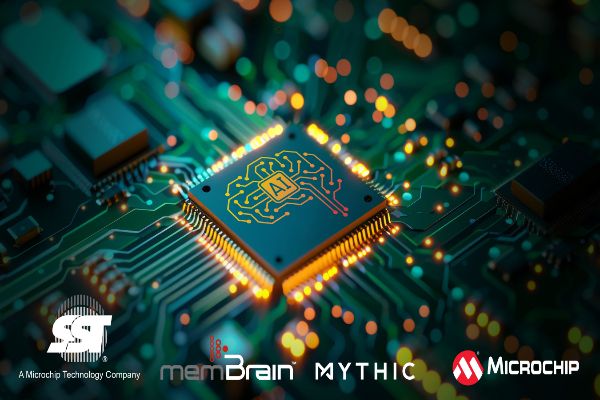
Mythic has selected memBrain neuromorphic hardware IP from Microchip Technology’s Silicon Storage Technology (SST) subsidiary for its upcoming edge-to-enterprise Analog Processing Units (APUs). By leveraging SST’s SuperFlash embedded non-volatile memory (eNVM) bitcells, Mythic aims to deliver exceptional analog compute-in-memory (aCIM) efficiency. This collaboration allows Mythic’s APUs to reach up to 120 TOPS per watt, providing highly power-efficient AI acceleration for both edge devices and data centers. The new APUs are expected to be as much as 100 times more energy-efficient than traditional digital GPUs.
One hundred fifty billion units of SST SuperFlash technology that Mythic is licensing have been shipped to date. SuperFlash technology is the de facto eNVM solution for a broad spectrum of industries including industrial, automotive, consumer and computing for critical data and code storage, and is licensed by all of the top ten semiconductor foundries worldwide.
“Mythic is pioneering innovative solutions in AI inference processing and AI sensor fusion for industrial, automotive and data center applications, effectively overcoming current AI power limitations,” said Mark Reiten, vice president of Microchip’s Edge AI business unit. “As the core memory technology for Mythic’s next-generation products, memBrain delivers significant power efficiency and high performance for both edge and data center applications.”
The memBrain cell features:
- Up to 8 data bits per bitcell (8 bpc) storage
- Single-digit nanoamp (nA) bitcell read current
- 10-year data retention at operating temperature
- 100,000 endurance cycles
- Full state machine control of the 8 bpc multi-state write operation
- Single cycle multiply-and-accumulate operations for aCIM
“Mythic selected SST after an industry-wide search of eNVM technologies and determined the memBrain cell technology best enabled us to achieve the ultra-low-power and high performance required by our customers,” said Dr. Taner Ozcelik, Mythic’s chief executive officer. “Additionally, the wide foundry availability of its industry-proven SuperFlash technology, coupled with the outstanding support of the SST engineering team has been invaluable during our product development cycle.”
SST’s memBrain technology has been developed and deployed in 40 nm and 28 nm foundry processes using production-ready SuperFlash memory. 22 nm memBrain development is planned to extend the technology roadmap. Designed to provide reliable, high-performance and low-power non-volatile storage directly on the chip, SuperFlash memory is widely used in applications that require fast access times, high endurance and data retention without the need for external memory components.