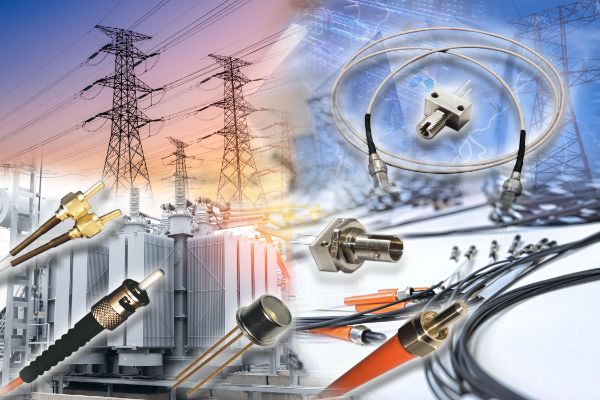
OMC, a leader in designing and manufacturing industrial fibre-optic data links and optical cable assemblies, has recently fulfilled a large optical link order for a major energy distribution company. With electrification accelerating, the company is seeing a sharp increase in demand for fibre-optic solutions, especially in high-voltage applications, and is scaling its operations to keep up. As part of this effort, OMC has introduced collaborative robots (cobots) to handle repetitive, labour-intensive tasks—boosting production capacity by up to ten times while maintaining high quality and consistency.
“We are pleased to be able to fulfil these requirements for large quantities of custom variants of our industrial fibre-optic datalinks and optoelectronic cable assemblies,” said William Heath, OMC Managing Director. “Mission-critical HV applications in power generation, transmission, distribution and supply infrastructure include reliable interference-resistant and electrically isolated sensing, monitoring, data transmission, communications and control. The dielectric construction and optical isolation of industrial fibre optic technologies mean they offer inherent advantages including enhanced safety, resistance to high voltage breakdown, high bandwidth capabilities with low signal loss, immunity to electromagnetic interference and resistance to environmental factors.”
While HV applications in power distribution networks can benefit from optical isolation because of the voltages present, achieving consistency of performance in fibre-optic datalinks often proves challenging for many providers. “Most manufacturers of optical fibre cables don’t touch the transmitter/receiver (Tx/Rx) part of the link – and similarly, few Tx/Rx providers are specialists in fibre-optic cable assemblies,” explains Heath. “And in our experience, customers don’t want to get involved in either: they simply want to convert an electrical signal at point A to an optical signal, transmit it, and then convert it back again at point B safely, reliably and consistently from link to link – from day one through to the full design lifetime of the system.”
OMC offers a fibre-optic link service specifically tailored to meet the demanding requirements of the high voltage sector. “In HV applications, where tolerances can be very tight, a lack of consistency between transmitter, receiver and cable characteristics means that customers are often forced to go through a lengthy and costly selection process to yield sufficient complete links to satisfy a production demand,” explains Heath. “But OMC specialises in the manufacture of both Tx/Rx devices, as well as the fibre-optic cable assemblies to link between them – so by tailoring our existing processes and technologies to suit each application, we can supply production quantities of fully-characterised fibre-optic links with 100% link consistency.”
OMC combines over 40 years of experience in producing glass and polymer fibre optic cable assemblies with its own proprietary Active Alignment technology to ensure that its fibre-optic datalinks perform consistently and reliably from link to link. During manufacture of its housed optical transmitters (Tx) and receivers (Rx), OMC powers on each active element and fine-tunes its performance to ensure that the electro-optical characteristics of every single device fall within a customer-specific performance window, exactly matching the required performance specification.
Of equal importance, when manufacturing the corresponding optical fibre cable assembly to be used between the Tx/Rx, OMC’s unique production techniques help ensure a very high level of consistency of link attenuation which is calibrated to this Tx/Rx performance window, meaning that each and every link can be expected to function for the full design life, regardless of how the transmitters, receivers and cables are paired during assembly/installation.
OMC offers a wide range of transmitters, receivers and connector styles, alongside both plastic and glass fibre systems. The company is also highly experienced in producing both polymer and glass fibre cable assemblies to suit customer requirements. The company’s complete datalink manufacturing service allows design engineers to avoid ‘mixing and matching’ off-the-shelf components, which can result in unreliable systems. And because it is technology-agnostic, OMC can advise on the best choice of technology to suit the application.