
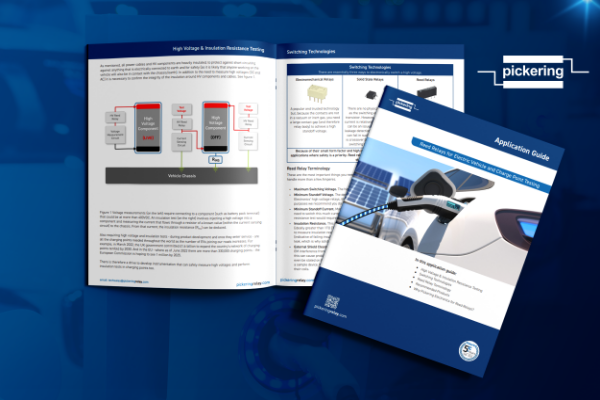
Pickering Electronics, a leading producer of high-performance reed relays, has released an application guide for engineers involved in high-voltage (HV) measurement and insulation testing in electric vehicles and charging infrastructure. Titled “Reed Relays for Electric Vehicle and Charge Point Testing,” the guide outlines why high-isolation reed relays are well-suited for use in test and instrumentation systems that measure high voltages and ensure the reliability of electrical insulation in EVs and charging points.
The electrification of drivetrains in electric vehicles (EVs) and hybrids (HEVs and PHEVs) is made possible by the presence of high voltage batteries, battery management systems (BMS), power inverters and powerful motors. All these high voltage components are ‘floating’, meaning that none of their power terminals are earthed to chassis. Accordingly, all HV components and high current-carrying cables must be heavily insulated. The design and manufacture of EVs – as well as the associated charging points needed to power them – therefore require specialist equipment and procedures to ensure safety. And as more EVs enter service, their maintenance, repair and recovery will also require similar equipment and procedures.
“Electric vehicles and charging points are demanding high voltage environments for instrumentation and test equipment,” said Robert King, Reed Relays Product Manager at Pickering Electronics. “Because of their compact size, high isolation and low leakage, reed relays are a strong fit for EV and chargepoint testing applications, where safety and measurement accuracy are both critical. Their mechanical contact path can switch AC or DC, while helping to minimise leakage that could otherwise affect insulation measurements.”
This guide explains that EV power cables and HV components are heavily insulated to protect against short circuiting against anything that is electrically connected to earth and for safety (since it is likely that anyone working on the vehicle will also be in contact with the chassis/earth). In addition to the need to measure high voltages (DC and AC), it is necessary to confirm the integrity of the insulation around HV components and cables. Also requiring high voltage and insulation tests – during product development and after they enter service – are the charging points needed as the number of EVs joining our roads increases.
“There is, therefore, a need to develop instrumentation that can safely measure high voltages and perform insulation tests in charging points too – and that instrumentation will require switching,” added King. “Reed relays can offer leakage currents below 1 nA and stand-off voltages of several kV in compact packages. The reed switch contacts are hermetically sealed, helping protect them from contamination and oxidation compared with open electromechanical contacts.”
Reed relays offer a compelling solution because they are:
- Hermetically sealed, keeping dust and moisture away from the contacts
- Capable of high switching and stand-off voltages
- Extremely low leakage, supporting accurate sensing and monitoring
- Galvanically isolated, helping protect instrumentation electronics
- Fast, compact, and able to deliver millions or even billions of operations
Download this free EV & chargepoint testing application guide to learn from Pickering’s expert insights and recommendations on selecting the best relay technologies for your specific high voltage measurement and insulation testing needs – and discover why reed relays provide the ideal switching technologies for EV and chargepoint applications.
Pickering is recognised for leading the high-end reed relay market through innovative product design, high-performance components and exceptional quality control. The company’s reputation for innovation is founded on decades of manufacturing excellence. All its relays use instrumentation-grade reed switches for stable, long-life operation—up to billions of cycles—along with formerless coil construction and the company’s patented SoftCenter technology, which improves mechanical robustness. Mu-metal screening enables high packing densities with minimal magnetic interference, and every relay is 100% tested to ensure consistent quality.