
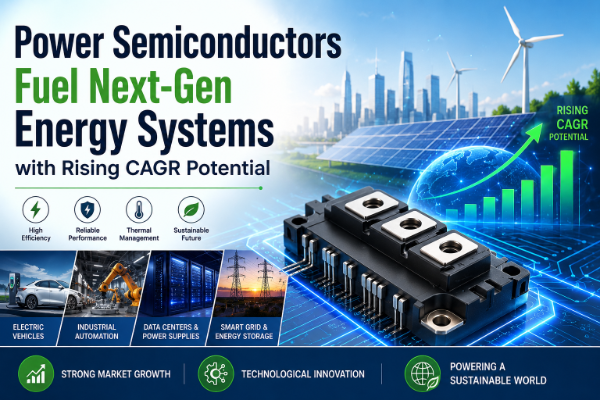
Power semiconductors technology has become one of the most significant technologies in the global energy sector in light of the process of transformation to electrification, incorporation of renewables, and intelligent energy management processes. They are special electric components that control the generation and consumption of electrical energy in different processes.
Dataintelo’s report revealed that the worldwide power semiconductor markets were estimated at $50.3 billion in 2025, and it will rise to $91.2 billion by 2034 at a CAGR of 6.8%. The continuous development of the industry may be attributed to the rising spending on renewable energy production, energy-efficient construction, and the penetration of electric vehicles.
Unlike standard semiconductor sections that are mainly responsible for computing, the power semiconductor market affects the efficiency of electrical energy consumption.
Increasing Needs Indicate Worldwide Energy Changeover
The global shift to electric systems is leading to stable need for cutting-edge power semiconductor technologies. According to forecasts, global energy usage will grow by over 25% by the year 2035, which is likely to be a result of the use of electricity in the field of transport, digital development, and modernization of industry.
Power semiconductors enhance the efficiency of systems by decreasing switching losses, allowing for higher frequencies, and reducing heat dissipation. Small changes in efficiency from 2% up to 5% can lead to huge economical savings.
Some trends will promote further market growth:
- Electric vehicle production is increasing by double-digit annual rates in several major economies.
- Renewable energy installations continue setting new annual capacity records.
- Data centers are adopting more efficient power conversion architectures.
- Smart manufacturing facilities are replacing conventional motor control systems with digitally managed power electronics.
These developments are creating consistent demand across both mature and emerging markets.
Technology Evolution Is Improving Performance
Power semiconductor technology has advanced significantly beyond conventional silicon-based components. While silicon devices remain widely used, newer materials such as silicon carbide (SiC) and gallium nitride (GaN) are expanding performance capabilities in high-voltage and high-frequency applications.
| Technology | Typical Operating Voltage | Efficiency Benefits | Common Applications |
| Silicon (Si) | Up to 650 V | Proven reliability and cost efficiency | Consumer electronics, industrial equipment |
| Silicon Carbide (SiC) | 650–3300 V | Lower switching losses and higher temperature tolerance | Electric vehicles, renewable energy inverters |
| Gallium Nitride (GaN) | Up to 900 V | High switching speed and compact designs | Fast chargers, telecom equipment, data centers |
SiC technologies enable power losses of reduction by 50-70% in certain operation conditions in comparison to standard silicon devices, while GaN technology allows for the development of more compact power converters providing higher frequencies with sufficient efficiency.
This results in the production of lighter, smaller, and more energy-efficient electric devices by manufacturers.
The Growing Sector of Renewable Energy Creates Opportunities for Business
Modern power electronics are key technologies in solar energy, wind energy, and energy storage systems. Wherever renewable energy development is taking place, efficient conversion between direct and alternating current is needed, meaning that power semiconductors are a must in the energy conversion process.
According to recent data, the amount of electricity generated from renewable energy sources has increased globally by more than 500 gigawatts per year, with solar energy being the largest contributing factor. Each utility-scale solar inverter comprises more than hundreds of power semiconductor devices supporting voltage regulation features, increasing the generation of energy, and ensuring the stability of the electricity grid.
Battery energy storage systems require complex power management which can handle charging cycles, voltage balancing, and bidirectional flow of energy. As the process continues of making stationary storage facilities larger, the demand for high voltage semiconductor solution increases proportionately.
Additional prospects result from developments in electricity-bringing similar solutions in modern electricity grid renovation.
Electric Mobility Boosts Market Growth
Electric vehicles are the fastest growing segment in the power semiconductor business. Modern battery-electric vehicles include a huge number of semiconductor devices used in traction inverters, on-board chargers, battery management devices, and auxiliary electronics systems.
Of note is that traction inverters in modern electric vehicles take almost 30% of the total semiconductor value of the vehicle, so improving the efficiency of devices is of particular importance. Higher efficient semiconductor devices increase the range since they allow reducing energy losses during acceleration and regenerative braking.
Similarly, the need for commercial transport rises. The electric buses, delivery fleets, railways and heavy-duty trucks require highly-powerful modules that operate under great pressure.
Charging infrastructure is the next expanding market. Fast charging stations that work at over 150 kilowatts rely on SiC based devices which allow improving performance, decreasing the volume and the cooling requirements of the equipment.
Outlook Remains Strong Across Multiple Industries
Power semiconductor technology continues to play a crucial role in the development of modern energy systems. These semiconductors are responsible for the efficient transmission and control of electricity in various applications, including renewable energy production and storage, electric transportation, and automation.
Over the next ten years, the continuous advancements of materials, power management systems, and power conversion technologies will enhance the role of semiconductor devices. As the world focuses on the electrification and achieving energy efficiency, power semiconductor technology is well poised to help create the next generation of energy systems that are reliable, sustainable, and connected.