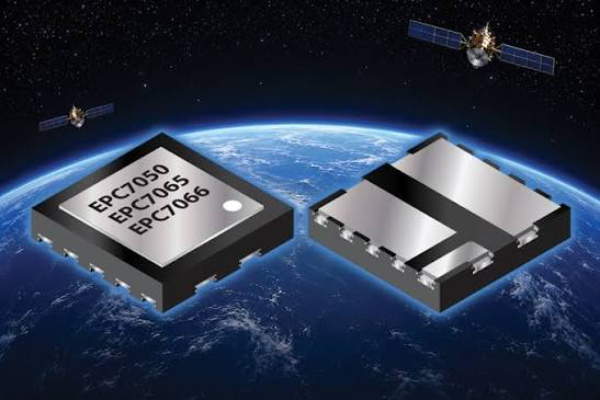
EPC Space has announced three radiation-hardened eGaN power transistors developed for power conversion applications in next-generation space computing platforms. The new EPC7050PCSH, EPC7066PCSH and EPC7065PCSH devices offer low on-resistance, high current handling and rapid switching in compact PQFN packages featuring integrated backside thermal pads.
Designed for space-constrained systems, the transistors help improve power density and conversion efficiency. Their low conduction losses and fast switching characteristics enable high-frequency operation. In addition, their zero reverse-recovery charge helps minimize switching losses typically associated with conventional diode-based designs.
The devices are available with 15V, 25V and 40V voltage ratings. The EPC7050PCSH supports 15V operation, 101A continuous current and a typical RDS(on) of 0.28 mΩ. The EPC7066PCSH is rated at 25V and delivers 101A continuous current with a typical RDS(on) of 0.37 mΩ. The EPC7065PCSH offers a 40V rating, 101A continuous current capability and a typical RDS(on) of 0.5 mΩ.
The three eGaN transistors are optimized for synchronous rectification on the secondary side of intermediate bus converters with output voltages from 5V to 12V. Their low RDS(on) × QG figure of merit enables higher switching frequencies while helping keep conduction and gate-drive losses low. They are also suitable for point-of-load buck converters and integrated voltage regulators (IVRs) used to deliver approximately 0.8V to processor core power rails.
Radiation tolerance is a key characteristic for space applications. EPC Space specifies total ionizing dose (TID) performance above 1Mrad, single-event effects (SEE) linear energy transfer (LET) tolerance of 85MeV cm²/mg, and neutron tolerance above 4×10¹⁵n/cm². These characteristics are intended to maintain transistor performance in radiation environments encountered by space-based electronics.
The new eGaN FETs address power-delivery requirements associated with the growing use of high-performance processors and accelerators in spacecraft. AI and high-performance computing increase both the electrical power requirements and power-density constraints of space platforms, making efficient conversion and thermal management increasingly important.
By combining radiation robustness, low conduction losses, high current capability, and fast switching, the new devices are intended to enable smaller, more efficient power-conversion stages for space computing architectures.