

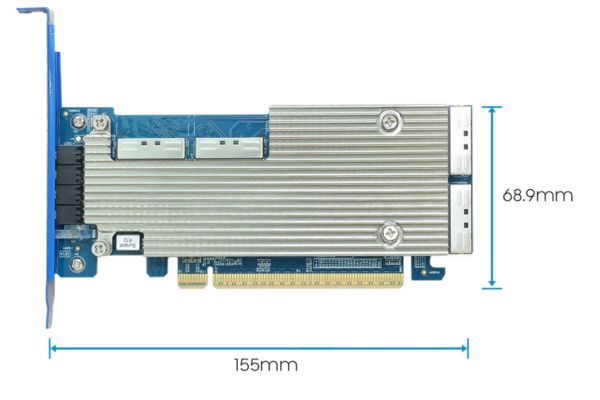
HighPoint Technologies, a leading provider of high-performance PCIe storage and connectivity solutions, has announced the launch of its complete, industry-versatile PCIe Gen 5 MCIO (Mini Cool Edge IO) Expansion Solution Ecosystem.
Designed specifically to solve physical PCIe slot starvation and address thermal constraints in compact 1U/2U server chassis, edge AI appliances, and high-performance computing (HPC) nodes, HighPoint’s modular MCIO Solutions allow system architects and AI infrastructure administrators to flexibly route full-bandwidth PCIe 5.0 lanes throughout the chassis without relying on rigid, space-limiting riser cards.
Addresses the Limitations of Rigid Hardware Environments
As AI inference models, multi-GPU clustering, and distributed compute workloads accelerate, enterprise, industrial and edge servers face severe mechanical and electrical constraints. Standard 1U and 2U chassis often lack the physical motherboard slots required to house multiple accelerator cards, smartNICs, or DPUs. Traditional rigid PCIe risers introduce airflow restrictions and severe mechanical interference, while host platforms often lack flexible BIOS bifurcation to manage auxiliary add-in cards.
HighPoint’s MCIO Gen 5 expansion architecture eliminates these bottlenecks by offering a modular, custom-tailorable three-tiered approach to varied system topologies, motherboard capabilities, and workload profiles.
A Versatile Three-Tier PCIe Gen 5 Expansion Architecture
HighPoint’s MCIO ecosystem delivers end-to-end PCIe 5.0 x16 (64 GB/s aggregate bandwidth) expansion via low-profile, flexible SFF-TA-1016 (MCIO) cabling, categorized into three distinct deployment tiers:
Tier 1: Direct Motherboard Onboard Slot Expansion:
Solution: Motherboard Native MCIO 8i Ports + MCIO-PCIEX16-G5 Passive Bridge Card
Use Case: This solution converts native MCIO 8i ports found on modern AMD EPYC and Intel Xeon motherboards directly into full-length, physical PCIe 5.0 x16 peripheral slots.
Key Advantage: Zero host PCIe slot footprint. AI administrators can add full-height, full-length accelerators, 400GbE NICs, or capture cards to auxiliary chassis bays without consuming a single physical PCIe slot on the motherboard.
Tier 2: Retimer-Based Signal Extension:
Solution: Rocket 1624L (2x Internal MCIO) / Rocket 1624M (2x External MCIO) + MCIO-PCIEX16-G5 Bridge Card
Use Case: For systems supporting standard PCIe bifurcation (x8/x8 or x4/x4/x4/x4), the Rocket 1624L/M acts as an ultra-low-latency physical signal extender and conditioner.
Key Advantage: Cost-effective PCIe 5.0 (32 GT/s) signal extension over long internal or external cable runs, allowing high-power accelerator cards to be relocated to optimal thermal zones within or outside the primary chassis.
Tier 3: Independent Switch-Based Multi-Slot Fabric:
Solution: Rocket 1628A (4x MCIO 8i) / Rocket 1624A (2x MCIO 8i) + MCIO-PCIEX16-G5 Bridge Card
Use Case: Powered by Broadcom PCIe Gen 5 intelligent switch architecture, this tier creates an independent internal PCIe switching fabric running off native OS bus drivers.
Key Advantage: 100% Bifurcation-Free. Operates seamlessly in any PCIe x16 slot regardless of motherboard BIOS limitations. Supports Direct Peer-to-Peer (P2P) communication across the switch fabric, offloading data movement between GPUs, accelerators, and network interfaces directly across the switch without CPU intervention or memory bus bottlenecks.
Breaking the Riser Bottleneck for AI System Builders
“Modern AI and edge compute nodes are physically outgrowing standard motherboard form factors,” said May Hwang, Marketing Director at HighPoint Technologies. “Engineers are constantly forced to compromise between thermal airflow and accelerator density. By delivering a comprehensive MCIO Gen 5 expansion ecosystem—from native onboard bridge adapters to intelligent switch-based multi-card fabrics—HighPoint gives AI administrators the mechanical and architectural freedom to place full-speed Gen 5 accelerators, GPUs, and network cards anywhere inside the chassis, completely bypassing the limitations of rigid riser cards.”
Key Technical Specifications & Features:
PCIe Bus Compliance: Fully compliant with PCI Express Base Specification 5.0, delivering up to 64 GB/s total bidirectional throughput per x16 link.
Connector Standard: SFF-TA-1016 (MCIO 8i) industry standard high-density cabling ensuring signal integrity at 32 GT/s.
Modular Form Factor: Low-profile add-in card designs optimized for high-density 1U/2U server environments and modular edge appliances.
Direct P2P Acceleration: Dedicated switch-based PCIe fabric (Rocket 1628A/1624A) maximizes throughput and minimizes latency between attached compute nodes and high-speed peripherals.
Broad OS & Hardware Compatibility: Universal plug-and-play support across Linux (RHEL, Ubuntu, Rocky Linux, Debian), Windows Server, and FreeBSD without requiring proprietary driver overhead.
Availability
HighPoint’s PCIe Gen 5 MCIO Expansion portfolio—including the MCIO-PCIEX16-G5 Bridge Card, retimer-based Rocket 1624L/1624M, and switch-based Rocket 1628A/1624A adapters—is available immediately through HighPoint’s worldwide network of authorized distributors, system integrators, and the HighPoint Online Store.









 Expansion Solution Ecosystem.)