
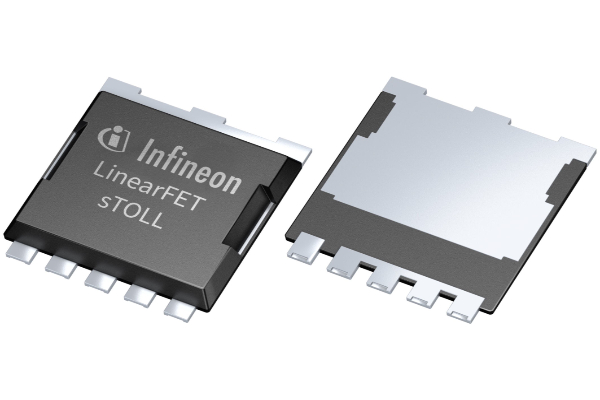
Infineon Technologies AG has introduced LinearFET, an advanced MOSFET technology designed to simplify the development of next-generation solid-state power distribution systems for electric and software-defined vehicles. The technology incorporates current sharing, inrush current management, and enhanced short-circuit robustness at the device level, helping automakers overcome key design challenges and accelerate the adoption of solid-state power distribution in modern vehicles.
As vehicles become increasingly electrified and software-defined, traditional power distribution architectures are reaching their limits. Engineers designing modern power distribution systems face three persistent challenges: safely paralleling MOSFETs to scale current capability, controlling high inrush currents during capacitor charging, and ensuring robust operation during short-circuit events. Addressing these typically requires additional circuitry, complex control strategies, or over-dimensioned components, increasing system complexity, board space, cost, and development effort.
LinearFET addresses all three directly at the MOSFET level: it enables predictable current sharing when paralleling MOSFETs for scalable high-current designs, provides controlled charging of large capacitive loads without external limiters, and delivers enhanced short-circuit robustness to help meet demanding automotive safety requirements. By incorporating these capabilities into the power device, LinearFET simplifies system design while improving robustness and safety.
The technology is suited for applications including power distribution units, battery disconnect switches, solid-state fuse systems, and zonal power architectures. It enables automotive designers to implement more compact and cost-efficient systems with significantly lower implementation complexity while maintaining high reliability and safety standards, supporting the industry’s transition from conventional fuse-box architectures toward software-controlled networks required in future electric and software-defined vehicles.