
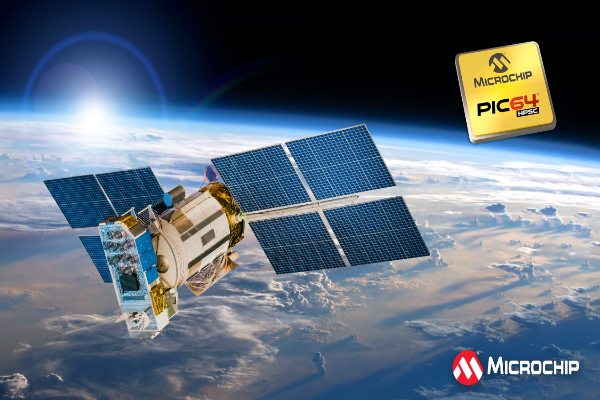
As civil, commercial, scientific and defense space missions increasingly rely on autonomy, software-driven operations and data-intensive workloads, developers need more powerful onboard computing solutions that can deliver high levels of reliability, security and resilience in harsh space environments. Microchip Technology has announced several major milestones for its PIC64-HPSC High-Performance Spaceflight Computing Series, a 64-bit multicore RISC-V platform developed to support spacecraft, satellites and other mission-critical space applications.
Early radiation characterization of the PIC64-HPSC1000-RH radiation-hardened variant has demonstrated Total Ionizing Dose (TID) performance to 200 krad(Si) and successful Single Event Latch-up (SEL) testing to 78.2 MeV·cm²/mg under specified operating conditions. Early testing also demonstrated robust system-controller operation during Single Event Effects (SEE) characterization, with no uncorrected errors or external resets required during the testing completed to date. These results provide developers with tangible evidence of the platform’s progress toward meeting radiation-tolerance requirements, helping enable future spaceflight systems from Low Earth Orbit to the Moon, Mars and beyond.
“Our vision for PIC64-HPSC was to develop a modern, high-performance computing platform capable of enabling the next generation of civil, commercial, scientific and defense space systems,” said Kevin So, vice president of Microchip’s communications business unit. “The combination of operational silicon, radiation-characterization results and customer evaluation activity demonstrates continued execution against that vision and marks an important step in the maturation of the platform.”
Through the PIC64-HPSC Early Access Program, participating customers have been evaluating silicon and development kits, and beginning application development with supporting software, tools, technical resources and direct engineering assistance from Microchip. A growing ecosystem of board partners is also developing PIC64-HPSC-based VPX and VNX+ computing platforms, providing additional paths for system developers to integrate the processor into future space systems. The Early Access Program can help space-system developers reduce program risk and advance application development.
Initial silicon performance measurements are in line with program objectives, providing a foundation for increasingly compute-intensive workloads such as onboard autonomy, high-performance payload processing, Earth observation and intelligence, secure communications, spacecraft control, scientific exploration and edge AI. By processing more sensor and mission data onboard, future spacecraft can reduce dependence on communications bandwidth, shorten decision-making latency and respond more rapidly to changing mission conditions. The importance of advanced onboard processing is also reflected in NASA’s FY26 Civil Space Shortfall Prioritization, which ranked advanced onboard computing for space operations as the third-highest civil space technology shortfall.
PIC64-HPSC is designed as a scalable computing foundation for a broad range of next-generation space systems. Its 64-bit multicore RISC-V architecture supports the industry’s move toward more open and scalable models for onboard autonomy, software-defined spacecraft, distributed processing, deterministic communications and heterogeneous computing.
PIC64-HPSC originated from NASA and JPL’s assessment of future spaceflight computing requirements and awarded the HPSC contract to Microchip in 2022. Today, operational silicon, customer evaluations and early radiation-characterization achievements reflect the program’s progress to date.
The HPSC program helped establish the foundation for Microchip’s 64-bit computing portfolio, which the company has since expanded its portfolio of PIC64 MPUs addressing performance requirements across a broad range of markets.
Pricing and Availability
PIC64-HPSC evaluation and development kits are available to select customers, providing access to silicon, development platforms, software, tools and Microchip engineering support.