

Battery life is one of the biggest design challenges in connected electronics. Wearable health monitors, medical sensors, Bluetooth devices and IoT gateways must collect data, communicate with other systems and process information without draining their batteries too quickly.
Traditional battery management relies on voltage measurements, current sensors and predefined power models. These methods are useful, but they may not fully explain how a device behaves under changing workloads, wireless conditions and operating temperatures.
Big data analytics can improve this process by analyzing large volumes of battery, sensor, processor and connectivity data to predict power consumption before the battery runs low. This allows engineers to make better decisions about power management, device performance and battery replacement.
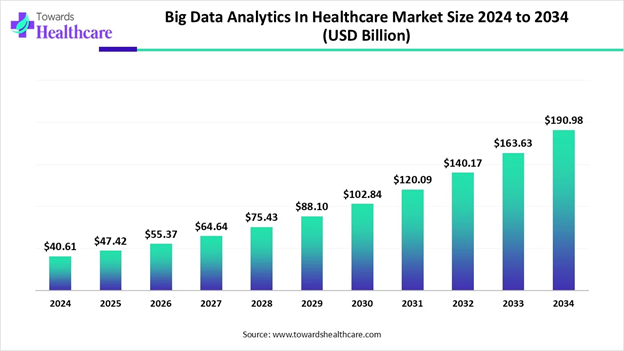
According to Towards Healthcare, the global big data analytics in healthcare market size is calculated at USD 47.42 billion in 2025, grew to USD 55.37 billion in 2026 and is projected to reach around USD 190.98 billion by 2034. The market is expanding at a CAGR of 16.73% between 2025 and 2034.
How Connected Electronics Consume Battery Power
Battery consumption depends on more than the device’s overall operating time. Different electronic components draw different amounts of power depending on their activity.
A connected medical sensor, for example, may spend most of its time collecting physiological measurements, processing signals and transmitting data to a smartphone or cloud platform. Each activity affects battery life differently.
The main sources of power consumption include:
- Sensors and analog front ends: Continuously measuring temperature, movement, heart rate or other physical signals requires energy.
- Microcontrollers and processors: Signal processing, data compression, encryption and local analytics increase processor activity.
- Wireless communication modules: Bluetooth Low Energy, Wi-Fi and cellular modems consume power during transmission, reception and network connection.
- Memory and storage: Writing measurements to flash memory and retrieving stored data contribute to the device’s energy requirements.
- Power management integrated circuits (PMICs): Voltage regulators, charging circuits and power-control functions introduce additional losses.
Wireless communication can be particularly demanding when a device repeatedly reconnects to a network, transmits large data packets or operates under weak signal conditions.
Understanding these individual loads is essential before building an accurate power-consumption model.
How Big Data Analytics Predicts Battery Consumption
Big data analytics combines measurements collected during device operation with historical usage patterns and environmental information. Instead of estimating battery life from a single reading, engineers can examine how power consumption changes across thousands of operating conditions.
A typical analytical system follows five stages.
1. Collecting Battery and Device Telemetry
The first step is gathering detailed operational data from connected electronics. Depending on the hardware, measurements may include battery voltage, current draw, temperature, state of charge, charging cycles and estimated state of health.
Engineers can also collect information about processor utilization, memory activity, sensor sampling rates, radio transmission time and network signal quality.
For example, a wearable device may record a sudden increase in current consumption whenever its Bluetooth module repeatedly attempts to reconnect to a smartphone. When this event appears across multiple devices, it becomes a useful signal for further analysis.
The quality of this data depends on the measurement hardware. Current-sensing circuits, shunt resistors, battery-monitoring ICs, analog-to-digital converters and embedded firmware help capture the information needed for analysis.
2. Transferring Data to an Analytics Platform
Once collected, device telemetry can be stored locally, transmitted to an edge gateway or uploaded to a cloud platform.
The architecture depends on the device’s connectivity, memory capacity, available bandwidth and power budget. A battery-powered sensor may not be able to transmit every measurement continuously without reducing its operating life.
For this reason, devices often aggregate readings, transmit periodic summaries or upload detailed logs only when required.
At larger scales, cloud data pipelines can combine telemetry from thousands of devices. Stream-processing systems can analyze incoming measurements, while data lakes or time-series databases retain historical records for longer-term analysis.
The data pipeline must also account for missing readings, inconsistent timestamps, duplicate events and differences between hardware models. Poor-quality telemetry can produce unreliable predictions even when the analytical model is sophisticated.
3. Identifying Patterns in Power Consumption
After collecting the data, analytical tools identify relationships between device activity and energy use.
For example, a connected sensor may consume more energy when:
- Its radio transmits frequently.
- Its processor performs intensive calculations.
- Its operating temperature changes.
- Its sampling frequency increases.
- Its battery ages and its usable capacity declines.
Engineers can compare these patterns across different firmware versions, battery types, operating environments and communication protocols.
The goal is to determine which activities have the greatest effect on battery life. A device that appears to have a battery problem may actually have an inefficient communication schedule, an unnecessary background task or a component that remains active longer than required.
4. Building Predictive Models
Machine learning and statistical models can use historical telemetry to estimate future power consumption.
Regression models can estimate average current draw under known operating conditions. Time-series models can forecast energy requirements over a future period. More advanced models can combine temperature, battery age, radio activity and processor workload to estimate remaining operating time.
A model may use features such as:
- Average and peak current consumption.
- Battery voltage and temperature.
- Radio connection time and transmission frequency.
- Processor activity and sensor sampling intervals.
- Historical charging and discharge patterns.
The predicted result could be the expected energy requirement over the next several hours or an estimate of how long the device can operate before reaching its low-battery threshold.
However, accurate prediction requires appropriate training data and validation. Battery chemistry, discharge rate, temperature and aging all affect usable capacity. A model trained on one device configuration may not transfer reliably to another without additional testing.
Technologies Behind Big Data Battery Analytics
Several hardware and software technologies work together to make this approach possible.
Battery-monitoring ICs and current sensors measure electrical parameters at the device level. Some battery-monitoring systems also estimate state of charge and state of health.
Embedded microcontrollers collect measurements, apply local filtering and manage how frequently data is sampled or transmitted.
Wireless modules and communication protocols transfer selected telemetry to gateways or cloud platforms. Bluetooth Low Energy may suit short-range wearable devices, while Wi-Fi or cellular connectivity may be appropriate for other applications.
Cloud data platforms store large datasets and combine readings from multiple devices. Distributed processing frameworks can analyze high-volume telemetry, while stream-processing systems identify changes as data arrives.
Machine learning tools identify consumption patterns, estimate remaining battery life and detect unusual behavior that may indicate a hardware or firmware issue.
Not every device needs a complex cloud architecture. A small sensor may perform basic power estimation locally and upload summarized data periodically. Cloud-based analytics becomes more valuable when organizations need to compare large device fleets, investigate long-term trends or update prediction models using broader datasets.
Practical Applications in Connected Electronics
Wearable Health Devices
Wearable monitors must balance continuous measurements with compact batteries. Analytics can identify when sensor sampling or wireless transmission consumes more energy than expected.
Engineers can use these findings to adjust sampling intervals, reduce unnecessary transmissions and estimate whether a device will last until its next planned charging period.
Medical IoT Sensors
Remote monitoring devices may operate for extended periods with limited access to charging facilities. Predictive models can estimate remaining operating time and identify devices that require battery replacement or maintenance.
In clinical applications, battery optimization must not compromise required measurement frequency, alarm delivery or device reliability.
Industrial IoT Equipment
Industrial sensors may operate across large facilities or remote sites. Fleet-level analytics can compare battery performance across equipment types and operating conditions.
Maintenance teams can prioritize devices whose predicted battery life is shorter than expected, reducing unnecessary inspections and unexpected interruptions.
Bluetooth and Cellular Devices
Wireless communication behavior can significantly influence battery consumption. Analytics can reveal whether frequent Bluetooth reconnections, weak cellular coverage or repeated data retransmissions are increasing energy demand.
These insights help engineers evaluate communication settings, antenna performance, transmission schedules and firmware behavior.
Challenges and Limitations
Big data analytics does not automatically produce accurate battery predictions. Several technical limitations must be addressed.
Measurement accuracy: Small current-sensing errors can distort estimates of energy consumption, particularly in devices that alternate between sleep and high-current operating states.
Battery aging: Capacity gradually declines with usage and time. Models must distinguish normal consumption from reduced battery health.
Data collection overhead: Transmitting telemetry consumes energy and bandwidth. Collecting excessive measurements can undermine the battery savings the system is designed to achieve.
Changing operating conditions: Temperature, network quality, software updates and user behavior can change power requirements. Models need to account for these variations.
Data privacy and security: Connected healthcare devices may generate sensitive operational or patient-related information. Telemetry should be limited to what is necessary and protected through appropriate access controls and encryption.
Model reliability: Predicted remaining battery life is an estimate, not a guarantee. Devices should retain hardware-level battery safeguards, low-power fallback behavior and suitable alerts when predictions are uncertain.
Opportunities for More Energy-Efficient Electronics
The greatest benefit comes when predictions influence device operation rather than simply appearing on a dashboard.
An embedded controller could use predicted energy demand to schedule noncritical processing, adjust data-upload intervals or enter a lower-power mode when appropriate. A cloud platform could identify firmware configurations that repeatedly cause excessive energy consumption and help engineers prioritize corrective updates.
Future systems may combine battery analytics with adaptive sampling, edge computing and energy-aware scheduling. For example, a wearable could process routine measurements locally and transmit selected summaries, while preserving immediate communication for important events.
These approaches require careful validation because lower power consumption must not come at the expense of data quality, safety or reliable connectivity.
Big data analytics gives engineers a broader view of battery performance by connecting electrical measurements with processor activity, wireless communication, operating conditions and battery aging.
For connected electronics, the value lies in understanding why energy is being consumed, predicting future demand and using those findings to improve device design and maintenance.
As wearable devices, medical sensors and industrial IoT systems become more connected, combining accurate battery-monitoring hardware with reliable data pipelines and predictive models can help extend operating life, reduce unexpected downtime and support more efficient electronics.
Source: https://www.towardshealthcare.com/insights/big-data-analytics-in-healthcare-market-sizing
About Author
Payal Rabde is a Healthcare Market Research Analyst at Towards Healthcare Research & Consulting with over 4+ years of experience in pharmaceutical, biotechnology, medical device, and healthcare market research. She holds an MBA in Pharmaceutical-Biotechnology Management and a B.Pharm, specializing in market analysis, forecasting, competitive intelligence, and strategic healthcare insights.
About Towards Healthcare Research and Consulting
Towards Healthcare Research & Consulting is a global strategy consulting firm with a presence in both Canada and India. We provide innovative solutions customized to the healthcare sector, helping business leaders overcome challenges and accelerate growth. We specialize in delivering advanced technological solutions, clinical research services, and powerful data analytics. Our focus is on building meaningful partnerships that foster innovation and deliver actionable insights to drive success in healthcare.