
Direct-to-Chip Liquid Cooling Market Overview
The global Direct-to-Chip Liquid Cooling Market is experiencing rapid growth as artificial intelligence (AI), high-performance computing (HPC), and cloud infrastructure increase the thermal management requirements of modern data centers. The growing deployment of graphics processing units (GPUs), AI accelerators, and high-density server racks is creating demand for advanced cooling technologies capable of removing heat directly from high-performance processors.
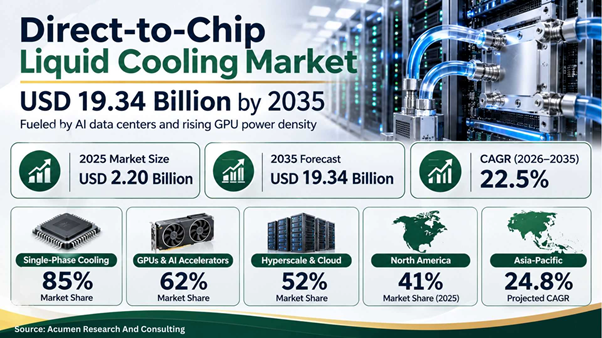
According to Acumen Research And Consulting, the Global Direct-To-Chip Liquid Cooling Marketwas valued at USD 2,198.20 million in 2025 and is projected to reach USD 19,337.21 million by 2035, expanding at a CAGR of 22.5% from 2026 to 2035.
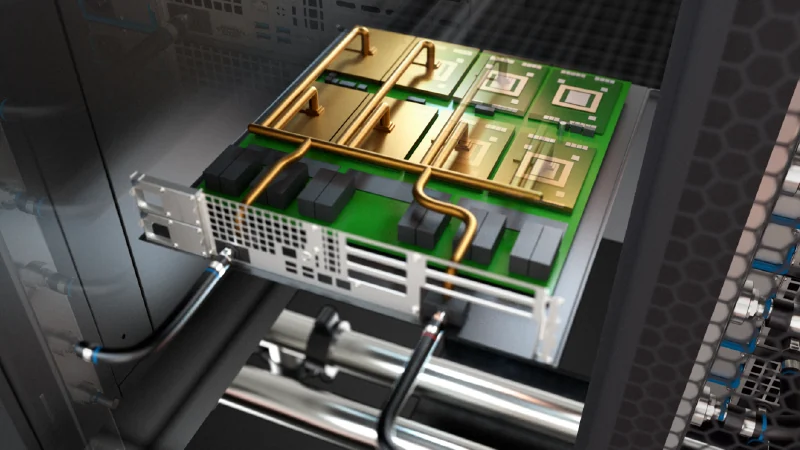
Direct-to-chip liquid cooling uses specialized cold plates attached directly to heat-generating components, such as CPUs and GPUs. A circulating coolant absorbs heat from these components and transfers it through a liquid distribution system to heat rejection equipment.
Unlike conventional air cooling, which relies on airflow to remove heat from server components, direct-to-chip cooling captures heat closer to its source. This makes it particularly relevant for AI infrastructure, where concentrated computing workloads generate substantial thermal loads.
The growing deployment of high-density GPU servers, combined with increasing rack power requirements, is encouraging hyperscale cloud providers, colocation operators, and enterprise data center developers to invest in liquid cooling infrastructure.
Direct-to-Chip Liquid Cooling Market: Key Statistics
- Direct-to-Chip Liquid Cooling Market size in 2025: USD 2,198.20 million
- Estimated market size in 2026: USD 3,121.44 million
- Projected market size by 2035: USD 19,337.21 million
- Direct-to-Chip Liquid Cooling Market Forecast CAGR (2026–2035): 22.5%
- Leading region: North America, with 41% share in 2025
- Leading component: Services, with 25% share in 2025
- Leading cooling mechanism: Single-phase direct-to-chip cooling, with 85% share
- Leading heat capture configuration: Hybrid, with 80% share
- Leading processor category: GPUs and AI accelerators, with 62% share
- Leading data center type: Hyperscale and cloud, with 52% share
- Leading deployment type: New-build facilities, with 64% share
- Leading end-use industry: IT and telecommunications, with 48% share
Key Factors Driving the Direct-to-Chip Liquid Cooling Market
Increasing AI and GPU Infrastructure Deployment
The expansion of AI model training, generative AI applications, and high-performance computing is significantly increasing demand for advanced data center cooling technologies.
Modern AI servers use powerful GPUs and specialized accelerators that generate substantial heat during intensive computing operations. As operators deploy larger GPU clusters, conventional air-based cooling can become increasingly difficult to scale efficiently.
Direct-to-chip liquid cooling addresses this challenge by transferring heat directly from processors through liquid-cooled cold plates. This approach helps data centers manage higher thermal loads and support increasingly powerful computing infrastructure.
Rising Data Center Rack Power Density
Data center rack power density is increasing as operators deploy more powerful processors and AI accelerators within individual server racks.
Higher power density creates concentrated heat loads that require more efficient thermal management. Direct-to-chip cooling enables targeted heat removal from high-temperature components without relying exclusively on conventional room-level airflow.
The growing adoption of high-density racks is creating demand for cold plates, coolant distribution units (CDUs), rack manifolds, quick disconnects, pumps, and associated fluid management infrastructure.
Expansion of Hyperscale and Cloud Data Centers
Hyperscale cloud providers and specialized AI infrastructure companies are investing in large-scale data centers to support cloud computing, AI training, and inference workloads.
These facilities require cooling systems capable of supporting high computing density, continuous operations, and scalable infrastructure deployment.
Direct-to-chip cooling is increasingly relevant to new AI data center projects because it can be incorporated into server and rack designs from the initial development stage.
Growing Focus on Energy Efficiency
Cooling represents an important part of data center energy consumption. As electricity demand increases, operators are evaluating technologies that can improve thermal management while reducing the energy required for cooling.
Direct-to-chip systems can improve heat transfer efficiency by capturing heat directly from processors. Their overall energy and water performance depends on the coolant, pumps, heat rejection equipment, facility configuration, and operating conditions.
The technology is also creating opportunities for heat reuse and integration with broader facility energy management systems.
Increasing Adoption of High-Performance Computing
Scientific research, financial modeling, engineering simulations, weather forecasting, and advanced analytics require substantial computing capacity.
These workloads are increasing demand for high-performance computing infrastructure with advanced thermal management capabilities. Direct-to-chip liquid cooling can support high-density processors and accelerators used in these environments.
Direct-to-Chip Liquid Cooling Market Segmentation Analysis
By Component: Services Lead the Market
The Direct-to-Chip Liquid Cooling Market is segmented into cold plates, coolant distribution units (CDUs), rack manifolds and secondary fluid networks, heat rejection and facility water integration, coolants, and services.
Services accounted for 25% of the market in 2025, generating USD 549.55 million. The segment is projected to reach USD 6,555.31 million by 2035, growing at a CAGR of 26.2%.
The growing complexity of liquid cooling infrastructure is creating demand for specialized engineering, installation, commissioning, maintenance, and monitoring services. Operators require expertise to integrate liquid cooling systems with server racks, facility water infrastructure, and existing electrical and mechanical systems.
Cold plates represented the second-largest component category, accounting for 24% of the market in 2025. They are essential to direct-to-chip cooling because they transfer heat from CPUs and GPUs into circulating coolant.
Other important components include:
- Coolant Distribution Units: Regulate coolant flow, pressure, and temperature across cooling loops.
- Rack manifolds and quick disconnects: Distribute coolant to individual servers and enable easier equipment maintenance.
- Heat rejection and facility water integration: Transfer captured heat from the cooling loop to facility-level heat rejection systems.
- Coolants: Provide the heat-transfer medium and require appropriate fluid quality and compatibility.
By Cooling Mechanism: Single-Phase Cooling Dominates
Single-phase direct-to-chip cooling dominated the market with an 85% share in 2025, generating USD 1,868.47 million. The segment is projected to reach USD 13,536.05 million by 2035, growing at a CAGR of 20.1%.
Single-phase cooling uses a coolant that remains in liquid form throughout the heat-transfer process. It offers an established cooling architecture and is widely used in current direct-to-chip deployments.
Two-phase direct-to-chip cooling accounted for 15% of the market in 2025 and is projected to grow at a CAGR of 30.9% through 2035.
Two-phase systems use the phase change of a coolant to absorb and transfer heat. Their potential to manage high thermal loads is creating interest among suppliers and operators developing next-generation high-density AI infrastructure.
By Heat Capture Configuration: Hybrid Cooling Leads
Hybrid heat capture accounted for 80% of the market in 2025, generating USD 1,758.56 million.
Hybrid configurations use liquid cooling for high-heat processors while retaining air cooling for other server components. This approach allows operators to address the most demanding thermal loads without necessarily converting every component to liquid cooling.
The segment is projected to reach USD 11,602.32 million by 2035.
Full liquid capture represented the remaining 20% of the market in 2025. It is projected to grow at a CAGR of 30.9% through 2035 as higher rack densities encourage broader adoption of liquid-based thermal management.
By Rack Power Density: High-Density AI Infrastructure Creates New Opportunities
The 50 to below 100 kW per rack category dominated the direct-to-chip liquid cooling market with a 38% share in 2025, generating USD 835.32 million.
The 100 to below 200 kW per rack category accounted for 30% of the direct-to-chip liquid cooling market in 2025, reflecting growing adoption of high-density computing configurations.
The 200 kW per rack and above category is projected to be the fastest-growing segment, with a CAGR of 37% from 2026 to 2035.
This growth reflects the increasing deployment of powerful AI accelerators and GPU clusters. Higher-density configurations require advanced cold plates, fluid distribution systems, and cooling architectures capable of managing concentrated heat loads.
By Processor/Device Cooled: GPUs and AI Accelerators Dominate
GPUs and AI accelerators accounted for 62% of the direct-to-chip liquid cooling market in 2025, generating USD 1,362.88 million. The segment is projected to reach USD 13,536.05 million by 2035, growing at a CAGR of 23.9%.
The growing use of GPUs in AI model training, inference, and high-performance computing is increasing demand for direct processor cooling.
CPUs represented 26% of the market in 2025, supported by their continued use across enterprise servers, cloud infrastructure, and data processing applications.
Other devices, including memory, network switch ASICs, and power electronics, also offer opportunities as liquid cooling architectures expand beyond primary computing processors.
By Data Center Type: Hyperscale and Cloud Facilities Lead
Hyperscale and cloud data centers accounted for 52% of the market in 2025, generating USD 1,143.06 million.
The expansion of large-scale AI infrastructure, cloud platforms, and specialized GPU computing facilities is supporting demand for direct-to-chip cooling technologies.
Colocation facilities represented the second-largest category, with a 24% share in 2025. Their adoption is supported by businesses seeking access to high-performance computing and liquid-cooled infrastructure through third-party data center providers.
Other segments include enterprise data centers, HPC and research facilities, edge data centers, and other specialized facilities.
By Deployment Type: New-Build Facilities Dominate
New-build installations accounted for 64% of the market in 2025, generating USD 1,406.85 million.
Purpose-built AI data centers can integrate liquid cooling infrastructure into their initial facility and server designs. This can simplify the coordination of cold plates, CDUs, manifolds, piping, and heat rejection systems.
Retrofit deployments represented 36% of the market in 2025 and are projected to grow at a CAGR of 23.8% through 2035.
Existing data center operators are upgrading cooling infrastructure to accommodate higher rack power density and GPU-based computing. Retrofit projects create opportunities for cooling system integrators, engineering providers, and equipment manufacturers.
By End-Use Industry: IT and Telecommunications Leads
IT and telecommunications accounted for 48% of the market in 2025, generating USD 1,055.14 million.
The segment benefits from expanding cloud services, AI infrastructure, high-performance computing, and digital service delivery.
Other end-use industries include:
- Banking, Financial Services, and Insurance (BFSI)
- Government and Defense
- Healthcare and Life Sciences
- Manufacturing and Automotive
- Energy and Utilities
- Other industries
Demand across these sectors is influenced by their use of high-performance computing, enterprise data infrastructure, and advanced analytics applications.
Regional Outlook: North America Leads, Asia-Pacific Grows Fastest
North America Direct-to-Chip Liquid Cooling Market
North America dominated the global market with a 41% share in 2025, generating approximately USD 901.26 million.
The region’s leadership is supported by its established hyperscale data center ecosystem, substantial cloud infrastructure investments, and growing deployment of GPU-intensive AI computing facilities.
The United States is a major demand center, with hyperscale cloud providers and technology companies investing in high-density computing infrastructure.
North America’s market is projected to reach USD 6,961.39 million by 2035, expanding at a CAGR of 20.9%.
Asia-Pacific Direct-to-Chip Liquid Cooling Market
Asia-Pacific is expected to be the fastest-growing regional market, with a projected CAGR of 24.8% from 2026 to 2035.
The region accounted for 28% of the global market in 2025, generating approximately USD 615.50 million. Its share is projected to increase to 34% by 2035.
Growth is supported by expanding data center capacity, increasing cloud adoption, and investment in AI infrastructure across China, India, Japan, South Korea, and Southeast Asian markets.
India is emerging as an attractive market as data center operators expand capacity to support cloud services, AI workloads, and enterprise digital transformation. The expansion of local manufacturing and technology partnerships is also creating opportunities for cooling equipment suppliers.
Europe Direct-to-Chip Liquid Cooling Market
Europe offers opportunities through investment in hyperscale and colocation facilities, increasing AI adoption, and the modernization of digital infrastructure.
Germany, the United Kingdom, France, and other major economies are important markets for advanced thermal management solutions.
Energy efficiency, facility design requirements, and the need to support high-density computing are expected to influence adoption across the region.
Latin America and Middle East & Africa
Latin America and the Middle East & Africa are emerging markets for advanced data center cooling technologies.
Expansion of cloud infrastructure, investment in digital services, and development of new data center facilities are expected to support demand. Adoption will depend on investment conditions, electricity availability, facility development, and access to specialized cooling technology providers.
Emerging Trends Shaping the Direct-to-Chip Liquid Cooling Industry
Two-Phase Liquid Cooling Innovation
Two-phase cooling is gaining attention because of its ability to absorb heat through the phase change of a coolant. The technology offers potential advantages for managing increasingly demanding thermal loads.
Although single-phase systems currently dominate, innovation in two-phase architectures may create new opportunities for high-density AI computing facilities.
Full Liquid Cooling Architectures
Traditional hybrid cooling systems use liquid cooling for processors and air cooling for remaining components.
As rack power density increases, full liquid capture configurations are attracting interest. These systems aim to capture a greater proportion of rack heat through liquid-based thermal management.
Higher-Capacity Coolant Distribution Units
The deployment of larger GPU clusters is increasing requirements for coolant circulation, temperature control, and fluid management.
Manufacturers are developing higher-capacity CDUs to support increasingly demanding server and rack configurations. Scalability, reliability, monitoring, and compatibility are important purchasing considerations.
AI Data Center Retrofit Opportunities
Existing data centers are evaluating upgrades to accommodate higher-density computing workloads.
Retrofit projects can involve new cold plates, coolant distribution equipment, piping, manifolds, and facility water integration. The ability to integrate liquid cooling into existing environments is becoming an important competitive capability for suppliers.
Integration with Advanced Facility Management
Liquid cooling systems are increasingly connected with monitoring and control platforms that track coolant temperature, pressure, flow, and system performance.
Intelligent monitoring can help operators identify potential problems, maintain fluid quality, and improve cooling system reliability.
Challenges Facing the Direct-to-Chip Liquid Cooling Market
Despite its strong growth potential, the Direct-to-Chip Liquid Cooling Market faces several challenges.
- High initial installation costs: Direct-to-chip cooling requires specialized cold plates, CDUs, piping, manifolds, coolant, and installation expertise.
- Retrofitting complexity: Existing facilities may require significant modifications to integrate liquid cooling systems.
- Coolant leakage risks: Maintaining leak-free connections and reliable fluid circulation is essential for protecting sensitive electronic components.
- System compatibility: Different server designs, rack configurations, and cooling architectures can complicate integration.
- Coolant management: Fluid quality, contamination control, material compatibility, and maintenance require specialized procedures.
- Operational expertise: Data center operators need trained personnel to manage liquid cooling infrastructure and troubleshoot system performance.
Addressing these challenges will require collaboration among data center operators, server manufacturers, cooling technology suppliers, and engineering service providers.
Competitive Landscape and Key Companies
The direct-to-chip liquid cooling market includes specialized thermal management providers, data center infrastructure companies, electronics manufacturers, and engineering solution providers.
Key companies operating in the Direct-to-Chip Liquid Cooling Market include:
- Vertiv
- Schneider Electric
- CoolIT Systems
- Boyd
- Asetek
- nVent
- Motivair
- Delta Electronics
- Rittal
- Accelsius
Competition is shaped by cooling performance, reliability, system compatibility, scalability, manufacturing capacity, and engineering expertise.
Companies are increasingly investing in advanced cold plates, high-capacity coolant distribution units, two-phase cooling technologies, and integrated thermal management platforms to address the requirements of AI infrastructure.
Recent industry investments also indicate growing interest in manufacturing expansion and advanced cooling technology development. For example, Acumen’s report highlights Accelsius’ USD 65 million Series B funding and Schneider Electric’s expansion of liquid cooling manufacturing in Bengaluru.
Future Outlook: Liquid Cooling Becomes Critical to Next-Generation AI Infrastructure
The direct-to-chip liquid cooling market is expected to experience substantial growth as AI workloads increase the thermal requirements of modern data centers.
The projected expansion of Direct-to-Chip Liquid Cooling Marketfrom USD 2.20 billion in 2025 to USD 19.34 billion by 2035 highlights the growing importance of advanced processor-level thermal management.
Single-phase systems currently dominate, but two-phase cooling and full liquid capture configurations are expected to gain attention as computing density increases.
For technology suppliers, important opportunities will emerge in cold plates, coolant distribution units, fluid management, high-capacity cooling systems, and specialized engineering services.
As AI infrastructure expands, the ability to manage heat efficiently, maintain system reliability, and support higher rack power density will become an increasingly important factor in data center investment decisions.
Frequently Asked Questions (FAQs)
What is the size of the direct-to-chip liquid cooling market?
The global direct-to-chip liquid cooling market was valued at USD 2,198.20 million in 2025, according to Acumen Research & Consulting.
What will the direct-to-chip liquid cooling market be worth by 2035?
The market is projected to reach USD 19,337.21 million by 2035.
What is the expected CAGR of the market?
The direct-to-chip liquid cooling market is expected to grow at a CAGR of 22.5% from 2026 to 2035.
Which region dominates the market?
North America dominated the market in 2025, accounting for 41% of global revenue.
Which region is expected to grow fastest?
Asia-Pacific is projected to be the fastest-growing region, with a CAGR of 24.8% from 2026 to 2035.
Which cooling mechanism currently dominates?
Single-phase direct-to-chip cooling dominated the market with an 85% share in 2025.
What is the fastest-growing cooling mechanism?
Two-phase direct-to-chip cooling is projected to grow at a CAGR of 30.9% from 2026 to 2035.
Which processor category accounts for the largest market share?
GPUs and AI accelerators accounted for 62% of the market in 2025, reflecting increasing demand from AI training and high-performance computing.
What are the major components of direct-to-chip liquid cooling systems?
Major components include cold plates, coolant distribution units, rack manifolds, quick disconnects, secondary fluid networks, heat rejection systems, coolants, and installation and maintenance services.
What are the major factors driving market growth?
Key drivers include increasing AI workloads, higher GPU power density, expansion of hyperscale data centers, growing HPC requirements, and demand for energy-efficient thermal management.
About Acumen Research And Consulting
Acumen Research And Consulting is a market research and business consulting firm providing industry analysis, market intelligence, and forecast reports across multiple sectors. Its research supports organizations seeking to understand market size, emerging trends, competitive dynamics, and strategic growth opportunities.