
Healthcare is increasingly moving beyond episodic hospital visits toward continuous monitoring, preventive care and remote patient management. At a recent Digital Healthcare Media Briefing, Analog Devices discussed how advances in sensing, semiconductor integration, low-power technologies and AI are supporting this transition.
The discussion also highlighted the growing role of wearables such as smart rings, smart bands and chest patches in capturing continuous vital-sign data and supporting remote healthcare. Analog Devices and Sensio Enterprise shared their perspectives on the technology and ecosystem requirements needed to make these solutions more accurate, accessible and suitable for healthcare applications.
How is digital healthcare changing the way healthcare is delivered?
According to Analog Devices, healthcare is shifting from treatment towards prevention, from hospital-centric care towards monitoring at home, and towards continuous management of chronic conditions such as diabetes, cardiovascular conditions and respiratory disorders.
Continuous monitoring can provide a longer-term view of a person’s health instead of relying only on periodic measurements. Wearables can collect vital signs and provide alerts through connected applications, potentially supporting monitoring before and after hospitalisation.
What role are wearables playing in preventive healthcare?
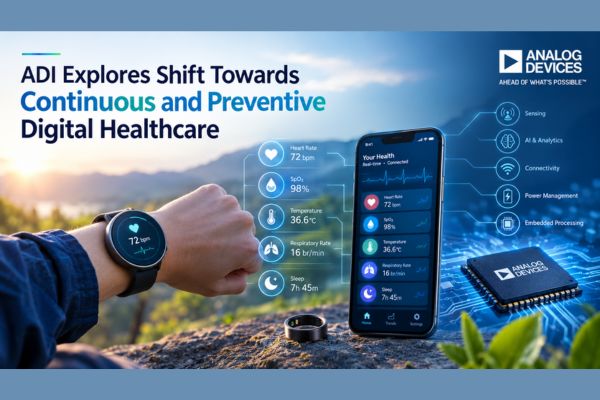
Wearables are evolving beyond fitness and activity tracking. Devices such as smart rings, smart bands and chest patches can capture parameters including heart rate, blood oxygen, temperature, respiratory rate, sleep and activity.
Sensio said that moving wearables into healthcare requires reliable, medical-grade devices, accurate sensors and algorithms, along with validation against established measurements. Building trust among doctors and healthcare professionals will be important before these devices can become part of clinical workflows.
How are semiconductor technologies enabling smaller and more efficient healthcare devices?
Compact integration is becoming important as wearable devices need to combine multiple sensors while maintaining battery life and signal quality. Analog Devices is developing integrated solutions, including analog front ends with optics, to support compact devices such as rings and watches.
Power management and intelligent measurement strategies can also help. Devices can remain in low-power modes for much of the time and activate measurements when required. Measurement frequency can also be adjusted depending on the vital sign and use case.
What role does AI play in continuous health monitoring?
The briefing highlighted a layered approach to AI. Processing can take place directly on the wearable through Edge AI, while smartphones can aggregate information from multiple signals. Cloud-based AI can then analyse longitudinal health data collected over months or years.
This approach could allow health insights to be personalised around an individual’s baseline rather than relying solely on population-level measurements. Analog Devices noted that models trained using larger datasets can also eventually be embedded into edge devices for local inference.
What are the major challenges in making wearable health data clinically useful?
Accuracy, signal quality, certification and data reliability remain important challenges. Motion artifacts, sensor placement and noise can affect measurements, particularly for PPG and ECG signals.
The briefing also emphasised the importance of certification. Wearable devices need appropriate validation and certification before hospitals and doctors can confidently integrate their data into clinical systems. Affordability, regulation and healthcare-system readiness are additional factors influencing adoption.
How can continuous monitoring become more accessible in India?
Awareness and affordability remain important considerations. The discussion also highlighted the need for products designed around Indian requirements rather than simply adapting products developed for other markets.
Sensio’s approach of designing, developing and manufacturing products in India was cited as an example of building solutions around local requirements. The broader ecosystem will require technology development, manufacturing capabilities, certification and greater awareness of continuous health monitoring.
What could the healthcare technology landscape look like over the next few years?
The briefing pointed towards greater use of continuous vital-sign monitoring, Edge AI and increasingly integrated semiconductor technologies. Advances in VLSI, power efficiency and semiconductor packaging could enable more functions to be incorporated into smaller wearable devices.
Analog Devices also sees healthcare as a potential significant market opportunity in India over the next five to seven years and highlighted the importance of building an ecosystem involving product companies, manufacturers, universities, AI capabilities and semiconductor engineering.
What technologies were highlighted during the briefing?
The demonstrations included the Sensio Orbit smart ring, MAX30011 EVKit, HSP4 chest-patch reference design and MAX86184 PPG analog front end. The solutions showcased how sensing, signal processing, connectivity, power management and embedded intelligence can come together in connected healthcare applications.