
Agileo Automation, a top global provider of control and connectivity solutions for semiconductor manufacturing, introduces Agil’EDA, a new software that implements Equipment Data Acquisition (EDA/Interface A). The solution helps semiconductor equipment makers fulfill the growing high-performance connectivity demands of leading fabs and advanced packaging operations.
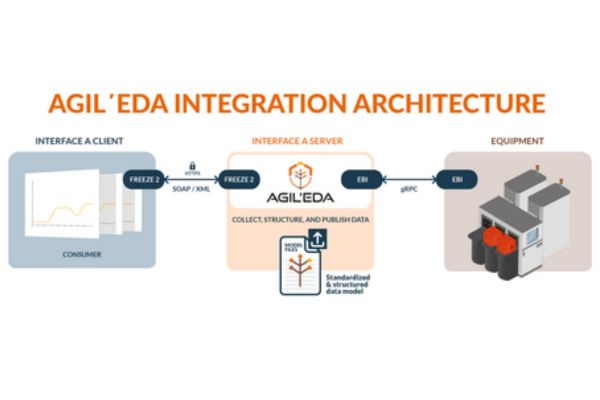
As semiconductor manufacturing moves towards higher levels of automation and data-driven optimization, fab owners increasingly require EDA alongside traditional SECS/GEM connectivity from OEMs for their production tools. Agil’EDA separates equipment control from data acquisition, ensuring that structured, high-frequency data collection does not interfere with critical equipment operations.
Designed for long-term deployment, Agil’EDA fully supports the widely used EDA Freeze 2 (SOAP/XML) and is architected for the transition to Freeze 3 (gRPC/protocol buffers). This next EDA freeze, expected in mid-2026, offers significantly higher data throughput and lower latency. Agileo successfully tested its Freeze 3 implementation at SEMI Standards Meetings in November 2024.
Incorporating robust cybersecurity features such as encrypted communications and authentication, Agil’EDA is available as a stand-alone solution for existing equipment software or as a pre-integrated component within Agileo’s A²ECF-SEMI framework. Combined with Agil’GEM and Agil’GEM300, it provides a comprehensive connectivity solution that significantly reduces time to market for OEMs.
“The key value for OEMs is a fast adoption path to a future-ready EDA architecture,” explains Marc Engel, chief executive officer of Agileo Automation. “By integrating Freeze 3 requirements in Agil’EDA architecture from the start, we address OEMs’ current needs while preparing them for future semiconductor manufacturing requirements.”