


The AI in Semiconductor Manufacturing Market is rapidly evolving from an emerging technology opportunity into a critical component of modern semiconductor production. As chip architectures become more sophisticated and manufacturing processes increasingly data-intensive, semiconductor companies are deploying artificial intelligence (AI), machine learning, computer vision, predictive analytics, and intelligent automation to improve yield, detect defects, optimize processes, and increase equipment efficiency.
According to Acumen Research and Consulting, the Global AI in Semiconductor Manufacturing Market was valued at USD 6.50 billion in 2025 and is projected to reach USD 26.82 billion by 2035, expanding at a 15.2% CAGR from 2026 to 2035. This rapid expansion reflects the growing importance of AI-driven manufacturing intelligence across wafer fabrication, testing, metrology, assembly, packaging, and semiconductor production planning.
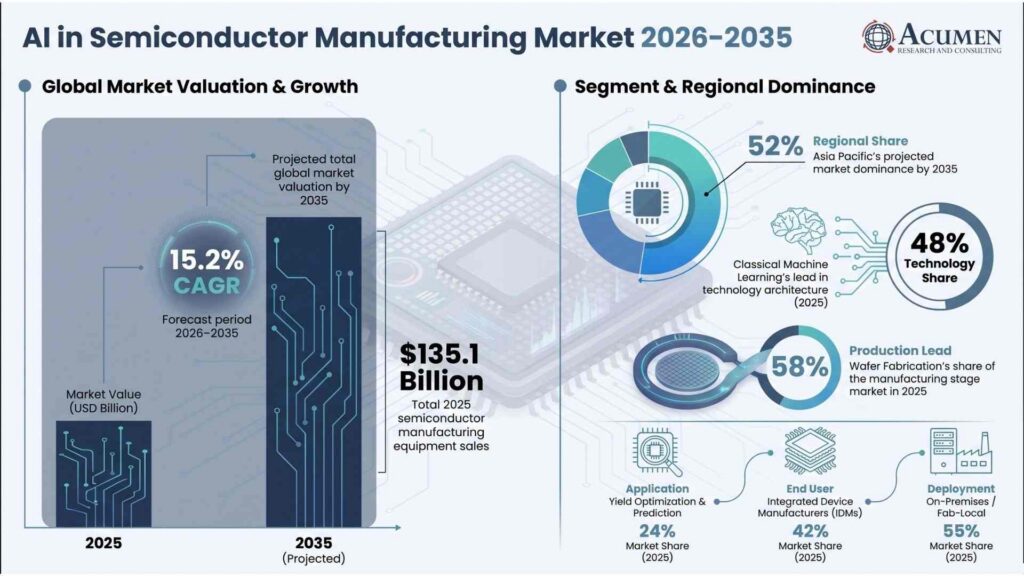
AI in Semiconductor Manufacturing Market: Key Statistics
- Market Size, 2025: USD 6.50 billion
- Projected Market Size, 2035: USD 26.82 billion
- CAGR, 2026–2035: 15.2%
- Leading Region, 2025: Asia Pacific with 48% market share
- Projected Asia Pacific Share, 2035: 52%
- Asia Pacific CAGR, 2026–2035: 16.2%
- North America Market Share, 2025: 28%
- Classical Machine Learning Share, 2025: 48%
- Deep Learning Share, 2025: 30%
- Software/AI Platforms Share, 2025: 46%
- On-Premises/Fab-Local Deployment Share, 2025: 55%
- Yield Optimization & Prediction Share, 2025: 24%
- Defect Detection & Classification Share, 2025: 22%
- Wafer Fabrication/Front-End Manufacturing Share, 2025: 58%
- Integrated Device Manufacturer Share, 2025: 42%
Why Is AI Transforming Semiconductor Manufacturing?
Semiconductor manufacturing generates enormous volumes of data from equipment sensors, process parameters, wafer inspections, metrology systems, and manufacturing execution systems. AI provides manufacturers with the ability to analyze these datasets continuously and identify relationships that may not be apparent through conventional monitoring.
AI-powered manufacturing systems can help identify process deviations, predict equipment failures, classify wafer defects, optimize production parameters, and support faster engineering decisions. This creates a continuous feedback loop in which manufacturing data can be converted into actionable intelligence.
The importance of this capability is increasing as semiconductor manufacturers pursue advanced process nodes and more complex chip architectures. According to Acumen Research and Consulting, global semiconductor manufacturing capacity is projected to reach 11.1 million wafers per month by 2028, while capacity for advanced 7nm-and-below processes is expected to increase by 69%, from approximately 850,000 wafers per month in 2024 to 1.4 million in 2028.
AI Chip Demand Is Driving Intelligent Fab Investment
The expansion of AI applications is simultaneously increasing demand for advanced semiconductors and encouraging manufacturers to make their production operations more intelligent.
Acumen reports that worldwide semiconductor manufacturing equipment sales increased 15% to USD 135.1 billion in 2025, compared with USD 117.1 billion in 2024. Increasing investment in advanced logic, memory, and AI-related semiconductor capacity is creating additional opportunities for AI-enabled process optimization and manufacturing automation.
As fabs become larger and manufacturing processes become more sophisticated, AI is increasingly being positioned as an operational layer connecting equipment, inspection, process control, metrology, and production data.
Which AI Technologies Are Leading the Semiconductor Manufacturing Market?
Classical machine learning held the largest share of the AI in Semiconductor Manufacturing Market at 48% in 2025, according to Acumen Research and Consulting. Its strong position is associated with established applications involving structured fab data, equipment monitoring, process optimization, analytics, and yield management.
Deep learning represented the second-largest technology segment at 30% in 2025. Its ability to analyze complex and high-dimensional datasets makes it particularly valuable for wafer inspection, anomaly detection, pattern recognition, and defect classification.
The future technology landscape is likely to become increasingly diverse as manufacturers adopt generative AI, reinforcement learning, computer vision, and other advanced AI architectures alongside established machine-learning systems.
Yield Optimization Is the Leading AI Application
Yield optimization and prediction represented the largest application segment with a 24% share in 2025. Yield is one of the most important economic performance indicators in semiconductor manufacturing, making AI-based identification of yield-loss drivers particularly valuable.
AI systems can analyze historical process parameters, equipment conditions, inspection results, and metrology information to identify relationships associated with yield variations.
The second-largest application was defect detection and classification, with a 22% share in 2025. AI and deep-learning models can analyze inspection data, recognize recurring defect patterns, distinguish defect types, and support root-cause investigations.
Other important applications include process control and optimization, predictive maintenance and equipment health, manufacturing planning and scheduling, and supply-chain and inventory optimization.
Software and AI Platforms Take the Lead
Software and AI platforms accounted for 46% of the Artificial Intelligence in Semiconductor Manufacturing Market in 2025, making them the leading offering segment. Acumen projects this share to increase to 51% by 2035.
The strength of software reflects the scalability of AI models and analytics platforms across manufacturing lines and facilities. Software can continuously process manufacturing information, support model retraining, and provide actionable intelligence for yield, quality, equipment performance, and production optimization.
Hardware remained another important component, representing 38% of the Artificial Intelligence in Semiconductor Manufacturing Market in 2025. AI manufacturing systems depend on computing infrastructure, AI-optimized chips, edge-processing hardware, sensors, cameras, and metrology equipment to generate and process the data required for intelligent manufacturing.
Why Does On-Premises AI Remain Dominant?
On-premises or fab-local deployment accounted for 55% of the Artificial Intelligence in Semiconductor Manufacturing Market in 2025, reflecting semiconductor manufacturers’ requirements for low latency, reliability, data security, and protection of proprietary manufacturing information.
Semiconductor fabs handle highly sensitive information involving manufacturing recipes, equipment performance, process parameters, yield data, and proprietary production techniques. Keeping AI workloads close to manufacturing equipment can therefore provide both operational and security advantages.
At the same time, cloud deployment is emerging as the fastest-growing deployment model, with Acumen forecasting a 20.8% CAGR from 2026 to 2035. Cloud environments can support centralized AI training, enterprise analytics, benchmarking, predictive maintenance, and cross-fab data management.
This points toward a future in which on-premises, edge, cloud, and hybrid architectures coexist according to individual manufacturing requirements.
Which Manufacturing Stage Uses AI the Most?
Wafer fabrication and front-end manufacturing accounted for 58% of the AI in Semiconductor Manufacturing Market in 2025, making it the largest manufacturing-stage segment.
The dominance of front-end manufacturing reflects the large volume of process, equipment, inspection, and metrology data generated during activities such as lithography, deposition, etching, cleaning, and related fabrication operations.
AI can help manufacturers analyze these interconnected data streams to identify process abnormalities and improve process consistency.
Wafer testing and metrology accounted for 15% of the Artificial Intelligence in Semiconductor Manufacturing Market in 2025, while assembly and packaging represented 14% and final testing accounted for 10%.
As advanced packaging becomes increasingly important for high-performance computing and AI-oriented semiconductor products, AI applications are expected to extend further beyond traditional front-end manufacturing.
Which Companies Are Leading AI in Semiconductor Manufacturing?
The AI in Semiconductor Manufacturing Market features a broad ecosystem of semiconductor manufacturers, equipment suppliers, AI technology companies, engineering-software providers, and industrial technology companies.
Acumen Research and Consulting identifies TSMC, Samsung Electronics, Intel, NVIDIA, Applied Materials, KLA Corporation, Lam Research, ASML, Tokyo Electron, Synopsys, Cadence Design Systems, Siemens, and Onto Innovation among the leading companies operating in the Artificial Intelligence in Semiconductor Manufacturing Market.
These companies participate in different layers of the AI semiconductor manufacturing ecosystem.
TSMC is applying AI across areas including computational lithography, process control, defect inspection, process simulation, fab operations, and production scheduling. Samsung is applying AI to computational lithography, predictive maintenance, anomaly detection, logistics optimization, and digital-twin applications.
Intel is incorporating machine learning into real-time defect analysis, process monitoring, and manufacturing optimization. Meanwhile, semiconductor equipment and process-control companies such as Applied Materials, KLA, Lam Research, ASML, and Tokyo Electron are integrating AI into equipment performance, inspection, metrology, process control, and manufacturing workflows.
NVIDIA is particularly significant at the AI computing and accelerated-simulation layer, while Synopsys and Cadence connect AI capabilities with semiconductor design, simulation, and engineering workflows.
Which Region Leads the AI in Semiconductor Manufacturing Market?
Asia Pacific dominated the AI in Semiconductor Manufacturing Market with a 48% share in 2025, according to Acumen Research and Consulting. The region is projected to increase its share to 52% by 2035 and is expected to record the highest regional growth rate, with a 16.2% CAGR between 2026 and 2035.
The region’s strength is closely connected to its extensive semiconductor ecosystem spanning foundries, integrated device manufacturers, memory producers, semiconductor equipment companies, packaging specialists, and electronics manufacturing facilities.
Taiwan, China, South Korea, and Japan are particularly important to the regional semiconductor manufacturing landscape. Increasing advanced-node production and manufacturing complexity are creating stronger requirements for AI-powered yield management, defect detection, process control, equipment monitoring, and factory optimization.
How Does North America Compare With Asia Pacific?
North America accounted for 28% of the AI in Semiconductor Manufacturing Market in 2025 and is projected to hold a 25% share by 2035. The regional market is expected to expand at a 13.7% CAGR from 2026 to 2035.
North America’s position is supported by semiconductor manufacturing investment, AI infrastructure, advanced fabrication facilities, semiconductor equipment development, and the presence of major AI technology providers.
Acumen estimates that the North American market will grow from approximately USD 2.11 billion to USD 6.71 billion between 2025 and 2035.
While Asia Pacific maintains a stronger market position, North America remains strategically important because of the convergence of semiconductor manufacturing, AI computing, engineering software, and advanced manufacturing capabilities.
Latin America Offers Emerging Opportunities
Latin America represented a smaller portion of the global Artificial Intelligence in Semiconductor Manufacturing Market but is expected to experience significant expansion. Acumen Research and Consulting projects the regional AI in Semiconductor Manufacturing Market to grow at a 15.2% CAGR from 2026 to 2035.
Growing electronics manufacturing, semiconductor assembly and testing activities, industrial automation, and gradual adoption of AI-based manufacturing technologies are creating opportunities for applications such as defect detection, predictive maintenance, process monitoring, quality control, and process optimization.
What Are the Biggest Challenges for AI Semiconductor Manufacturing?
Despite its substantial potential, AI adoption in semiconductor manufacturing presents significant implementation challenges.
The first is high implementation cost. AI deployment can require investment in computing infrastructure, sensors, inspection systems, software integration, data engineering, and model development.
The second challenge is data integration. Semiconductor fabs often contain equipment from multiple generations and suppliers, creating complex data environments that must be standardized before AI systems can deliver consistent results.
The third challenge is validation. Semiconductor manufacturing requires exceptionally high levels of process control and reliability, meaning AI recommendations must be thoroughly evaluated before being incorporated into production decisions.
Cybersecurity and protection of intellectual property are also critical considerations, particularly as manufacturers connect more equipment and data sources.
The Future of AI in Semiconductor Manufacturing
The next phase of the AI in Semiconductor Manufacturing Market will likely involve a transition from isolated AI applications toward interconnected and increasingly autonomous manufacturing environments.
AI agents, digital twins, edge AI, predictive maintenance, intelligent inspection, automated process control, and AI-powered manufacturing analytics are creating the foundation for smarter fabs.
The strategic opportunity lies in connecting these technologies rather than deploying them as independent tools. A manufacturing environment that integrates equipment data, inspection information, metrology, process parameters, production schedules, and AI models can create a continuous intelligence loop across the fab.
This evolution is particularly important as manufacturers move toward advanced nodes and increasingly complex architectures, including advanced packaging, chiplets, and high-bandwidth memory.
Strategic Outlook for the AI in Semiconductor Manufacturing Market
The AI in Semiconductor Manufacturing Market is positioned at the intersection of two powerful technology transformations: the rapid expansion of AI and the increasing complexity of semiconductor manufacturing.
Acumen Research and Consulting projects the Artificial Intelligence in Semiconductor Manufacturing Market to expand from USD 6.50 billion in 2025 to USD 26.82 billion by 2035, representing a 15.2% CAGR from 2026 to 2035.
The most significant opportunities will increasingly emerge from AI applications that deliver measurable improvements in semiconductor yield, defect detection, process control, equipment health, production efficiency, and manufacturing intelligence.
As AI moves deeper into the semiconductor factory, competitive advantage will depend less on simply adopting artificial intelligence and more on how effectively manufacturers integrate AI, machine learning, computer vision, advanced analytics, edge computing, digital twins, automation, and manufacturing data into a unified production environment.
The semiconductor fab of the future will not simply manufacture chips with AI. It will increasingly use AI to understand, optimize, predict, and continuously improve how those chips are manufactured.