
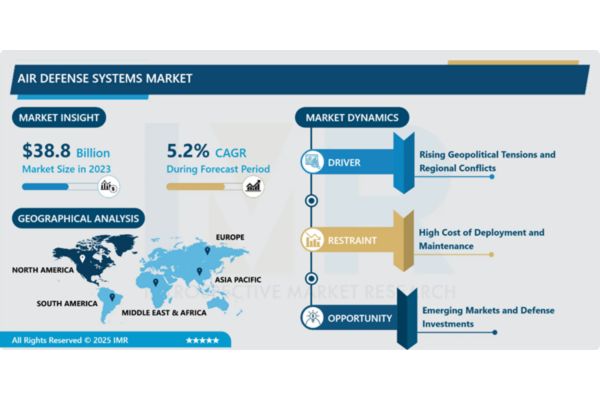
The global Air Defense Systems Market size reached US$ 38.80 billion in 2023 and is projected to hit around US$ 61.23 billion by 2032, growing at a compound annual growth rate (CAGR) of 5.20% over the forecast period, according to a new market study published by Introspective Market Research (IMR). This surge is being propelled by rising geopolitical tensions, state-level modernization of air defenses, and growing demand for multi-layered, integrated systems that can counter increasingly complex aerial threats.
Quick Insights
- 2023 market size: USD 38.80 Billion
- Projected 2032 market size: USD 61.23 Billion
- Forecast CAGR (2024–2032): 5.20%
- Top regions by analysis: North America, Western & Eastern Europe, Asia Pacific, Middle East & Africa, South America
- Leading players: Lockheed Martin, BAE Systems, Boeing, Thales, Rheinmetall, Northrop Grumman, Saab, Hanwha, IAI etc.
- Key system types covered: Missile defense systems, anti-aircraft systems, counter-UAS (Unmanned Aerial Systems), counter-rocket/artillery/mortar (C-RAM) systems
- Platform breakdown: Land-based, Naval, Airborne
- Range categories: Long-range, Medium-range, Short-range systems
What’s Driving Growth – and What’s Holding It Back?
The IMR report identifies geopolitical risk and rising regional conflicts as the single largest tailwind fueling demand for advanced air defense capabilities. Simultaneously, the high cost of deployment and maintenance remains a critical headwind, especially for emerging economies.
Where the Opportunity Lies — and Why It Matters
What’s next for air defense systems?
- Emerging markets & modernizing militaries: As more countries build out indigenous defense capabilities, demand for advanced, integrated systems is accelerating.
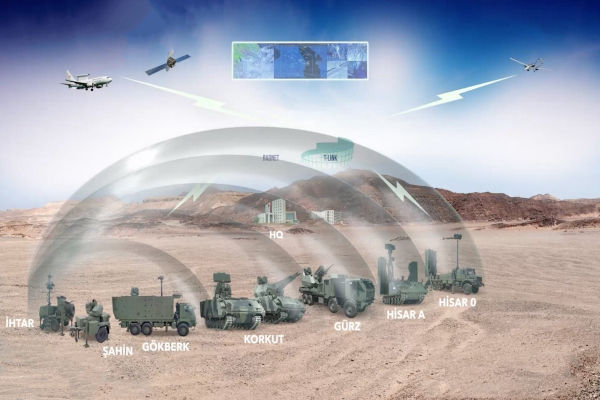
- Layered, connected defenses: Multi-tiered architectures combining missile defense, C-UAS, and C-RAM on unified command-and-control frameworks are gaining traction.
- Technology leapfrogging: The next wave of innovation centers on directed-energy weapons (e.g., lasers), AI-driven radars, and autonomous interceptors that can engage asymmetric threats. This aligns with broader industry trends.
Expert Insight
“Governments worldwide are increasingly recognizing that airspace is no longer a homogeneous threat environment. From hypersonic missiles to drone swarms and cruise threats, modern defense requires networked, adaptive, and layered systems,” said Dr. Aisha Raman, Principal Consultant at Introspective Market Research. “Our analysis shows that demand is not just for traditional missile systems, but for integrated architectures where sensors, command & control, and effectors operate in concert — and that is reshaping procurement and R&D strategies globally.”
Regional & Segment Outlook
North America continues to dominate the global air defense systems market, supported by robust and sustained defense spending, multi-year procurement pipelines, and continuous modernization programs. The region benefits from strong institutional backing for next-generation air and missile defense programs such as the Patriot PAC-3, Aegis Ballistic Missile Defense, THAAD, and advanced radar modernization initiatives. Major defense contractors headquartered in the region — including Lockheed Martin, Northrop Grumman, and Raytheon — drive significant R&D investments, resulting in accelerated upgrades across sensors, effectors, and command-and-control architectures. Program backlogs and multi-domain operational doctrines further ensure that North America maintains a leading position through 2032.
Europe is rapidly upgrading its legacy systems amid heightened geopolitical tensions and evolving aerial threat landscapes. Western Europe is investing heavily in interoperable and NATO-standardized air defense architectures, with strong collaboration among countries to develop integrated early-warning systems, medium-range missile platforms, and counter-drone capabilities. Eastern Europe, meanwhile, is experiencing accelerated procurement cycles as nations fortify their airspace in response to regional instability. Collectively, Europe is driving demand for multi-domain, digitally linked air defense ecosystems that can operate seamlessly alongside allied systems.
Asia Pacific is emerging as the fastest-growing region, fueled by rising territorial disputes, expanding defense budgets, and strong government commitments to indigenous manufacturing. Nations such as India, Japan, South Korea, and Australia are actively modernizing their air defense networks, with large-scale procurement of missile interceptors, long-range radars, AEW aircraft, and advanced C-UAS technologies. China’s rapid development of integrated air defense systems also influences regional modernization trends, creating competitive pressure that drives further investment. The shift toward self-reliance — supported by domestic defense manufacturers — positions Asia Pacific as a long-term growth hub for both hardware and software-driven air defense innovation.
Middle East & Africa and South America are gaining traction as emerging growth clusters, particularly for short- to medium-range air defense systems and counter-UAS solutions. Middle Eastern nations continue to invest heavily in missile defense platforms to counter asymmetric and drone-related threats, while Gulf countries are also adopting integrated multi-layer defense architectures. In Africa and South America, defense modernization is more gradual but steadily growing, with increasing focus on cost-efficient, scalable solutions that can address local security needs. Procurement is also influenced by international partnerships, technology transfers, and geopolitical alliances that shape system selection and deployment strategies.
By component, weapon systems — including missile launchers, interceptors, and guns — currently account for the largest revenue share due to their high procurement cost and recurring upgrade cycles. However, command-and-control (C2) systems and fire-control systems are registering faster innovation and higher spending growth. The shift toward networked defense ecosystems is accelerating investments in digital battlefield management, sensor fusion, AI-enabled decision systems, and advanced tracking radars. As militaries transition from siloed to integrated operational frameworks, C2 and fire-control components are expected to become pivotal growth contributors over the next decade.
By type, missile defense systems dominate the market in absolute value, driven by the global need to counter long-range, cruise, and ballistic missile threats. Yet, counter-UAS (C-UAS) and counter-rocket, artillery, and mortar (C-RAM) systems are rapidly gaining momentum, becoming the fastest-growing categories. The proliferation of low-cost drones, loitering munitions, and swarm technologies is forcing governments to invest in agile, cost-efficient, and high-precision air defense layers. This shift is reshaping procurement strategies, leading to hybrid solutions that combine kinetic interceptors, electronic warfare, and directed-energy weapons.
By platform, land-based air defense systems continue to generate the highest share of global revenue due to their role in territorial and base protection. These systems offer scalability and are widely deployed across national defense infrastructures. However, airborne platforms — particularly AEW (Airborne Early Warning) aircraft and advanced radar-equipped aircraft — are expected to register the strongest CAGR. Their ability to provide long-range surveillance, multi-angle detection, and rapid response capabilities makes them essential for modern, high-tempo defense operations. Naval platforms also continue to evolve, especially for nations with expanding maritime security priorities.
By range, medium-range air defense systems hold the dominant share of the market, offering a balanced combination of cost-efficiency, mobility, and interception capability. These systems are widely deployed by land forces due to their versatility against aircraft, missiles, and drones. Long-range interceptors remain crucial for strategic defense, particularly for countering high-velocity ballistic missiles and advanced cruise threats. Despite their smaller volume, long-range systems command significant investment due to their strategic importance and complex technological requirements, ensuring continued demand from advanced militaries.
Notable Breakthroughs & Industry Developments
Recent developments in the air defense sector underscore the rapid innovation that IMR’s report highlights:
- Lockheed Martin has deepened its partnership with Poland to produce PAC-3 MSE interceptor components locally, enhancing resilience and reducing supply chain dependencies.
- BAE Systems launched the Tridon Mk2, a next-gen 40 mm anti-aircraft system optimized for high-precision response in contested environments. Emerging directed-energy platforms, such as laser-based air defense systems, are gaining traction — for instance, Rafael’s Iron Beam, which promises extremely low per-shot costs for intercepting short-range threats.
- On the command & control front, advancements in AI and autonomous decisioning are being adopted more widely, reflecting broader defense trends.
Challenges and Cost Pressures
Despite the strong outlook, the market grapples with several key challenges:
- High CapEx and OpEx: Deploying and maintaining integrated air defense architectures is capital-intensive; recurring costs remain a barrier for less affluent nations.
- Interoperability: Integrating new systems (missiles, radars, C2) with legacy platforms presents technical and logistical complexity.
- Supply chain vulnerabilities: Export controls, semiconductor shortages, and long lead times for critical components (especially for advanced effectors) can delay program execution.
- Technology obsolescence: Rapid advancements, especially in AI and directed energy, risk making current investments outdated without mid-life upgrades.
Active Key Players in the Air Defense Systems Market
- Aslesan A.S.
- BAE Systems plc
- Boeing
- Elibit Systems Ltd.
- General Dynamics
- Hanwha Corporation
- Israel Aerospace Industries Ltd.
- Kongberg Gruppen ASA
- L3Harris Technologies Inc.
- Leonardo S.p.A
- Lockheed Martin Corporation
- Northrop Grumman
- Rheinmetall AG
- RTX Corporation
- Saab AB
- Thales Group
- Other Active Players.
Case Study Highlight
Poland’s PAC-3 MSE Local Production Partnership In a landmark defense-industrial collaboration, Lockheed Martin partnered with Polish firms in May 2024 to manufacture components of the Patriot PAC-3 MSE interceptor locally. This move is a strategic play to strengthen Poland’s missile defense capacity, reduce dependency on imports, and foster indigenous industrial competence a model that other countries are beginning to replicate.