
Introduction
The modern vehicle is no longer defined by mechanics alone. It is increasingly shaped by software.
What was once a set of mechanical systems has evolved into a software-defined vehicle (SDV). It is a connected, upgradable platform where software controls behavior, performance, and user interaction.
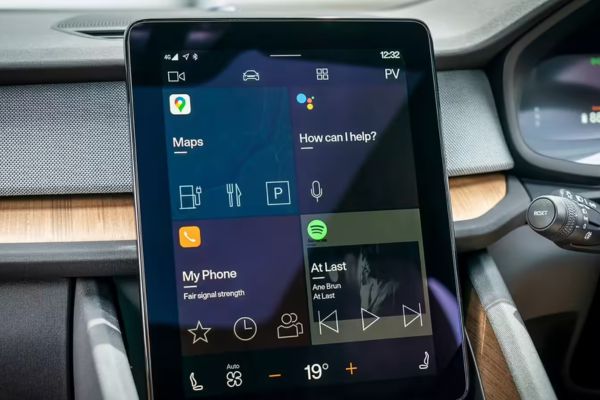
At the center of this shift is the infotainment system. It is no longer a side feature. It is now the main interface of the digital cockpit.
This cockpit brings together media, navigation, ADAS insights, and vehicle controls into a single, unified environment. It is where the driver sees, decides, and interacts. Consequently, expectations have shifted.
Users now demand seamless connectivity across devices, deep personalization based on behavior, and immersive experiences while driving.
Yet, beneath this sophistication lies a clear limitation.
Most infotainment systems today are feature-rich, but not truly aware. They respond when prompted. They execute commands. But they rarely understand context or act ahead of the user.
This gap is critical. It signals a deeper shift underway. Infotainment is no longer just a feature embedded within the vehicle.
It is becoming the experience layer that shapes how people see mobility.
To understand how this transformation began, it is important to trace its evolution from the earliest, hardware-driven systems.
Era 1: Analog Infotainment: Hardware-Driven Systems (Pre-2000s)
In the mid-1900s, car interiors were quite simple. From the 1960s to the 1980s, car entertainment meant just the radio.
Cassette players and CDs came later as luxuries. But the idea never changed; entertainment was a one-way broadcast. There was no connectivity, smart software, or user experience. Drivers used buttons and knobs. The system just made a sound, and that was it.
Existing only in some cases, the displays were monochrome segmented LCDs displaying only the track number and station frequency. The vehicle, driver, and outside world worked independently of each other with no means of communicating their respective locations, speeds, or directions.
The hardware-centric era was characterized by what it could not do rather than what it could do. In the hardware-centric era, there was no personalization, no high-level intelligence, and no integration between devices.
To separate the hardware-driven isolation opened the door for the emergence of the digital age in the infotainment system.
Era 2: Digital Infotainment: Embedded Systems & Early UI (Early 2000s)
The move from analog to digital systems marked the first major shift in automotive infotainment. In the early 2000s, vehicles began using digital displays, embedded GPS navigation, and software-based interfaces.
Dashboards could now show maps, calculate routes, and guide drivers with turn-by-turn directions. This was a big step forward from physical knobs, dials, and paper maps.
Basic LCD screens also enabled simple graphical menus. These menu-driven interfaces gave users more flexibility than traditional hardware controls.
However, these systems were mostly isolated. Data was stored locally on the device and could not be updated in real time. If a road changed, the system could not adapt unless a manual update was installed.
While the shift from analog to digital was important, it did not bring true intelligence. The vehicles were digital, but not intelligent.
This created a new requirement, not just digitization, but the ability to connect with external systems and real-time data sources.
Era 3: Connected Infotainment: Rise of HMI & Interactive Systems (2010 to 2018)
The shift to digital systems improved interfaces, but they remained closed and locally driven. That boundary began to break with the arrival of high-speed connectivity and smartphone integration.
Infotainment was no longer limited to in-vehicle data.
This change came from improved connectivity. Bluetooth and USB enabled seamless device pairing, while CarPlay and Android Auto brought mobile ecosystems into the dashboard. Cloud connectivity added real-time data, transforming infotainment into a connected system.
Alongside media and navigation, connected safety services also became part of infotainment platforms. In the U.S., GM’s OnStar Emergency Button enabled drivers to instantly connect with live advisors for emergency assistance, vehicle diagnostics, and roadside support. This marked an early shift of infotainment from convenience to a mission‑critical, connected safety layer.
This directly changed how users interacted with the vehicle.
Touchscreens replaced physical controls. Voice recognition reduced the need for manual input. App ecosystems expanded functionality beyond built-in features.
At the center of this shift was the Human-Machine Interface (HMI).
HMI evolved into a unified control layer, bringing together infotainment, vehicle settings, and ADAS interactions. As buttons disappeared, haptic technology provided tactile feedback on touchscreens, improving accuracy and reducing distraction. Interaction became multi-modal, combining touch, voice, and gesture.
Display systems advanced to TFT-LCD capacitive touchscreens, enabling responsive interfaces.
Even with connectivity and improved interaction, the systems remained reactive, where users were demanding intelligence-driven evolution.
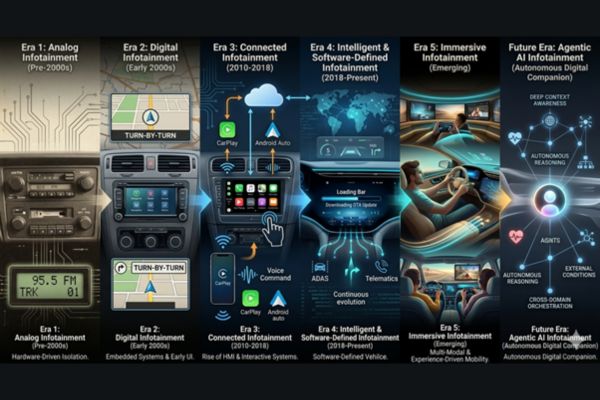
Era 4: Intelligent & Software-Defined Infotainment (2018 till Present)
Connectivity expanded access, but interaction remained reactive. Systems could fetch data and execute commands, yet they still depended on user input. This limitation led to a deeper architectural shift: the emergence of the software-defined vehicle.
In this era, hardware serves as a stable platform while software drives continuous evolution.
Over-the-air (OTA) updates redefine infotainment as a living system, allowing features and performance to evolve post-deployment without physical intervention. Simultaneously, the convergence of AIoT and cloud computing brings real-time intelligence into the cockpit.
Infotainment systems now process live data streams to enable dynamic navigation and behavior-based personalization.
The role of the interface also expands. It serves as a central control layer, integrating telematics, driver assistance, and connected services into a single computing domain.
Modern HMI systems bring these touchpoints together through voice, touch, and smart interfaces.
High-resolution OLED panels and heads-up displays (HUDs) support this shift by providing critical information with minimal distraction.
Despite these advancements, intelligence remains rule-based; systems respond efficiently but still lack autonomous decision-making capability.
Era 5: Immersive Infotainment: Multi-Modal & Experience-Driven Mobility (Emerging)
Rule-based intelligence improved response, but it kept the user in control of every action. As vehicles move toward higher levels of autonomy, the focus begins to shift from controlling the car to experiencing the journey.
This shift defines experience-driven mobility.
Electric vehicles and semi-autonomous systems reduce the cognitive load on the driver. Attention is no longer fixed only on driving. The cabin starts to function like a connected living space, supporting entertainment, productivity, and relaxation during transit.
Interaction also evolves into a multi-modal system.
Voice, touch, and gesture are no longer separate inputs. They work together as a unified interface. Users can speak, tap, or gesture based on context. AR-HUDs (Augmented Reality Heads-Up Displays) take this further by projecting navigation cues and critical alerts directly onto the road view, improving awareness without shifting focus.
Design now extends beyond the driver.
A strong Passenger-Centric approach is emerging. Curved OLED multi-display ecosystems, rear-seat screens, and dedicated interfaces enable streaming, gaming, and personalized content for each occupant. The vehicle becomes a shared digital environment, not just a driving tool, an evolution explored in advanced infotainment trends.
Despite this level of immersion, a core limitation remains.
Yet, even with immersive experiences, systems still lack a true understanding of user intent, creating the foundation for the next evolution.
Future Era: Agentic AI Infotainment: Autonomous Digital Companion
Looking ahead, the next major leap in infotainment will be driven by Agentic AI.
Current systems will remain rich in features, but they will still depend on user input. They will respond efficiently, yet they will not fully understand intent. This gap will drive the shift toward autonomous intelligence.
Agentic AI will transform infotainment into a decision-making engine. It will introduce deep context awareness, continuously interpreting driver behavior, environment, and real-time conditions. By combining inputs from ADAS, telematics, and biometric signals, the system will move beyond execution toward reasoning.
This will enable cross-domain orchestration.
Infotainment, safety systems, and vehicle controls will operate as a unified cognitive layer, making coordinated decisions in real time.
Hardware will evolve alongside this intelligence. Micro-LED and adaptive interfaces will dynamically adjust layouts and information based on user needs.
The interface will become secondary, as infotainment will evolve into a digital companion that understands, decides, and acts.
Explore MosChip’s Automotive Engineering Solutions, which enable this transformation through end-to-end capabilities in digital cockpit, ADAS, connectivity, and SDV platforms, helping build the next generation of connected, intelligent mobility experiences.
To know more about MosChip’s capabilities, drop us a line, and our team will get back to you.
Author Name:
Vinod Kumar Galla
Author Bio

Vinod Kumar Galla is the Director – PES at MosChip, where he leads automotive and embedded systems engineering with a strong focus on next‑generation mobility platforms. With over 25 years of experience in embedded engineering and more than 18 years in automotive software and systems, he brings deep expertise in system architecture, AUTOSAR, ADAS, functional safety (FuSa), ASPICE, and verification and validation. Vinod has held senior technical leadership roles across global organizations, driving complex product development and engineering solutions. Passionate about building safety‑critical, scalable automotive systems, he actively mentors engineering teams and contributes to advancing intelligent, software‑defined vehicles.