

The Paradigm Shift in Automotive Mobility
The global automotive industry is undergoing a structural reorganization, driven by the convergence of stringent environmental mandates and a definitive consumer shift toward utility-based platforms. As traditional internal combustion engine (ICE) models face increasing regulatory tailwinds and obsolescence, the Electric SUV (E-SUV) has emerged as the linchpin of the zero-emission transition. This segment successfully synthesizes high-performance electric powertrains with the “rugged design” and elevated ground clearance that have defined consumer preference for the last two decades.
Electric SUV Market Snapshot
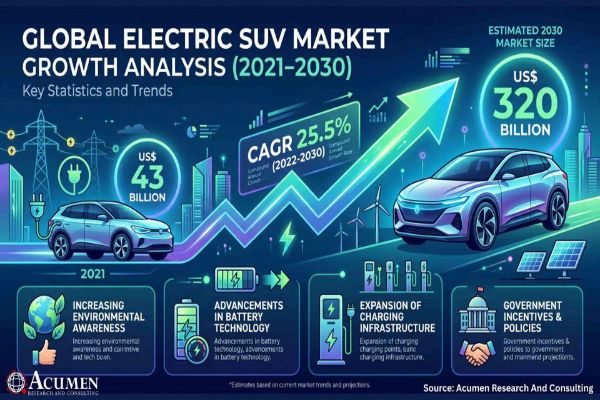
The global electric SUV market was valued at USD 43 billion in 2021. However, the trajectory suggests a high-velocity industry transformation; the market is projected to scale to a staggering USD 320 billion by 2030. This represents a compound annual growth rate (CAGR) of 25.5%, a figure that signals a total disruption of the traditional automotive hierarchy.
Electric SUV Market Strategic Outlook
This transition represents more than a change in fuel source; it is a fundamental replacement of current-generation automobiles to address systemic issues such as rising pollution, global warming, and the depletion of natural resources. By adopting the E-SUV format, manufacturers are meeting the modern family’s demand for spaciousness and safety while radically narrowing the carbon footprint of the most popular vehicle class on the road.
Electric SUV Market Dynamics: Decoding the Catalysts and Hurdles
The growth of the Electric SUV market is defined by a push-pull relationship between rapid technological innovation and the Capex requirements of infrastructure development. While government intervention and shifting economic factors are accelerating adoption, logistical bottlenecks remain a primary concern for long-term segment penetration.
Primary Growth Drivers
Four core pillars are currently sustaining Electric SUV Market expansion:
- Environmental Imperatives: Global awareness of pollution and climate change acting as a brand-loyalty driver.
- Fuel-Efficient Mobility Penetration: A secular shift toward solutions that mitigate reliance on volatile fossil fuel markets.
- Sustained SUV Preference: The multi-decade trend of consumers favoring SUVs and MUVs over estate cars or MPVs.
- Optimization of Battery Economics: Steady reductions in battery pack costs, bringing EVs closer to price parity with ICE counterparts.
Strategic Insight: The Fuel Price Catalyst
Macro-economic volatility serves as a primary revenue booster for the E-SUV sector. Surging fuel prices act as a heavy incentive for consumers to seek insulation through electric propulsion, effectively accelerating the “incumbent pivot” as legacy automakers race to capture this migrating demand.
Electric SUV Market Barriers vs. Strategic Responses
To navigate the current landscape, stakeholders are deploying specific countermeasures against existing market limitations:
| Market Barriers | Strategic Responses & Opportunities |
| Deficit in charging infrastructure | Public-Private Partnerships (PPP) for nationwide DC fast-charging rollouts. |
| High initial Capex for EV networks | Development of self-driving electric technology to enhance vehicle ROI. |
| Premium vehicle price points | Aggressive utilization of strict emission regulations and consumer subsidies. |
Download the Sample Report Pages to explore our detailed infrastructure gap analysis and strategic response modeling.
Beyond these macro-drivers, the specific composition of the market reveals which technical segments are capturing the most significant market share.
Electric SUV Market Segmentation: Propulsion, Type, and Capacity
Identifying high-growth niches within the Electric SUV Market requires a granular understanding of sub-segmentation. The Electric SUV Market is increasingly fragmented between different propulsion technologies and chassis designs tailored to specific demographics.
Propulsion Dynamics: BEV vs. Hybrid
While Battery Electric Vehicles (BEVs) captured the majority share of the market in 2021, Hybrid vehicles are projected for significant growth through 2030.
- The Technical Synergy: Hybrids leverage the dual-engine approach—integrating a gasoline engine with electric motors—to optimize fuel economy and range.
- The Bridge Strategy: Hybrids offer a critical transitional value proposition. For range-conscious consumers in regions where EV potential is hindered by infrastructure gaps, hybrids provide the efficiency of electric power without the range anxiety of pure-electric models.
Vehicle Type: The Rise of the Compact Crossover
The compact crossover segment achieved dominant market penetration in 2021. Built on a “unibody chassis,” these vehicles provide the “smooth ride” and car-like handling desired by urban commuters. They successfully fill a market void, offering high ground clearance and SUV practicality without the prohibitive fuel consumption or maneuvering difficulties of larger, traditional SUV frames.
Seating Capacity: Targeted Demographics
The 5-seater segment currently maintains a dominant position, specifically targeting the “medium income” demographic. These vehicles are “right-priced” and “right-sized” for small families who prioritize car-like smoothness. Conversely, the 6-seater and above segment is poised for considerable growth as larger households transition away from traditional internal combustion minivans.
Regional Powerhouses: The Rise of APAC and European Leadership
The geopolitical center of automotive manufacturing is shifting toward regions that have successfully integrated state policy with industrial output.
Asia-Pacific’s Dominant Trajectory
The Asia-Pacific (APAC) region is the fastest-growing electric SUV market globally. This dominance is underpinned by:
- The China Advantage: Access to economical domestic resources and robust state-level strategic planning.
- The India Growth Story: SUV penetration in India has exploded, moving from 12.59% of the passenger vehicle (PV) sector in 2010-11 to over 25% by 2017. Current projections suggest SUVs will command 40% of India’s PV sector within the next decade.
Europe’s Regulatory Competitive Moat
Europe remains a leading theater for electric SUV market growth, with SUVs now standing as the largest selling vehicle segment in the region. This growth is reinforced by the European Union’s CO2 legislation, which mandates a 15% emission reduction for light and medium vehicles by 2025.
Strategic Synthesis: Regulations as a Market Floor
Strict government regulations serve as a guaranteed demand floor. By mandating emission reductions and facilitating tax refunds, governments create a “competitive moat” for early adopters, ensuring market resilience even during periods of broader economic fluctuation.
Competitive Landscape: Key Players and Strategic Investments
The electric SUV market is defined by intense rivalry as legacy OEMs (Original Equipment Manufacturers) attempt an incumbent pivot against “EV-first” entities.
Core Market Participants
The following organizations are the primary architects of the E-SUV future:
- Tesla
- BYD Company Limited
- BMW Group
- Volkswagen AG
- Ford Motor Company
- Daimler AG
- Honda Motor Co., Ltd.
- Groupe Renault
- Tata Motors
- Kia Corporation
- Volvo Car Corporation
Analysis of Market Entrenchment
These players are not merely competing on vehicle design; they are competing on ecosystem integration. By leveraging government-backed subsidies and public charging infrastructure investments, these companies are effectively lowering the entry barriers for the mass market. Tesla continues to set the benchmark for software-integrated E-SUVs, while BYD has achieved segment leadership through a vertically integrated supply chain in the APAC region.
Frequently Asked Questions
How big was the global electric SUV market in 2021?
In 2021, the global electric SUV market reached a valuation of US$ 43 billion. This baseline reflects the initial wave of high-income early adopters and the first significant shift in fleet electrification strategies by major global automakers.
How fast is global electric SUV market expected to grow during forecast period of 2022 to 2030?
The market is anticipated to expand at a CAGR of 25.5% through 2030. This growth rate significantly outpaces the general automotive sector, signaling a total disruption of the industry and a projected final valuation of US$ 320 billion by the end of the decade.
Who are the key players in electric SUV market?
The landscape is dominated by a mix of specialized EV disruptors and pivoting legacy giants. Key participants include Tesla (software and performance leader), BYD Company Limited (vertical supply chain expert), and traditional powerhouses like Volkswagen AG, BMW Group, Ford, and Daimler AG. Other significant contributors include Honda, Renault, Tata Motors, Kia, and Volvo.
Which region held the dominating position in the global electric SUV market?
The Asia-Pacific (APAC) region held the dominating market share during the analysis period. This is largely attributed to aggressive manufacturing subsidies in China and the rapid adoption of SUV platforms in emerging economies.
Which region exhibited the fastest growing CAGR for the forecast period of 2022 to 2030?
The Asia-Pacific region is projected to register the fastest CAGR. Factors contributing to this include the availability of economical domestic resources, strong state support, and the rising middle-class demand in India, where SUVs are expected to capture 40% of the passenger vehicle market.
What are the current trends and dynamics in the global electric SUV market?
The market is primarily propelled by surging fuel prices, rising environmental mandates, and a secular shift toward fuel-efficient, high-performance utility vehicles. Current dynamics are also heavily influenced by government-led investments in charging infrastructure and the implementation of tax refunds and subsidies that lower consumer entry barriers.
By segment Propulsion, which sub-segment held the maximum share?
The Battery Electric Vehicle (BEV) segment held the maximum market share in 2021. While hybrids are growing as a transitional “bridge” technology, pure electric motors are viewed as the ultimate replacement for internal combustion engines to meet global net-zero targets.
The Road Ahead for Electric SUVs
The projected $320 billion milestone is more than a fiscal target; it is a testament to a permanent change in global consumer behavior. The E-SUV has become the primary vehicle of the 21st century by successfully aligning luxury, utility, and environmental responsibility. As battery costs continue their downward trajectory and infrastructure matures through public-private partnerships, the dominance of the Electric SUV will transition from a market trend to the global automotive standard.