
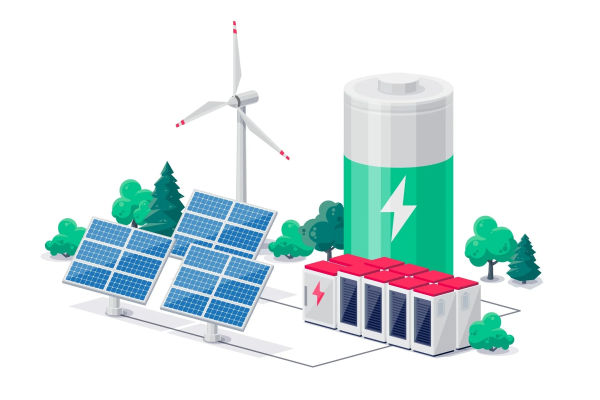
The global energy storage technologies for renewables market is on a transformative growth trajectory, fueled by soaring demand for solar, wind, and other renewable energy systems. With a forecast spanning 2025 to 2034, the market is primed for exponential expansion as nations pursue energy independence, decentralization, and carbon-neutral strategies.
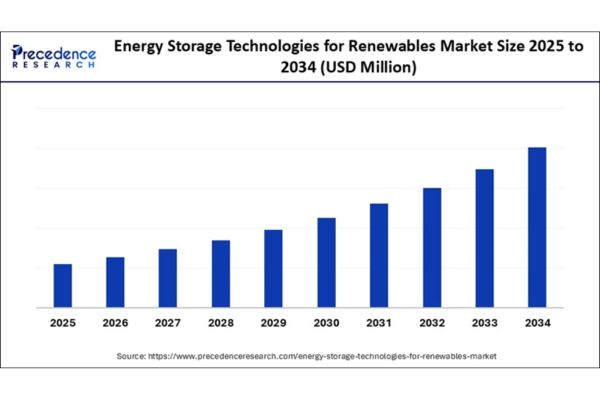
Driven by breakthroughs in lithium-ion batteries, pumped hydro, and AI-enabled grid management, energy storage is no longer a supporting technology, it is the linchpin of the global clean energy transition. North America held the largest share (30%) in 2024, while Asia Pacific is expected to record the fastest CAGR through 2034, signaling a redefined global energy order.
Quick Insights
- Market Base Year (2024): Dominated by North America (30%)
- Forecast Period (2025–2034): Asia Pacific set for fastest growth
- By Technology Type: Electrochemical storage led with lithium-ion batteries (45% share in 2024)
- By Storage Duration: Short-term storage (<4 hours) held 40% market share in 2024
- By Application: Utility-scale power accounted for ~50% of the market in 2024
- By End-Use Sector: Power generation companies represented 55% share in 2024
- Fastest-Growing Segments: Medium-term storage (4–12 hours), mechanical storage, industrial energy users, and microgrids/off-grid applications
Market Dynamics: What’s Fueling the Growth?
Adoption of Renewables Driving Massive Demand
With renewables now mainstream, grid reliability remains a challenge. Energy storage solutions, ranging from lithium-ion batteries to pumped hydro, are increasingly vital to balance fluctuating supply and demand. Between 2024 and 2034, battery capacity is expected to expand to 18.2 GW, reshaping grid resilience.
AI as the New Brain of Energy Storage
Artificial Intelligence is no longer a futuristic concept, it is actively optimizing charging, discharging, and predictive maintenance for energy storage. According to a 2024 BCG survey, nearly 60% of energy leaders expect AI to deliver measurable efficiency gains in renewable optimization and equipment failure prediction within one year.
As UN Secretary-General Antonio Guterres noted, AI data centers consume electricity equal to 100,000 homes, underscoring the urgent need to integrate AI-driven renewables to prevent fossil fuel rebound effects.
Restraints and Cost Pressures
Despite optimism, the high upfront cost of infrastructure remains a challenge. Solar panels, wind farms, and battery storage require substantial capital investments. While costs are declining, affordability and large-scale financing remain barriers in developing economies.
Energy Storage Technologies for Renewables Market Segmentation
- By Technology Type: Electrochemical storage, led by lithium-ion batteries, dominated with 45% share in 2024 thanks to high energy density, fast response, and scalability. Mechanical storage, especially pumped hydro, is vital for large-scale, long-duration needs, while thermal and chemical storage are gaining traction in niche industrial and grid-balancing applications.
- By Storage Duration: Short-term storage (<4 hours) held 40% share in 2024, essential for peak load management and daily solar fluctuations. Medium-term storage (4–12 hours) is set for rapid growth, bridging renewable variability and supporting microgrids and off-grid projects with enhanced stability.
- By Application: Utility-scale power led with ~50% share in 2024, driven by the need to stabilize grids and integrate renewables at scale. Meanwhile, microgrids and off-grid applications are growing fastest, fueled by rural electrification, energy independence, and decentralized power demand.
- By End-Use Sector: Power generation companies dominated with 55% share in 2024, leveraging storage for renewable integration and peaker plant replacements. Industrial energy users are the fastest-growing, adopting large-scale storage to ensure reliability, cut costs, and meet decarbonization goals.
Opportunity and Trend: Is Long-Duration Energy Storage the Next Game-Changer?
While lithium-ion remains dominant, the global spotlight is shifting to Long-Duration Energy Storage (LDES). Capable of storing power for 8 hours to multiple days, LDES technologies, including thermal storage, compressed air, and next-gen battery chemistries, are being positioned as the future enabler of grid stability, renewable penetration, and fossil fuel phase-out.
Global utilities and energy majors are channeling billions into LDES pilots, signaling new revenue streams, lower emissions, and energy democratization.
Expert Quote
“Energy storage technologies are no longer supplementary—they are the backbone of the global energy transition. From lithium-ion dominance to the rise of long-duration storage, the sector is undergoing a revolution. Governments, investors, and corporations must recognize that storage is the key to unlocking renewable energy’s full potential.”
— Dr. Arvind Nair, Principal Consultant, Precedence Research
Regional Insights
North America: Established Leader
With federal incentives, state-level renewable targets, and the Inflation Reduction Act (IRA), North America continues to lead. In 2024, over two-thirds of U.S. utilities credited federal policies as the most influential in accelerating energy storage adoption.
- $27 billion Greenhouse Gas Reduction Fund supports local clean energy finance institutions
- $8.3 billion “Solar for All” program expanding rural electrification
- $4.3 billion in climate pollution reduction grants targeting 36 GW renewable + storage by 2030
Asia Pacific: Fastest-Growing Region
Asia Pacific is set to dominate growth through 2034, driven by industrialization, EV adoption, and government mandates.
- China leads with large-scale solar, wind, and hydropower investments, plus aggressive battery R&D.
- India is fast emerging, with NTPC’s 2025 tender for 1,700 MW/4,000 MWh BESS deployment across 11 sites, landmark in utility-scale storage development.
Europe, Latin America, and Middle East & Africa
Europe remains a policy-driven hub for grid modernization and EV storage. Latin America is increasingly investing in solar-backed storage for remote electrification, while the Middle East & Africa explore storage to balance solar and wind mega-projects with grid constraints.
Energy Storage Technologies for Renewables Market Top Companies
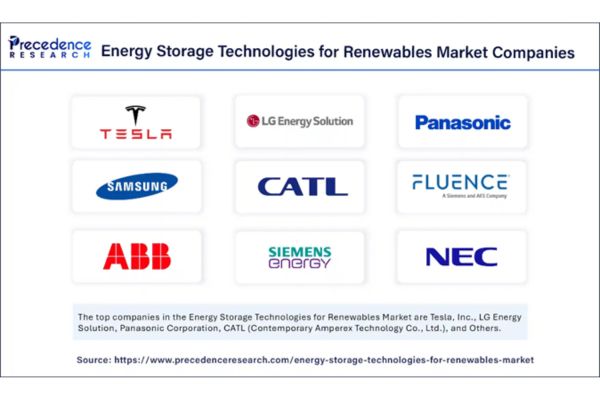
- Tesla, Inc.
- LG Energy Solution
- Panasonic Corporation
- Samsung SDI
- CATL (Contemporary Amperex Technology Co., Ltd.)
- Fluence Energy, LLC
- ABB Ltd.
- Siemens Energy AG
- NEC Energy Solutions
- BYD Company Ltd.
- Johnson Controls International plc
- Enphase Energy, Inc.
- Eos Energy Enterprises, Inc.
- VARTA AG
- Hitachi Energy
- Wärtsilä Corporation
- Saft Groupe S.A.
- General Electric (GE)
- Mitsubishi Electric Corporation
- Northvolt AB
Noteworthy Market Developments
Terraflow Energy’s Gigawatt-Scale Vanadium Flow Battery Project (U.S.)
Terraflow Energy, a Texas-based startup, has unveiled plans for a one-gigawatt energy storage system in Victoria, Texas, capable of powering 250,000 homes for up to ten hours. The project includes a manufacturing facility producing up to 2 GW of vanadium-based flow batteries annually, creating over 1,000 jobs. The technology offers long-duration storage with enhanced safety compared to lithium-ion systems and aims to stabilize grids supporting AI data centers. A complementary 9.6 MW, 5‑hour system in Bellville is expected online by early 2027.
Saudi Arabia & UAE Scale Battery Storage Ambitions
Saudi Arabia aims to exceed 11 GWh of battery storage capacity by end‑2025, with the UAE pursuing a 19 GWh solar-plus-storage project in Abu Dhabi offering 24-hour energy supply. Chinese manufacturers BYD and CATL are leading suppliers, taking advantage of dramatically reduced cell prices—around $50/kWh—to deliver large-scale deployments.
Quidnet Energy’s Geochemical Energy Storage Pilot (U.S.)
Quidnet Energy has pioneered Geochemical Energy Storage (GES) technology: injecting water into underground rock for long-term storage, then releasing it to generate electricity via turbines. In early 2025, a successful megawatt-hour-scale demonstration stored energy for six months without losses. A utility-scale GES project in Texas is slated for 2026 roll-out.
Additional Global Highlights
- UK surges in battery approvals: In Q2 2025, the UK approved 8.4 GW of new battery energy storage systems, double the volume from the previous year, driven by a goal of 95% carbon-free electricity by 2030.
- Australia’s Akaysha Energy gets green light for a 500 MW battery storage facility in South Burnett, launching construction in 2025 and creating ~150 local jobs.
- $950 million investment in Victoria’s energy assets: HMC Capital acquired Neoen’s wind, solar, and battery portfolio in Australia, aiming to assemble a 15 GW renewables pipeline.