

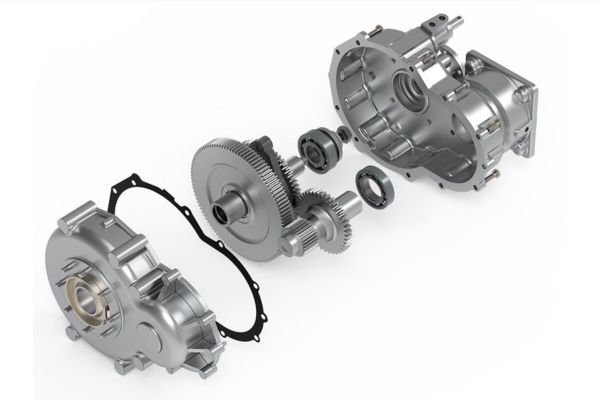
The global Electric Vehicle (EV) Transmission Market is projected to grow from USD 9.72 billion in 2023 to USD 28.74 billion by 2032, expanding at a CAGR of 12.8% during the forecast period. According to Introspective Market Research (IMR), the market is gaining momentum as automakers accelerate EV production, demand rises for drivetrain efficiency optimization, and advanced multi-speed transmission technologies gain traction across passenger and commercial electric vehicles.
Electric vehicle transmissions play a critical role in transferring power from the electric motor to the wheels while optimizing efficiency, torque delivery, acceleration, and range. While single-speed systems dominate mainstream EV platforms, multi-speed and electronically controlled transmission technologies are increasingly attracting investment as automakers seek performance improvements and heavy-duty electrification capabilities.
Quick Insights
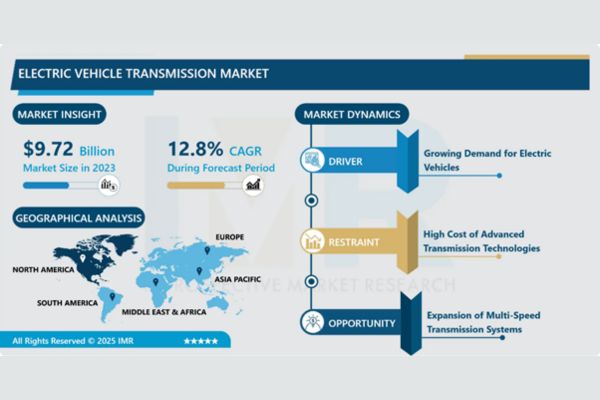
- Market Size (2023): USD 9.72 Billion
- Forecast Size (2032): USD 28.74 Billion
- CAGR (2024–2032): 12.8%
- Dominant Transmission Type: Single-Speed Transmission
- Fastest-Growing Segment: Multi-Speed Transmission
- Leading Vehicle Type: Battery Electric Vehicles (BEVs)
- Leading Regions: Asia-Pacific and Europe
- Key Players: Aisin, BorgWarner, ZF Friedrichshafen, Magna, Schaeffler, Dana
- Core Driver: Growing demand for electric vehicles
- Key Opportunity: Expansion of multi-speed EV transmission systems
- Primary Challenge: High cost of advanced transmission technologies
Revenue Breakdown & Market Segmentation
| Segment Category | Key Insights |
| Base Year | 2023 – USD 9.72 Billion |
| Forecast Year | 2032 – USD 28.74 Billion |
| CAGR | 12.8% |
| By Transmission Type | Single-Speed, Multi-Speed |
| By Vehicle Type | BEV, HEV, PHEV |
| By Component | Gearbox, Electric Motor, Power Electronics, Bearings |
| By End User | OEMs, Aftermarket |
| By Region | North America, Europe, Asia-Pacific, MEA, South America |
- Single-speed transmissions currently dominate due to lower complexity, cost efficiency, and broad compatibility with mainstream BEV platforms.
- Multi-speed systems are emerging as a strategic growth segment in performance EVs and commercial electric vehicles.
What’s Driving Growth? What Trends Are Reshaping the Market?
Why is the EV transmission market becoming strategically important in electric mobility?
- Rapid EV adoption: Expanding EV production is driving direct demand for dedicated transmission systems.
- Efficiency optimization focus: OEMs are using transmission design to improve range and power delivery.
- Growth in commercial EVs: Heavy-duty electric vehicles are creating opportunities for multi-speed architectures.
- E-axle and integrated drivetrains: Manufacturers are integrating motors, inverters, and transmission systems into compact solutions.
- Shift-by-wire and intelligent controls: Electronic transmission control systems are enabling higher precision and performance.
Regional & Segment Analysis
- Asia-Pacific leads due to strong EV manufacturing ecosystems and large-scale electrification programs.
- Europe remains a high-growth region driven by stringent emission regulations and premium EV innovation.
- North America is witnessing rising investment in drivetrain technology and commercial EV platforms.
Segment Insights:
- BEVs hold the dominant share due to dedicated electric drivetrain adoption.
- Multi-speed systems are expected to grow rapidly in performance and heavy-duty use cases.
- OEMs account for the majority of revenue due to factory-installed system integration.
Latest Industry Developments
- ZF Friedrichshafen launched a next-generation 2-speed EV transmission for commercial electric trucks in 2024.
- BorgWarner expanded its e-transmission portfolio through acquisition to strengthen drivetrain capabilities.
- Leading suppliers are accelerating investment in integrated e-axle platforms, combining motors, inverters, and transmissions.
- OEMs are increasing focus on lightweight, compact, high-efficiency transmission systems for next-generation EV architectures.
Challenges & Cost Pressures
- High development costs: Advanced transmission technologies raise system costs.
- Complex engineering trade-offs: Balancing efficiency, torque, and weight remains challenging.
- Single-speed dominance: Simpler architectures reduce urgency for multi-speed adoption in some segments.
- Supply chain pressures: Precision components and electronics add sourcing risk.
Case Study: Multi-Speed Transmission for Electric Trucks
A commercial EV manufacturer deploying two-speed transmission technology in heavy-duty trucks demonstrated improvements in torque management, hill-climb performance, and energy efficiency highlighting the value proposition of advanced transmission systems in freight electrification. This reinforces multi-speed systems as a growing opportunity in commercial EV platforms.