


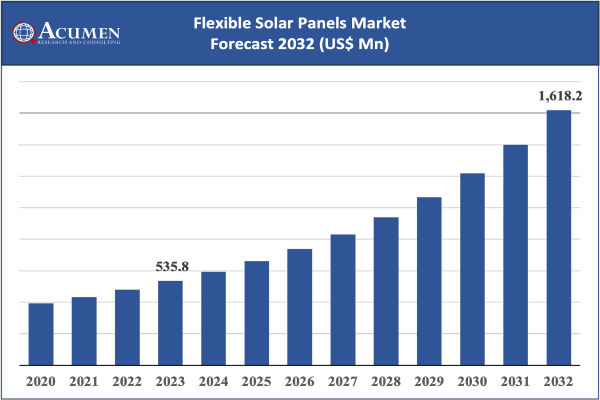
According to Acumen Research And Consulting, the global Flexible Solar Panels Market, valued at USD 535.8 Million in 2023, is forecast to surge to USD 1,618.2 Million by 2032 with an impressive CAGR of 13.4% from 2024 to 2032. As demand for portable, lightweight energy solutions accelerates, flexible photovoltaic (PV) technologies are reshaping the broader solar energy landscape.
1. What Are Flexible Solar Panels?
Unlike rigid, glass‑covered panels, flexible solar panels are crafted using thin-film materials such as amorphous silicon, cadmium telluride, or copper indium gallium selenide (CIGS). These ultra-lightweight panels can be bent and installed on curved surfaces, making them ideal for unconventional applications. They’re increasingly deployed in sectors like aerospace, commercial rooftops, portable chargers, and electric vehicles.
2. Flexible Solar PanelsMarket Data Breakdown
Here’s a snapshot of the flexible solar panels market:
- 2023 Value: USD 535.8 Million
- 2032 Forecast: USD 1,618.2 Million (13.4% CAGR)
- Asia-Pacific led with USD 289.3 Million in 2023
- North America expected to grow at 14.3% CAGR 2024–2032
- CIGS panels held ~45% market share in 2023
- Industrial applications comprised ~40% share
3. Why the Surge in Adoption of Flexible Solar Panels?
The global surge in the adoption of flexible solar panels is not coincidental—it’s the result of several converging technological, economic, and environmental factors. As the world seeks smarter, cleaner, and more adaptable energy solutions, flexible photovoltaics have emerged as a transformative technology across sectors.
Here are the key reasons behind the rising popularity of flexible solar panels:
a) Growing Demand for Lightweight and Portable Renewable Energy Solutions
In contrast to rigid solar panels, flexible alternatives can be easily folded, rolled, or bent—making them ideal for mobile use. Their lightweight nature enables deployment in:
- Off-grid locations
- Camping and outdoor recreation
- Disaster relief efforts
- Wearable electronics
- Military field operations
As consumer lifestyles become increasingly mobile and sustainability-focused, portable solar energy solutions have become more attractive. This mobility factor is a major growth accelerator for the flexible solar panels market.
b) Increased Integration with Electric Vehicles (EVs), RVs, and Boats
The electrification of transport systems has created a unique opportunity for integrated solar charging. Flexible panels can be installed on the curved surfaces of:
- Electric vehicles (EVs)
- Recreational vehicles (RVs)
- Caravans and trailers
- Boats and yachts
Unlike traditional panels, which require flat, rigid mounting, flexible solar panels offer the adaptability needed to conform to aerodynamic vehicle designs. Some automakers are already testing solar car roofs and on-the-go battery trickle charging—boosting demand for durable and efficient flexible PV modules.
c) Supportive Government Policies and Sustainability Mandates
Global policies encouraging renewable energy adoption are significantly contributing to the global flexible solar panelsmarket expansion. Many countries are offering:
- Tax credits and incentives for solar adoption
- Green building mandates requiring BIPV (Building-Integrated Photovoltaics)
- Grants and subsidies for decentralized or rural electrification
- Sustainability targets for transportation and infrastructure
Flexible solar panels play a key role in meeting these goals because they’re easier to integrate into diverse environments, especially where traditional panels aren’t feasible. As public and private institutions prioritize carbon neutrality, flexible solar is gaining institutional backing.
d) Technological Advancements in Thin-Film and Organic PV Materials
Breakthroughs in thin-film solar technology—including materials like CIGS (Copper Indium Gallium Selenide), perovskites, and organic photovoltaics (OPV)—have dramatically improved:
- Conversion efficiency
- Panel durability
- Manufacturing scalability
- Aesthetic integration (color, transparency)
These advances are narrowing the efficiency gap between flexible and traditional crystalline panels while lowering production costs. Emerging technologies such as solar textiles and transparent solar films are pushing innovation into everyday objects—from windows to wearable electronics.
e) Urban Infrastructure and BIPV (Building-Integrated Photovoltaics)
Architectural applications of flexible solar are a fast-growing niche. Developers and municipalities are exploring PV integration into:
- Building facades
- Solar rooftops
- Windows and curtain walls
- Bus stops and public furniture
Because flexible solar panels can be customized to fit curved or irregular surfaces, they offer greater versatility than rigid glass panels. This trend is especially strong in smart city projects and urban areas with limited roof space, making flexible PV a critical enabler of solar-powered infrastructure.
f) Aerospace and Defense Applications
In the aerospace and defense sectors, where performance, weight, and flexibility are paramount, flexible solar panels are widely used for:
- Satellites and high-altitude drones
- Remote surveillance equipment
- Portable military base stations
- Wearable soldier gear
The high power-to-weight ratio of CIGS and organic PV panels makes them a natural fit for missions where every gram matters. Increased military and space-related budgets in the U.S., China, and Europe are further boosting this niche market segment.
g) Growth in Remote Connectivity and Industrial IoT
As industrial IoT (Internet of Things) devices and remote sensors become more common in agriculture, mining, telecom, and oil & gas, there’s growing demand for autonomous power sources. Flexible solar panels offer:
- Easy deployment on curved or temporary structures
- Lightweight options for drones or mobile towers
- Resilience in harsh environmental conditions
This positions flexible PV systems as a key enabler of off-grid, low-maintenance IoT applications.
h) Consumer Lifestyle Trends Favouring Eco-Conscious Products
From solar backpacks and power banks to camping lanterns and off-grid mobile homes, eco-conscious consumers are demanding renewable alternatives for their power needs. This surge in sustainable consumer products is fuelling partnerships between solar manufacturers and:
- Outdoor and lifestyle brands
- Consumer electronics companies
- Startups in wearable tech
Flexible solar fits naturally into this product ecosystem, offering a compact and green power source for the modern digital nomad.
i) Declining Production Costs and Improved Durability
Manufacturing innovations—particularly in roll-to-roll printing and lightweight encapsulants—have significantly reduced the cost of flexible solar panels. As the technology matures:
- Efficiency rates are rising (approaching 20–25%)
- Durability is improving with waterproof and UV-resistant coatings
- Lifespan is extending, making them viable for long-term installations
These improvements are overcoming early concerns about panel fragility and driving adoption in commercial and industrial segments.
4. Flexible Solar Panels Market Regional Dynamics
Asia-Pacific (APAC): Dominating Production and Deployment
2023 Market Share: USD 289.3 Million
CAGR (2024–2032): Expected above 13%
Key Countries: China, India, Japan, South Korea, Australia
Why It Leads:
- China is the world’s largest manufacturer of solar panels, including thin-film and flexible PV technologies. It benefits from massive economies of scale, government subsidies, and a vertically integrated supply chain.
- India and Japan are aggressively investing in renewable energy infrastructure as part of national sustainability missions like India’s “Green Energy Corridor” and Japan’s post-Fukushima solar revolution.
- South Korea is promoting solar R&D and smart grid integration through government-led innovation zones.
- Australia, with abundant sunlight and strong off-grid energy needs in rural areas, is a hotbed for residential and portable solar adoption.
Regional Drivers:
- Low-cost manufacturing hubs
- Government subsidies and policy mandates (e.g., China’s 14th Five-Year Plan, India’s solar rooftop programs)
- High demand for rural electrification
- Solar-integrated wearables and mobile charging gaining traction
North America: A Hub for Innovation and Portable Solar
2023 Market Value (Est.): Significant share led by the U.S.
CAGR (2024–2032): ~14.3%
Key Countries: United States, Canada
Why It’s Growing Fast:
- The United States is seeing rapid expansion in flexible solar adoption, particularly in off-grid, outdoor recreation, defense, and electric vehicle segments.
- Federal and state incentives under policies like the Inflation Reduction Act (IRA) are boosting investment in solar R&D and manufacturing.
- The region is home to some of the most innovative companies in the space, including MiaSolé, Ascent Solar, and PowerFilm, known for aerospace-grade flexible solar solutions.
Regional Drivers:
- Federal tax credits and renewable energy grants
- High demand for solar-powered camping and RV accessories
- Growth in EVs and the electrification of last-mile delivery
- Defense sector use in military field equipment
- Increasing adoption in BIPV and urban infrastructure
Europe: Sustainability and BIPV Integration at the Forefront
2023 Market Position: Strong adoption in Western Europe
CAGR (2024–2032): 12–13%
Key Countries: Germany, France, UK, Netherlands, Norway
Why It’s Gaining Momentum:
- Europe is aggressively pursuing Net-Zero by 2050, and flexible PV technologies are central to building-integrated photovoltaics (BIPV) and urban energy systems.
- Countries like Germany and Netherlands lead in sustainable architecture, using solar windows, canopies, and façade installations.
- Scandinavia is embracing flexible panels for cold-climate EVs, public transportation, and off-grid cabins.
Regional Drivers:
- Stringent emissions targets and carbon pricing policies
- Strong public-private investment in green building
- Growth in architectural solar design and energy self-sufficient homes
- Innovations in perovskite and OPV from European labs
Latin America: Rural Electrification and Decentralized Power
2023 Market Size: Moderate, with strong growth outlook
Key Countries: Brazil, Chile, Mexico, Argentina
Why It’s Emerging:
- Many rural areas still lack reliable grid access, making flexible solar an ideal solution.
- Governments are supporting mini-grid and micro-grid solutions in the Amazon, Andes, and remote agricultural zones.
- Growing use of flexible solar in mobile telecom towers, public lighting, and disaster relief.
Regional Drivers:
- Demand for low-cost, modular solar systems
- Climate challenges driving renewable focus
- NGO and government funding for off-grid energy access
- Rising awareness among smallholder farmers and rural industries
Middle East & Africa (MEA): Unlocking Solar Potential in Harsh Environments
2023 Market Share: Niche, with high potential
Key Countries: UAE, Saudi Arabia, South Africa, Kenya, Nigeria
Why It’s an Opportunity Zone:
- Some of the highest solar irradiance levels globally make MEA ripe for solar development.
- Flexible panels are favoured in mobile healthcare, remote schools, and solar-powered kiosks.
- Governments are increasingly investing in solar under long-term energy diversification plans (e.g., Saudi Vision 2030, South Africa’s REIPPPP).
Regional Drivers:
- Off-grid demand in rural and refugee settlements
- Interest in solar-powered desalination and water pumping
- Solar integration in oilfield IoT and telemetry systems
- Harsh climate compatibility (lightweight, UV-resistant materials)
Comparative Regional Summary Table
| Region | 2023 Value Estimate | CAGR (2024–2032) | Key Drivers |
| Asia-Pacific | USD 289.3 Million | ~13% | Manufacturing hub, policy support, electrification |
| North America | High Share (Est.) | ~14.3% | EV integration, BIPV, consumer gadgets |
| Europe | Moderate | ~13% | Net-zero targets, BIPV adoption, solar architecture |
| Latin America | Emerging | ~11–12% | Off-grid demand, agricultural energy needs |
| MEA | Niche but growing | ~10–12% | Mobile infrastructure, solar for utilities and development projects |
5. Key Drivers, Restraints & Opportunities
Drivers
- Mobility: lightweight energy for portable systems
- Tech Gains: efficiency via OPV and perovskite innovation
- Regulations: green subsidies & sustainability mandates
Restraints
- Cost: still more expensive than rigid PV
- Durability: shorter lifespan in harsh conditions
- Efficiency gap vs. silicon panels
Opportunities
- EV integration: solar roofs/panels for charging
- BIPV: solar textiles, windows, facades
- Portable tech & wearables: smart fabrics & IoT
6. Segmentation Insight
By Material
- CIGS dominates with >45–55% share
- a-Si, CdTe, OPV, perovskite fast-growing
By Application
- Industrial/Commercial (primary) ~40%
- Residential ~30%
- Mobile/Electronics 20% and rising
- Aerospace & EV are emerging segments
7. Major Players & Innovation
Key players actively shaping the flexible solar panels market include:
MiaSolé, Alta Devices, Global Solar Energy, Enecom, SunPower, Flisom, Solbian, Sun Harmonics, Powerfilm
- MiaSolé leads CIGS development with panel efficiencies up to 20.5%
- Flisom uses roll-to-roll CIGS manufacturing to lower costs and win BIPV and mobility contracts
- Ascent Solar produces high-density CIGS panels (48 W/kg), ideal for aerospace/EVs
Emerging tech, such as flexible perovskite and tandem solar cells, are pushing device efficiency to nearly 30% in labs.
8. Industry Trends & Future Outlook
Solar Textiles & Wearables
Innovations in solar cell fabric, with integrated photovoltaic fibers, are enabling power-generating clothes, backpacks, and tents.
EV Integration
The market’s next frontier: charging cars on the go—solar roofs for buses, trains, or delivery vehicles.
BIPV & Smart Cities
Flexible PV is blending into architecture with solar windows and building facades—smart power becomes structural.
Circular Manufacturing
Attention is shifting to recyclable substrates and eco-encapsulants—offering sustainable disposal and green credentials.
9. Recommendations for Stakeholders
- Manufacturers: Scale up OPV/perovskite R&D and expand BIPV collaborations with construction sectors.
- Investors: Watch leaders like MiaSolé and Ascent Solar innovating perovskite and CIGS tech.
- Governments: Continue incentives for renewable energy—ushering flexible solar into rural electrification and EV charge infrastructure.
The Flexible Solar Panels Market is entering a high-growth phase, with a forecast reaching USD 1,618.2 Million by 2032 at a 13.4% CAGR. With its increasing application in EVs, portable power, BIPV, and solar textiles, it is transforming how and where we harness sunlight. Major players and emerging technologies—such as CIGS, OPV, and perovskite—are shaping a future where solar panels are lightweight, versatile, and seamlessly integrated into daily life.
For investors, policymakers, and industry professionals, the message is clear: flexible solar is not just a niche technology—it’s a catalyst for decentralized, ubiquitous, and sustainable energy systems.