
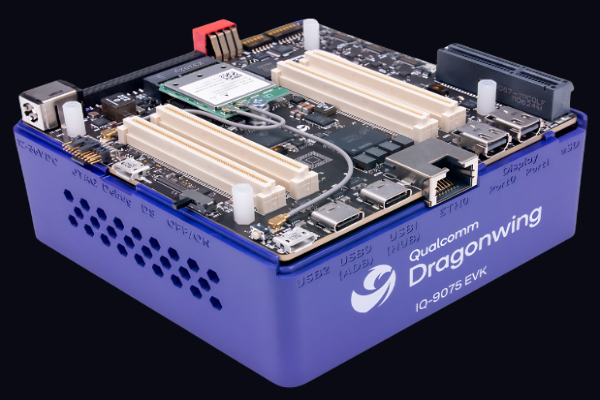
Forlinx Embedded has expanded its edge AI portfolio with two powerful platforms featuring Qualcomm’s Dragonwing IQ-9 and IQ-8 series. The new lineup includes the FET9075AA-C System-on-Module (SoM) and OK9075AA-C single-board computer (SBC), powered by the Qualcomm QCS9075 processor, alongside the FET8275AA-C SoM and OK8275AA-C SBC, which are built around the Qualcomm QCS8275 processor.
The two platforms made their first public appearance at Forlinx Embedded’s booth during electronica 2026 in Munich, Germany, in November. Alongside the new hardware, Forlinx presented two application demonstrations highlighting the platforms’ capabilities in multimodal AI retrieval and multi-channel intelligent video analytics.
By combining high-performance computing hardware with practical edge AI solutions, Forlinx aims to help developers and industrial customers accelerate the development of intelligent vision, industrial safety, smart surveillance and other AI-driven applications.
Two Edge AI Platforms Designed for Different Performance Requirements
Built on Qualcomm’s Dragonwing IQ-9 and IQ-8 platforms, the new Forlinx products provide two levels of edge AI computing performance to address a range of industrial application requirements.
FET9075AA-C SoM: 100 TOPS for Advanced Edge AI
The FET9075AA-C is powered by the Qualcomm QCS9075 processor, featuring eight Kryo Gen 6 CPU cores running at up to 2.36 GHz and a 100 Dense TOPS NPU for demanding on-device AI workloads.
The module integrates 36GB LPDDR5 memory and 256GB UFS 3.1 storage, providing the computing resources required for multi-model inference, high-resolution machine vision and multimodal AI applications.
It also features an Adreno 663 GPU, Adreno VPU 765, a dedicated four-core real-time subsystem and rich industrial interfaces, including TSN-enabled Ethernet, PCIe Gen4 and CAN-FD connectivity. With an operating temperature range of -40°C to +85°C, the module is designed for demanding industrial environments.
The accompanying OK9075AA-C SBC provides a ready-to-use hardware platform for application development and evaluation, featuring four MIPI CSI camera interfaces, four DisplayPort 1.4 outputs supporting 4K@60fps, triple Ethernet, eight isolated CAN-FD channels and two isolated RS485 interfaces.
FET8275AA-C SoM: 40 TOPS for Industrial Edge AI
The FET8275AA-C is based on the Qualcomm QCS8275AA processor, featuring an eight-core heterogeneous Kryo CPU architecture and a 40 TOPS NPU.
It integrates 12GB LPDDR5 memory and 256GB UFS 3.1 storage, offering a balanced combination of AI computing performance, processing efficiency and industrial connectivity.
The module also features an Adreno 623 GPU, a dedicated four-core real-time subsystem, TSN Ethernet, PCIe Gen4 and multiple camera interfaces. These capabilities make it suitable for industrial vision, intelligent monitoring, robotics and real-time control applications.
The accompanying OK8275AA-C SBC provides a practical evaluation platform with dual Ethernet, four isolated CAN-FD interfaces, two isolated RS485 interfaces, three MIPI CSI camera connectors and M.2 expansion options for wireless connectivity.
Both SBCs are designed to simplify hardware evaluation and application development, enabling developers to focus on AI algorithms and system integration without first designing a custom carrier board.
Two AI Demonstrations Showcased at electronica 2026
To demonstrate how the new platforms can support real-world edge AI applications, Forlinx presented two application solutions at its electronica 2026 booth.
1. IQ9075-Based Multimodal Text-to-Image Retrieval
Powered by the Qualcomm Dragonwing IQ-9075 platform, this solution demonstrates how users can search for specific visual targets in video footage simply by entering text descriptions.
Unlike conventional video surveillance systems that rely on manual playback or predefined search conditions, the solution combines object detection, tracking and cross-modal retrieval to make visual information easier to locate.
The workflow begins with real-time video acquisition from a USB camera. YOLO26 performs object detection and tracking, identifying targets and maintaining their tracking information. SigLIP2 then converts the target images into feature embeddings, which are stored in a local vector database.
When a user enters a natural-language description, the system encodes the text into a feature vector and performs similarity-based retrieval against the locally stored image embeddings. It then returns the images that best match the description, ranked by similarity.
With the IQ-9075’s 100 TOPS AI computing capability, the solution demonstrates the potential of multimodal AI retrieval directly on an edge device.
Key advantages include:
- High-performance edge AI: 100 TOPS of AI computing power supports demanding multimodal inference workloads.
- Local text-image retrieval: Image encoding, text encoding and similarity matching are performed locally, reducing dependence on cloud services.
- Enhanced data privacy: Image features and retrieval operations remain on the device, helping keep sensitive video data within the local environment.
Potential applications include personnel search in industrial parks and exhibition venues, security surveillance and video traceability, as well as customer-flow analysis in smart retail environments.
2. IQ8275-Based Multi-Channel AI Video Analytics
Powered by the Qualcomm Dragonwing IQ-8275 platform, this solution demonstrates multi-channel video processing and AI inference for industrial safety monitoring.
The system supports 36 video streams, consisting of four USB camera inputs and 32 local video streams. Through a coordinated hardware and software processing pipeline, it integrates video decoding, image preprocessing, AI inference and result visualization.
The VPU handles parallel hardware video decoding, while the GPU performs image preprocessing, including scaling, format conversion and DMA-BUF-based data handling. The NPU then executes parallel inference using QNN-compiled YOLOv8 models and customized industrial safety algorithms.
Detection results are overlaid on the corresponding video streams and displayed in a multi-window layout.
The solution is designed to support independent parallel processing across multiple video channels, with fair task scheduling and real-time QNN inference. It demonstrates the ability to maintain smooth video playback while switching between multiple streams and running AI detection tasks concurrently.
Key capabilities include:
- 40 TOPS edge AI computing: Supports multi-channel AI inference workloads.
- High-concurrency video processing: Combines parallel hardware decoding, GPU preprocessing and NPU inference into an end-to-end pipeline.
- Industrial safety detection: Supports customized models for identifying people, vehicles, objects and environmental hazards, including missing safety helmets, smoke, fire and waste.
The solution is suitable for factory safety monitoring, centralized video surveillance across industrial parks and large-screen monitoring centers.
Bringing Edge AI from Hardware to Real-World Applications
The launch of the FET9075AA-C and FET8275AA-C platforms represents another step in Forlinx Embedded’s development of high-performance Qualcomm-based edge AI solutions.
From 100 TOPS multimodal AI retrieval to 40 TOPS multi-channel video analytics, the two demonstrations at electronica 2026 illustrated different ways of applying edge AI computing to industrial and commercial scenarios.
Beyond hardware platforms, Forlinx provides embedded software support, hardware customization and system-level development services to help customers move from platform evaluation to product integration and deployment.
With the new Qualcomm Dragonwing-based SoMs and development kits, Forlinx continues to expand its edge AI portfolio, supporting developers and industrial customers in building intelligent, connected and reliable embedded systems.