
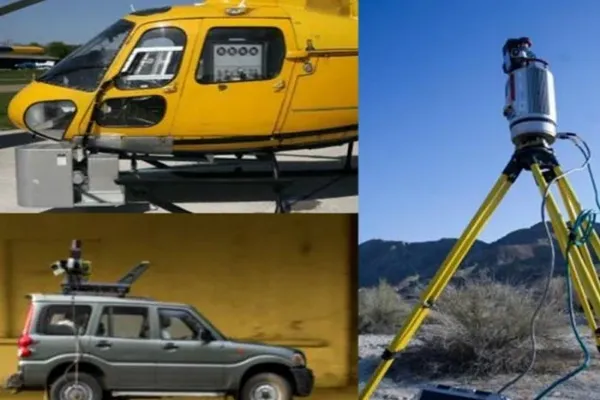
Genesys International Corporation has announced that it has won a major contract from the National Mission for Clean Ganga (NMCG), under the Ministry of Jal Shakti, Government of India. The assignment involves conducting an aerial LiDAR survey along with geotagged videography of the River Ganga’s drainage network. Covering Uttar Pradesh, Bihar, Jharkhand, and West Bengal, the project will deploy both manned aircraft and UAVs/drones to collect detailed, high-resolution geospatial data of the river corridor and its connected drainage systems. A key highlight of the project is the rapid data acquisition capability enabled by Genesys’ integrated sensor systems.
The assignment includes aerial LiDAR survey, photogrammetry, orthorectified imagery, and geotagged videography of natural and manmade drainage systems merging into the river. The project will generate a high-accuracy, decision-ready geospatial dataset to support river-corridor assessment, drainage identification, terrain understanding, and downstream planning, monitoring, and intervention. Key outputs include 3D LiDAR point cloud, orthorectified imagery, annotated aerial video, and geotagged drainage information, creating a robust digital foundation for technical review and river management.
Mr. Sajid Malik, Chairman and Managing Director, Genesys International, said: “We are proud to have secured this important assignment in support of the mission of Clean Ganga. This project highlights how manned aerial survey systems and unmanned aerial vehicles can together create river intelligence at scale. We believe this is an important emerging geospatial vertical, with the potential to support environmental restoration, wastewater planning, floodplain management, and multiple development use cases across India’s river systems.”
The engagement also reflects the growing promise of river intelligence as a strategic geospatial vertical. By combining LiDAR, aerial imagery, and drone videography of drains and outfalls, the resulting dataset can support multiple use cases, including drain and confluence mapping, pollution hotspot identification, wastewater interception planning, floodplain and terrain analysis, river-edge infrastructure planning, environmental compliance monitoring, and digital decision-support systems for basin management.