
Overview
Wearable medical devices are becoming an important part of modern healthcare. Continuous glucose monitors, ECG patches, smartwatches and connected vital-sign monitors help collect patient data outside hospitals. These devices need reliable wireless connectivity to share health information with healthcare professionals and remote monitoring platforms.
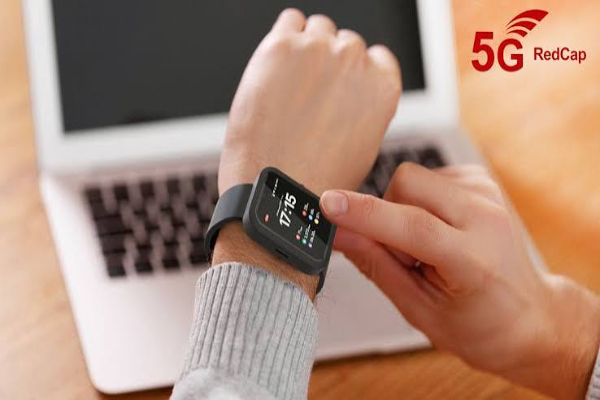
However, conventional 5G modems can be too complex, expensive and power-intensive for small, battery-operated medical wearables. 5G RedCap (Reduced Capability) offers an alternative. Introduced in 3GPP Release 17, this technology simplifies 5G connectivity for devices that require moderate data speeds without the advanced features of high-performance 5G smartphones.
By reducing modem complexity and bandwidth requirements, RedCap creates new possibilities for compact, connected medical devices. It could support the next generation of wearable healthcare technology, particularly in remote patient monitoring, cardiac care and rehabilitation.
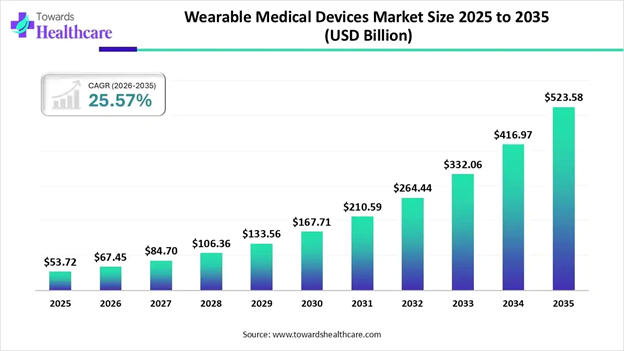
The global wearable medical devices market size is calculated at USD 53.72 billions in 2025, grew to USD 67.45 billion in 2026, and is projected to reach around USD 523.58 billion by 2035. The market is expanding at a CAGR of 25.57% between 2026 and 2035.
What Is 5G RedCap and How Is It Different from Conventional 5G?
5G RedCap is a reduced-capability version of 5G New Radio (NR). It is designed for connected devices that need more performance than basic low-power IoT technologies but do not require the high data speeds of conventional 5G.
RedCap reduces hardware complexity through narrower bandwidth, fewer antenna requirements and limited support for certain advanced radio features. This can help manufacturers develop smaller and potentially more power-efficient connected devices.
The following table highlights the key differences:
| Feature | Conventional 5G | 5G RedCap |
| Main purpose | High-speed connectivity | Moderate-speed IoT connectivity |
| Bandwidth in FR1 | Supports wider bandwidths | Maximum 20 MHz |
| Antenna configuration | Advanced MIMO support | Simplified antenna configuration |
| Hardware complexity | Higher | Reduced |
| Suitable applications | Smartphones and high-performance devices | Wearables, sensors and industrial IoT |
| Design priority | High data performance | Balance of performance, size and power consumption |
Under commonly cited 3GPP Release 17 configurations, RedCap can support theoretical peak data rates of approximately 150 Mbps download and 50 Mbps upload. Actual speeds depend on network conditions and device configuration.
For medical wearables, this level of connectivity can be sufficient for transmitting ECG readings, heart-rate measurements, temperature data and other patient information.
How 5G RedCap Modems Work in Wearable Medical Devices
A RedCap-enabled medical wearable combines sensors, a processor, a cellular modem, an antenna and a battery. Each component plays a role in collecting, processing and transmitting patient information.
First, medical sensors collect physiological data such as heart rate, ECG signals, body temperature and movement. An embedded processor filters the readings and prepares the information for transmission.
The 5G RedCap modem then sends the data through a compatible 5G Standalone (SA) network to a healthcare platform or remote monitoring system. Healthcare professionals can access the information and review relevant changes.
Unlike Bluetooth-based devices, cellular-connected wearables can transmit data directly through a mobile network without depending on a nearby smartphone or home Wi-Fi connection. This can be useful for patients who need monitoring while travelling or living away from healthcare facilities.
Key Technology Trends in 5G-Connected Medical Wearables
1. Continuous Remote Patient Monitoring
Remote patient monitoring is one of the important applications of RedCap connectivity. Wearable ECG patches, heart-rate monitors and connected vital-sign devices can transmit selected health measurements to remote monitoring platforms.
This can help healthcare providers follow patients after hospital discharge, monitor long-term conditions and review health information between appointments. It may also reduce dependence on frequent in-person monitoring for suitable patients.
2. Compact and Power-Efficient Wearable Designs
Medical wearables have limited space for batteries, antennas and electronic components. Conventional 5G hardware can create design challenges because of its complexity and power requirements.
RedCap simplifies modem architecture by reducing bandwidth and certain advanced radio features. This gives manufacturers more flexibility to develop compact wearable devices. However, actual battery performance still depends on transmission frequency, network coverage, sensor activity and power-management design.
3. Integration with AI-Based Health Analytics
The combination of wearable sensors, 5G connectivity and artificial intelligence can improve how healthcare data is collected and analysed.
For example, an ECG wearable can collect heart activity and transmit selected readings to a connected platform. AI-based software can analyse the information and identify patterns that may require further medical assessment.
RedCap supports the communication process, while AI systems perform the analysis. This combination could strengthen remote monitoring, although clinical decisions must remain supported by validated medical processes.
4. Connected Rehabilitation and Elderly-Care Devices
Wearable motion sensors, fall-detection devices and connected rehabilitation equipment can use cellular connectivity to share movement-related information with healthcare teams.
For example, a rehabilitation wearable can record a patient’s movement patterns and transmit progress data to a monitoring platform. This can help professionals follow recovery outside hospitals.
5. Development of Enhanced RedCap
3GPP Release 18 introduced enhanced RedCap (eRedCap), which targets devices with lower data-rate requirements and further opportunities to reduce hardware complexity.
This development could support simpler medical sensors and connected devices that do not require the full performance of standard RedCap. It may also give manufacturers more flexibility when selecting connectivity solutions for different wearable applications.
Components and Technologies Used in RedCap Medical Wearables
Developing a RedCap-enabled wearable requires several electronic and software components.
The 5G RedCap modem provides cellular connectivity, while the radio-frequency (RF) front-end includes filters, amplifiers and antenna-matching components that support wireless communication.
Medical sensors such as ECG electrodes, optical sensors, temperature sensors and accelerometers collect patient information. Microcontrollers and processors manage sensor readings, local processing and device operations.
Power management integrated circuits regulate energy consumption and support battery operation. Embedded software manages connectivity, data processing, security and firmware updates. Cloud platforms receive and process transmitted information for authorised healthcare professionals.
Semiconductor companies are also developing connectivity platforms for this category. For example, MediaTek’s M60 platform supports 3GPP Release 17 RedCap features and targets compact, power-conscious IoT and wearable applications.
Challenges and Risks for Medical Device Manufacturers
Despite its potential, RedCap adoption in medical wearables involves several technical and commercial challenges.
Battery performance: Reduced modem complexity does not automatically guarantee longer battery life. Frequent data transmission, weak network coverage and continuous sensor activity can increase power consumption.
Network availability: RedCap requires compatible 5G Standalone network support. Coverage and operator readiness vary across countries, which may restrict adoption in some regions.
Data security and patient privacy: Connected medical devices transmit sensitive health information. Manufacturers must implement encryption, secure authentication, access controls and protected software updates.
Medical validation and compliance: Wearables intended for clinical use must meet applicable medical-device safety, accuracy and regulatory requirements. Reliable wireless connectivity alone does not establish clinical validity.
Integration costs: Manufacturers must consider modem certification, antenna design, network testing, cloud infrastructure and connectivity expenses before commercialising products.
Opportunities for Hospitals, Manufacturers and Investors
5G RedCap can create opportunities across the connected healthcare ecosystem.
Hospitals can use cellular-connected wearables to support remote patient monitoring and follow-up care. Medical device manufacturers can explore new product designs, including cardiac patches, wearable vital-sign monitors and connected rehabilitation devices.
Telecom operators can develop RedCap connectivity services for healthcare and other IoT applications. Semiconductor companies and component suppliers may find opportunities in modem development, RF components, antenna systems and low-power electronics.
Investors can also monitor developments in connected medical devices, remote monitoring platforms and healthcare data infrastructure as RedCap-compatible networks and products become more widely available.
What Should Industry Watch Next?
The adoption of 5G RedCap in medical wearables will depend on more than modem development. Network availability, battery optimisation, device certification, data security and integration with hospital information systems will influence its commercial success.
As 5G Standalone networks expand, RedCap could become an important connectivity option for medical wearables that need more capability than basic IoT networks but do not require conventional 5G smartphone performance.
For hospitals and manufacturers, the opportunity is to develop connected devices that make continuous patient monitoring more practical and accessible. However, clinical reliability, patient safety and secure data handling must remain central to every application.
Source: https://www.towardshealthcare.com/insights/strategic-wearable-medical-devices-market-sizing
About Author
Payal Rabde is a Healthcare Market Research Analyst at Towards Healthcare Research & Consulting with over 4+ years of experience in pharmaceutical, biotechnology, medical device, and healthcare market research. She holds an MBA in Pharmaceutical-Biotechnology Management and a B.Pharm, specializing in market analysis, forecasting, competitive intelligence, and strategic healthcare insights.
About Towards Healthcare Research and Consulting
Towards Healthcare Research & Consulting is a global strategy consulting firm with a presence in both Canada and India. We provide innovative solutions customized to the healthcare sector, helping business leaders overcome challenges and accelerate growth. We specialize in delivering advanced technological solutions, clinical research services, and powerful data analytics. Our focus is on building meaningful partnerships that foster innovation and deliver actionable insights to drive success in healthcare.