

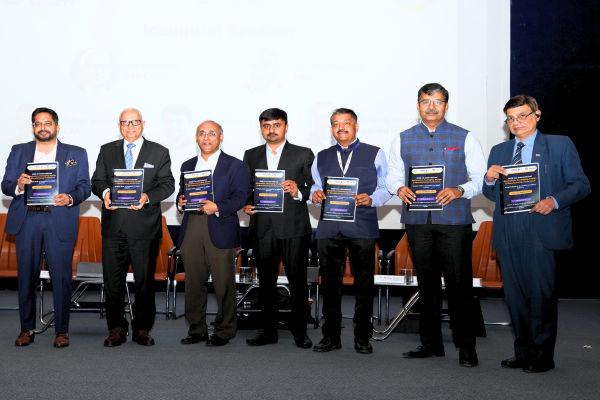
The first International Electronics, Packaging, Design & Manufacturing Conference (EPDMC 2026) concluded at Manav Rachna International Institute of Research and Studies (MRIIRS). The three-day event brought together global leaders from the semiconductor industry, along with researchers, industry experts, startups, and policymakers. Organised under the IEEE Electronics Packaging Society in collaboration with the IEEE EPS Delhi Chapter, the conference was held under the theme “Bridging Skills and Innovation for India’s Industry.”
Dr. Prashant Bhalla, President of Manav Rachna Educational Institutions, noted, “India’s electronics production has crossed $100 billion, and the electronic system design and manufacturing sector is emerging as a key pillar of economic growth. While India is recognised for its semiconductor design talent, we are strengthening manufacturing, packaging, testing, and system integration capabilities to build a resilient ecosystem.”
Ajit Manocha, President and CEO of SEMI, delivered the keynote, stating, “We are at a massive inflection point. Global IC revenue is projected to reach $1 trillion in 2026 and $2 trillion by 2035, driven by IoT, AI, and quantum technologies. AI is accelerating innovation, enabling more functionality per device and more devices per system, while redefining energy efficiency for data centres. Heterogeneous integration and advanced packaging will support high-performance computing, automotive, medical, and emerging applications over the next decade.”
Ravi Mahajan, Fellow, Advanced Packaging Technology Manufacturing at Intel Corporation, highlighted the role of heterogeneous integration and AI in energy-efficient, high-performance systems. “Data centres consume massive amounts of power, and improving efficiency is both an economic and environmental imperative. Heterogeneous integration is the way forward. The Heterogeneous Integration Roadmap (HIR) unites ecosystems across computing, mobile, aerospace and defence, medical, automotive, and IoT, integrating advances in materials, photonics, sensors, design, manufacturing, test, and thermal management.”
Mahajan added, “AI combined with heterogeneous integration opens tremendous opportunities for research, innovation, and technology development. The roadmap helps countries and companies navigate the geopolitical, technological, and economic shifts in the semiconductor ecosystem. It is our roadmap, and collectively, we will drive this forward.”
Prof. (Dr.) Ashwini Kumar Aggarwal, Founder & Chair of the IEEE EPS NCR Chapter, shared the vision behind EPS and EPDMC 2026. “While the IEEE Delhi Section has 8,700 members, there was no dedicated platform for electronics packaging engagement in northern India. EPS was launched to address this, and over the past year, we conducted 17 events without relying on IEEE resources. About a year ago, we conceptualised EPDMC to bring together academia, industry, and global leadership to strengthen India’s electronics ecosystem.”
Aggarwal explained, “The conference shifts the focus from volume manufacturing to creating value and integration across the supply chain. Academic tracks are contributed by leading universities, while corporate partners support industry tracks. Discussions cover emerging technologies, including quantum systems, and strategies to strengthen India’s semiconductor ecosystem. Supported by Dr. Ravi Mahajan and Aditya Sonocha for global guidance, the conference promotes mentorship, collaboration, and industry-academia networking.”
The programme featured technical tracks on heterogeneous integration, 3D ICs, fan-out and wafer-level packaging, reliability and thermal management, AI-driven optimisation, and sustainable semiconductor manufacturing. Panels addressed skill development, OSAT and EMS readiness, photonics integration, and applications across automotive, aerospace, IoT, and quantum technologies.
Aligned with Make in India and the India Semiconductor Mission, EPDMC 2026 included the release of qualification packs for semiconductor packaging and sessions on accelerating AI through high-bandwidth hybrid photonics, strengthening design-for-manufacturing and design-for-packaging alignment.
Dr. Umesh Dutta, CEO, MRIIF and Associate Professor, Department of ECE, emphasised, “The conference is a collaborative platform for industry, academia, and ecosystem stakeholders to enhance capability building across the semiconductor value chain.” Sustainability is embedded across sessions, covering wide bandgap semiconductors like SiC and GaN, and energy-efficient AI architectures using advanced interconnects and photonics.
The conference programme featured advanced technical sessions, expert tutorials, and industry-focused workshops across semiconductor design, manufacturing, packaging, and emerging technologies. Dr. Meena Mishra, Outstanding Scientist (OS) and Director, Solid State Physics Laboratory (SSPL), DRDO, spoke on the importance of electronics manufacturing from India’s perspective and emphasised the need to strengthen capabilities across the semiconductor value chain, including materials, fabrication, packaging, and system-level integration.










 concluded at MRIIRS.)