
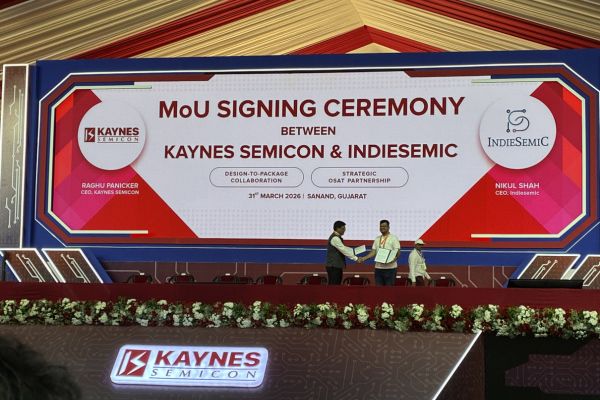
IndiesemiC, a fabless semiconductor and chip design firm, has entered into a Memorandum of Understanding (MoU) with Kaynes Semicon, a prominent Outsourced Semiconductor Assembly and Test (OSAT) provider located in Sanand, Gujarat. This collaboration represents a strategic move to strengthen India’s semiconductor ecosystem by combining domestic chip design with local manufacturing and testing capabilities. The partnership will focus on the qualification, assembly, and testing of QFN40, QFN64, and other agreed-upon semiconductor packages for IndiesemiC’s expanding range of ultra-low power, compact System-in-Package (SiP) modules and System-on-Chip (SoC) solutions.
The objective of this MoU is to create a scalable and reliable manufacturing pathway for Indiesemic’s semiconductor products, while leveraging Kaynes Semicon’s advanced OSAT infrastructure and packaging expertise. At a time when global supply chain disruptions and strategic technology dependencies are prompting companies to rethink manufacturing resilience, the partnership reflects a shared vision to support the growing demand for locally designed and locally supported semiconductor solutions. It also aligns with India’s broader push towards building a more integrated, self-reliant, and future-ready semiconductor value chain.
As part of the initial roadmap, the collaboration will focus on QFN40 and QFN64 packages, which are expected to support Indiesemic’s product roadmap across IoT, wearable, and display-led applications, while also laying the foundation for future package expansion. IndiesemiC plans to build 10 million units over the next three years for one of its global customers, along with an additional 5 million units annually for other customers. This planned scale reflects not only the commercial potential of the partnership but also the growing maturity of India’s semiconductor design ecosystem and the increasing need for domestic manufacturing readiness.
Commenting on the development, Nikul Shah, Founder & CTO, IndiesemiC, said, “This collaboration with Kaynes Semicon is an important step in strengthening the backend manufacturing readiness required to support India’s growing semiconductor ambitions. As a chip design company building solutions for next-generation electronics, it is critical for us to work closely with capable domestic partners who can support package development, qualification, and scalable execution.”
He further added, “The semiconductor industry is increasingly moving towards tighter integration between design, packaging, and deployment. In that context, partnerships like these are not just commercially relevant, but strategically important for India. They help create the ecosystem depth needed to move from isolated capabilities to a more complete and resilient semiconductor value chain. We believe this collaboration will support faster productisation, better alignment between innovation and manufacturing, and ultimately contribute to India’s long-term semiconductor self-reliance.”
IndiesemiC has been steadily expanding its footprint in India’s semiconductor and embedded systems ecosystem through its focus on low-power, compact, and high-performance chip solutions tailored for emerging applications. The company has been working on System-in-Package (SiP) modules, SoCs, and integrated semiconductor architectures designed to address the evolving needs of sectors such as IoT, wearables, smart electronics, and embedded systems. With a strong emphasis on design innovation, performance, and local capability building, Indiesemic represents a new generation of Indian semiconductor companies contributing to the country’s technology and manufacturing ambitions.
The MoU between Indiesemic and Kaynes Semicon is more than a strategic business collaboration it reflects the broader momentum building within India’s semiconductor ecosystem. By bringing together design innovation and backend manufacturing capability, the partnership aims to create a stronger foundation for semiconductor product development, localisation, and scale. As India continues to strengthen its position in the global semiconductor landscape, such collaborations will play a defining role in shaping a resilient, innovation-led, and globally competitive semiconductor ecosystem.