
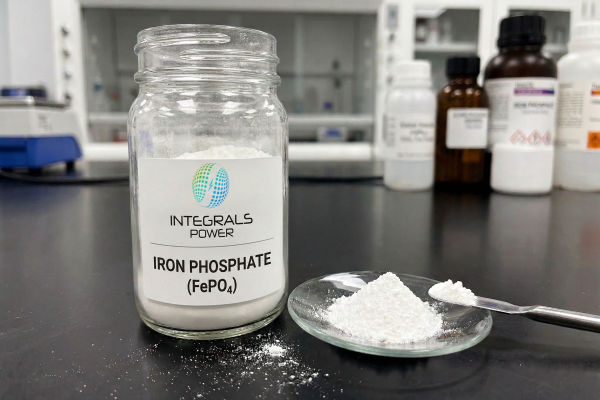
UK-based battery technology firm Integrals Power has developed and produced high-purity iron phosphate precursor material at its UK facility. Using a low-temperature synthesis process, the company minimizes energy use and CO₂ emissions, avoids reliance on by-products, and achieves precise control over particle properties. This is a significant advance, as iron phosphate is the key precursor for Lithium Iron Phosphate (LFP) battery materials, most of which are currently sourced from China.
Integrals Power successfully manufactured a variety of iron phosphate formulations, which were then used to create cost-effective LFP cathode materials. In collaboration with a leading UK university, these materials were tested at the cell level, demonstrating performance and quality that surpass benchmark Chinese samples—while remaining competitively priced on a $/kWh basis.
Proving that high-quality, cost-effective manufacturing of Iron Phosphate using raw materials sourced from localised supply chains is key to establishing mass production of LFP cells in the UK, Europe, and North America. This is essential to reducing reliance on China – which last year introduced export restrictions on key battery cathode active materials including LFP, manufacturing technologies, and cells – and improving the security, sustainability and transparency of the entire value chain.
Integrals Power Founder and CEO, Behnam Hormozi, said: “Almost every LFP battery in use today traces its supply chain back to China. We’ve spent years developing a way to change that – and now we can show it works, it’s cost-competitive, and it’s ready to scale. By rethinking the chemistry from first principles, we’ve developed a manufacturing process for the Iron Phosphate precursor that is cleaner, more energy-efficient and – as our testing confirms – produces a better material. It’s a breakthrough that represents the foundations on which a viable Western LFP supply chain can be built, and for EVs, grid energy storage, and the data centres that power AI, this is of paramount importance.”
The International Energy Agency’s Global EV Outlook 2025 report1 stated that in 2024, LFP batteries accounted for more than 10% of Europe’s EV battery market, representing a year-on-year growth of 90% for two years running. Of these, the IEA said that nearly all were made in China. The IEA highlighted the risk posed by this situation, noting that OEMs in Europe see LFP as a means of reducing cost, yet the Chinese government’s export restrictions on battery materials and technology pose a threat to manufacturing in Europe as long as reliance on China continues unchanged.
Localised supply chains will also become increasingly advantageous to meeting the requirements of EU battery regulations, and compliance with the Rules of Origin requirements that apply to electric vehicles (EV) exported between the EU and the UK from 2027: 55% of an EV’s overall value, and 65% and 70% of the cells and battery pack respectively must be made in the EU or UK in order to avoid 10% tariffs.
Grid-scale energy storage systems are even more reliant on LFP: IEA figures show that more than 90% of all those made worldwide use this cell chemistry2, making energy security and independence an even more strategically important factor behind the urgent establishment of localised supply chains to supply the batteries that are needed in the smart grids that buffer increasingly large quantities of renewable energy and provide back-up power to high-demand and fast-growing industries including data centres and artificial intelligence.
Integrals Power has also patented a number of innovations for over 20 cathode active materials including LFP, highlighting that far from being a commodity product, this cell chemistry still holds considerable development potential in applications where cost and safety are the most important attributes. Successfully demonstrating that the Iron Phosphate precursors needed to manufacture it can be made and commercialised in the UK further highlights the role that it can play in establishing and growing sovereign capability in this strategically important sector.
Over the coming months, Integrals Power will commence the supply of FP and Lithium Iron Phosphate samples to major OEMs, battery cell manufacturers, and strategic partners as part of structured validation programmes.
These samples will support performance benchmarking across many applications. This validation phase represents a critical step toward broader industrial adoption. Subject to successful customer qualification, Integrals Power will proceed with the next stage of commercial scale-up, expanding precursor and cathode production capacity to support long-term supply agreements and large-volume manufacturing in the UK, Europe, and North America.