
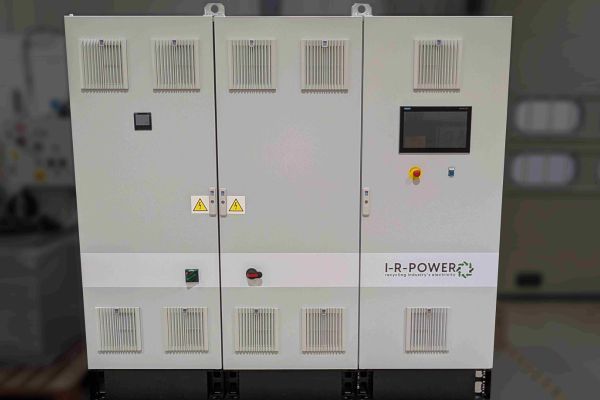
IR Power, a Scottish energy technology company under MWNW Group, has unveiled an innovative solution to tackle the huge energy losses that occur when factory machinery slows down. Their system allows manufacturers to achieve significant energy savings through a rental model—requiring no upfront payment, with costs only coming from verified savings.
In many modern factories, large machines are constantly speeding up and slowing down as part of normal operations—automotive presses lifting and lowering, conveyor belts starting and stopping, and industrial mixers ramping up and down. Each time these machines decelerate, they produce electricity that is typically wasted.
IR Power’s plug-and-play technology works similarly to regenerative braking in electric vehicles but is designed for industrial equipment. It captures this otherwise wasted energy and feeds it back into the factory’s power grid for immediate reuse. On large automotive press lines, where machines cycle every six seconds, this approach can recover 10–20% of total electricity usage—translating to £50,000–£100,000 in annual savings per machine cluster at current UK energy prices.
The problem: Proven technology, broken business model
While energy recovery technology has existed for years, previous solutions required expensive custom engineering that typically demanded weeks or months of install and interrupted operations, high upfront costs, and longer integration cycles – particularly where drive systems had to be modified or replaced. At historical electricity prices of £50/MWh, the complexity wasn’t justified. At today’s prices of £100-150/MWh – combined with binding net-zero commitments – the economics have fundamentally changed.
The solution: Redesigned technology and commercial model
IR Power has eliminated the adoption barriers that prevented previous solutions from scaling:
Standardised sizing – Three standard product sizes work across different applications, replacing expensive custom engineering that previously cost £30-40k or more.
Plug-and-play installation – Systems connect to existing equipment in hours. No modifications to machines, no changes to operations, and no production downtime.
Rental model – Customers pay nothing upfront. Monthly fees are based only on measured energy savings. If the system doesn’t save energy, customers don’t pay.
Equipment agnostic – Unlike solutions locked to one manufacturer’s drives or motors, IR Power’s systems integrate with any supplier. Factories can connect multiple machines into a single energy recovery network, optimising across the entire site.
Fail-safe design – When braking energy exceeds system capacity, excess safely routes to existing waste resistors while the system continues operating. Competitor systems often shut down completely when overloaded, requiring manual restarts.
Why now: Energy prices and net-zero create perfect storm
With industrial electricity prices doubling and manufacturers facing binding net-zero commitments, energy efficiency has shifted from ‘nice-to-have’ to business-critical. IR Power’s technology addresses both imperatives simultaneously: cutting costs and carbon.
Industrial machines have 20–30-year lifespans and even upgrading drive systems can cost £1m or more, making retrofit the viable route for capturing immediate savings. The rental model, typically approved as operating expense rather than capital, removes approval barriers and aligns incentives perfectly – IR Power only succeeds when customers save money.
Richard Bradshaw, Founder and Managing Director of IR Power, said:
“For years, energy recovery systems existed but didn’t deploy at scale because they cost too much and put all the risk on customers. We’ve inverted that model completely. Our customers pay zero upfront – no capital expenditure, just operating expense. Installation takes hours with no production downtime. And here’s the key: if our system doesn’t save them money, we don’t get paid; we take all the performance risk. The equipment lasts 15-20 years, so customers get over a decade of pure savings. The technology works – it always has. Our job was removing every barrier that prevented adoption: the cost, the complexity, the risk, and the disruption.”
Commercial deployment
IR Power is beginning commercial deployments in 2026, prioritising press applications including tier-one automotive and construction materials manufacturing. The company deliberately chose diverse sectors to prove the technology across different operating conditions before accelerating deployment.
The addressable market includes thousands of suitable machines across automotive, construction materials, food processing, and other sectors in the UK alone, with global expansion planned once the model is proven. Target applications include motor-driven machinery with frequent start/stop or speed-change cycles where braking energy is highest and most consistent.